
ESG-related investing is encountering significant headwinds, exacerbating the need for more rigorous methodology to assess how to drive long-term financial value. Marc Mullen speaks to Michel Driessen about his new book, co-authored with Sebastian Schmidt.
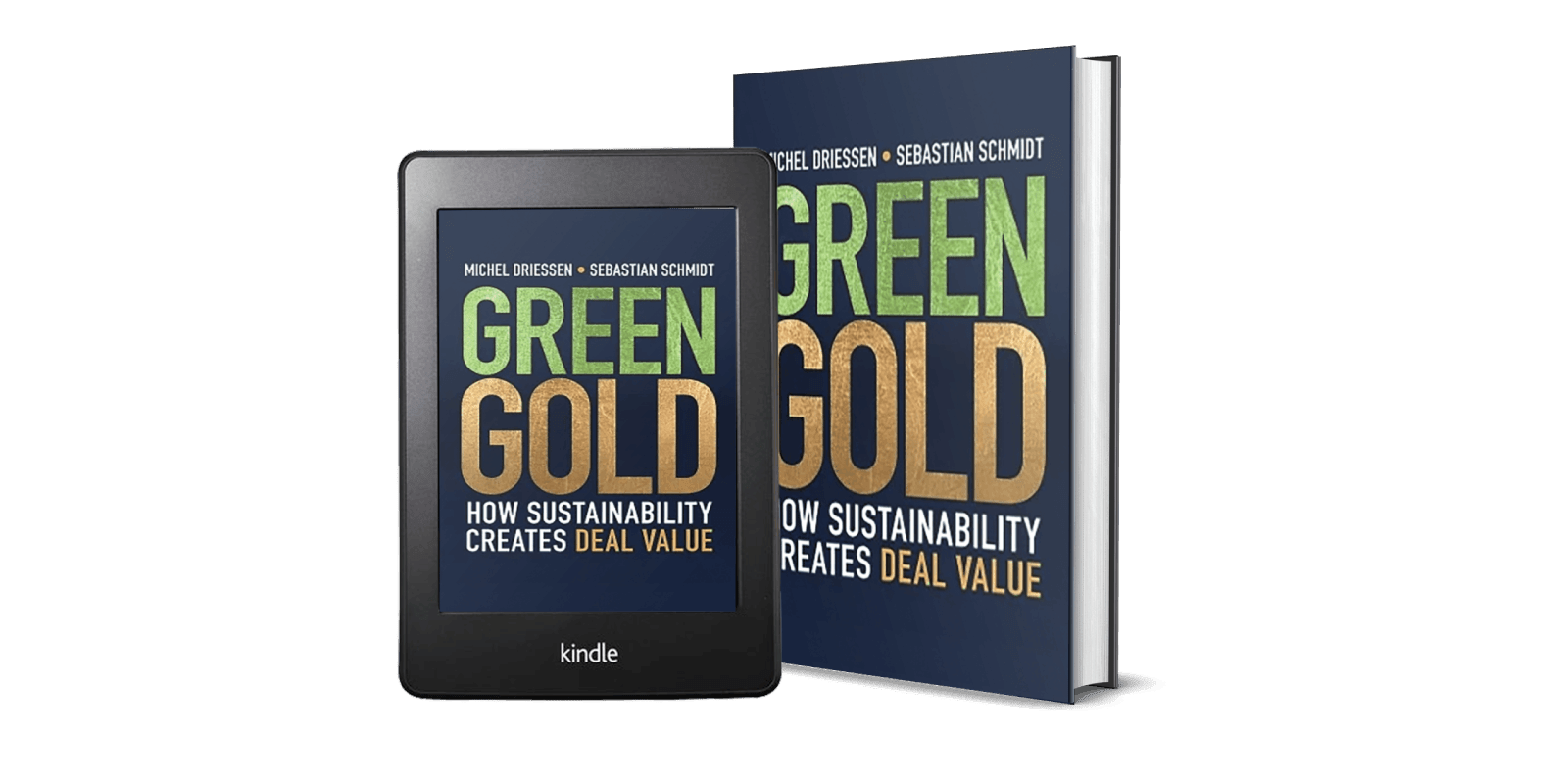
Green Gold: How Sustainability Creates Deal Value
Written by Michel Driessen and Sebastian Schmidt
Published by Wiley in the UK.
Available from foyles.co.uk, waterstones.com and amazon.co.uk in hardback and e-book format.
Green gold is an alloy – predominantly gold, but with silver and other metals, such as cobalt or cadmium mixed in. Both naturally occurring and synthetic, the alloy was valued for its unique colour. But the process of creating synthetic green gold, using arsenic-based pigments, was toxic and, as a result, not sustainable.
In Michel Driessen’s and Sebastian Schmidt’s book – Green Gold: How Sustainability Creates Deal Value – green gold is the exact opposite: its central theme is that strong ESG credentials can drive deal value.
The book starts with an overview of sustainability leading up to the coining of the acronym ESG (environmental, social and governance) in the 2004 UN report Who Cares Wins. “The way that environmental, social and corporate governance issues are managed is an integral part of companies’ overall management capability and quality,” it said.
Future forward
But this is not a history book. “What we try to achieve with the book is establish a detailed methodology and approach for investing and creating deal value in sustainability,” says Driessen. “We look to move beyond the correlation between ESG and higher valuation multiples, and the cost of capital for ESG investing and multiples. We look at cause and effect. Because, the question we are trying to solve is: ‘If I invest in a transaction related to ESG, do I get a higher multiple when I sell that investment?’ There are no hard and fast rules or methodology, but what we want to do is get it into the mainstream, that analysts can put this into a spreadsheet to assess the value that can be delivered from an ESG transaction.”
One of the key reasons the link between ESG performance and financial value isn’t better established is the lack of standardised methods and comparable results at a sufficiently detailed level, says Driessen: “We want to get to a place where we have an enabler, a mechanism to assess ESG factors, capturing the relevant business drivers from a sector lens, leading to more transparency on revenue and cost implications.”
In the immediate aftermath of Covid-19, a plethora of government actions and regulation around sustainable investing emerged from the EU, the UK government and the FRC. The book includes research that identifies $6.4trn of capital between 2020 and Q1 2025 flowing into “sustainability-led” transactions (companies that provide sustainable products, services, software or technologies), accounting for 16% of disclosed deal value in that period.
Published in February this year, the book was completed halfway through 2025, by which time the second Trump administration’s attitude to ESG issues had been established and was, if anything, being accelerated. The authors accept that “the progress towards sustainability is not a linear path” but point out that “the financial value story needs to be even more pressing” because of this recent loss of momentum. If a big part of the ESG pushback is a reaction against ESG as a box-ticking exercise that only makes the case for such a book even more compelling.
Method action
One of the central parts of the book is the Value Bridge methodology, adapted by the authors to link ESG initiatives to financial performance, translated into KPIs like EBITDA and cash flows. The authors first establish a strong correlation between ESG performance and a lower cost of capital and higher price multiples. But that doesn’t mean all ESG investments deliver higher value. Its hypothetical worked Value Bridge case study related to BorgWarner, the $14bn revenue per annum US manufacturer of components for the automotive sector, could perhaps be viewed as free advice to BorgWarner’s management.
The book addresses the turning tide in ESG and sustainability PR, “from greenwashing to greenhushing to greenhiding”. There are some highly engaging case studies covering where ESG has gone wrong. One is AIM-listed Boohoo, the fast fashion label, that boomed as an online retailer during the early part of the pandemic until revelations about staff pay and conditions emerged. That tale also raised questions about the methodologies of ESG ratings agencies, which Boohoo had duped.
The threat of greenwashing accusations has led some businesses to exercise greater discretion – ‘greenhushing’ – and be more circumspect about making ESG claims that may be found wanting. Driessen says that more recently still, with a sustainability pushback in seemingly full effect, businesses have been deliberately keeping ESG policies out of the public view – ‘greenhiding’ if you will.
Despite the current geopolitical climate in North America and more widely, ESG remains an important element, and in some cases is the main driver for corporate strategy, M&A and investment activity
“I think it’s very important to get the balance of the ESG story right with the right group of stakeholders,” says Driessen. “It must be correct of course. And it is not only a story for the analysts, which it can often be limited to – it’s also for the investors, the community and the consumers. PR is often greatly underestimated, but it is super-important and you need to take all stakeholders into account. Consumer sentiment has become very important, and companies that do that well have a positive impact on their share price.”
The book also covers private equity’s approach to ESG, which is often more detailed and focused than corporates’. ESG due diligence needs to go way beyond a tick-box exercise if it is to understand the key issues that drive financial value.
Clear and present
Historically, how much ESG investing has been down to sentiment rather than absolutes? How have ESG initiatives improved performance and therefore value? “I would love to say that it is entirely down to methodology,” says Driessen. “However, in today’s world, ESG is no different to other factors. Sentiment and narrative play a big role. Irrespective of whether it’s ESG or R&D or innovation or cybersecurity, if you can’t articulate that in a clear manner, you lose it. If you get it right, the share price will respond accordingly.
“And if the acquisition is not being seen as strategic, then the share price will also respond negatively.”
This is a very timely book. We are at something of a crucial point for sustainability and investing; we need a way of assessing how we deliver long-term financial value. Ultimately, sustainability can only exist if value is delivered – and it’s that metric that this book seeks to create a framework for. I’m sure there will be many more takes on this theme, each of which will bring us closer to a standardised approach to best practice.
Authors
Michel Driessen is chair of Queen’s Tower Advisory and the director of the M&A Research Centre at Bayes Business School. He was previously a senior partner in the strategy and transactions group at EY in London.
Sebastian Schmidt is a partner at EY-Parthenon. He leads the decision support and modelling group within its European strategy and transactions team.
