
If Financial Reporting Council (FRC) CEO Richard Moriarty was to name one corporate governance priority that he wants to deliver during his tenure at the watchdog it would be boards that think for themselves.
Speaking in the first session of ICAEW’s annual Corporate Governance Conference on 6 March, Moriarty drew attention to what he sees as a paradox among businesses: that while leaders and boards tend to call for reduced regulation, or more principles-based rules, the likes of company secretaries, advisers and lawyers typically demand more prescription – plus firm guidance on what rules mean.
Prefer to listen?
This audio file was produced by AI and has been adapted from the original article for audio purposes.
For Moriarty, one factor behind the calls for a more prescriptive approach is the politics of ‘something must be done’ in the wake of corporate failures.
In parallel, he said: “Companies too often outsource their thinking to advisers and lawyers. One of my biggest challenges to boards is: Think for yourselves.
“One thing that worries my FRC colleagues about boards that don’t think for themselves is that compliance partners in some of those companies actually add in extra measures to the margins around regulations.”
Moriarty stressed that stakeholders in politics, business and regulation must all work together to resolve this issue. Turning specifically to companies, he said: “When it comes to risk taking, I would encourage boards to be a bit more enquiring and curious – and also to have a bit more courage. If in doubt, talk directly to your regulator.”
"Certainly, when it comes to the FRC and ‘comply or explain,’ there have been times when businesses have called me or my team to say: ‘We’re thinking of doing X, but we’ve had advice that it would go against the Corporate Governance Code.’ And we’ve disagreed, and said: ‘Go ahead – trust your judgement.’
“When I leave the FRC, if there’s one thing I want people to remember, it’s for boards to think for themselves.”
Calculated risks
Interviewed by ICAEW Chief Policy and Communications Officer Iain Wright, Moriarty expressed firm agreement with the opening address of the conference, provided by current ICAEW President Derek Blair, who asserted that company failures are all part and parcel of a diverse, capitalist economy.
“We’re very clear at the FRC – and it’s mentioned in our strategy – that our role is not to prevent corporate failure,” Moriarty said.
In his view, that stipulation ties into the need for the market to accept risk, and for regulation to be smart and proportionate.
To illustrate those points, Moriarty nodded to his previous role as CEO of the Civil Aviation Authority. “There is no 100% guaranteed way to keep an aircraft safe,” he said. “We had to take calculated risks – and I went to bed every night knowing that, even with the highest safety standards in aviation in the Western world, if something went seriously wrong, those standards would come into question. I’d be called before a select committee – and, shortly afterwards, I’d be working elsewhere.”
However, he noted: “The key is not to get bent out of shape in anticipation of those political moments. Otherwise, we’ll just end up writing more rules, driving up costs and punishing the virtuous for long-tail, black-swan events. And the system will just generate more compliance and complexity.”
Alongside his role at the FRC, Moriarty chairs Paradigm Housing Group, operating in the highly regulated housing association sector – which he argued has lessons for the wider regulatory world.
“I’m always aware that, in my boardroom, I’m doing 90% compliance and 10% value-added exercises,” he said. “That’s partly down to a saturation of regulation, because it comes at me from all sources.
“I think it's really important that we take a step back as a system and ask ourselves: ’Are we comfortable with the totality of regulation creation?’ Particularly as it applies to boards – because, after all, boards can only meet a certain number of times a year, especially non-executive members.”
In Moriarty’s assessment, the UK has a “real opportunity” to distinguish itself as a global destination of choice for good corporate governance and sensible regulation.
Trust product
Existing selling points include a principles-based approach – embodied in the UK Corporate Governance Code, which can be adapted to fit any business model – plus the flexibility of ‘comply or explain’.
For those reasons, Moriarty is sceptical of the argument that the nature of UK corporate governance rules is why some companies opt to list in New York. Indeed, he noted, US listing and reporting regulations are more onerous than those in the UK and – as a result of certain, high-profile pieces of legislation – penalties for directors who commit fraud or mislead investors are considerably higher.
“I think it’s more to do with the fact that the owners get a 20% premium uplift,” Moriarty said. “If they have to accept something like Sarbanes-Oxley, under which directors can go to jail, that’s a very different regime to the UK.”
One of the talk’s most fascinating moments stemmed from a question from the floor: “In the age of artificial intelligence, is the annual report outdated?”
Wright quickly pointed out that the Department for Business and Trade (DBT) is poised to launch an “absolutely fundamental” project on the modernisation of corporate reporting, and that it will be a major priority for ICAEW this year.
Asked for the FRC take, Moriarty said: “When it comes to the annual report, particularly of accounts, it’s not a marketing brochure – it’s a trust product. So, whether your report is produced, influenced or read by AI, we must never forget that, ultimately, the public will expect humans to have assured themselves on the veracity of that trust product.”
Moriarty confirmed that the FRC is eager to support the DBT project. “Corporate reports are like geological layers – they’ve just been added to over time,” he said. “But the problem is, nothing’s ever taken off.
“What we’ve not had for decades is a step-back review of, why do we need this? Whose purpose is it for? And what’s the minimum amount of information that’s both high quality and high value? So, this is a once-in-a-generation opportunity to do a reset and the Institute’s role will be pivotal.”
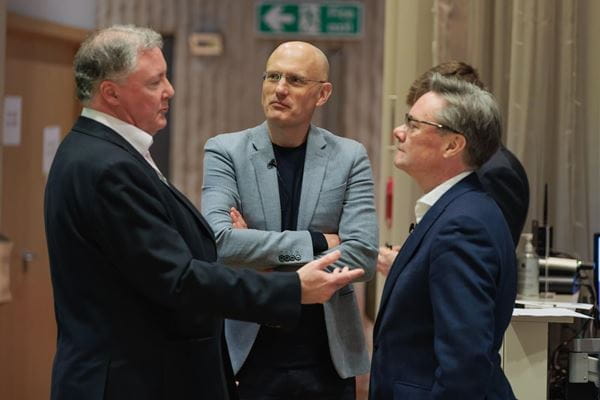
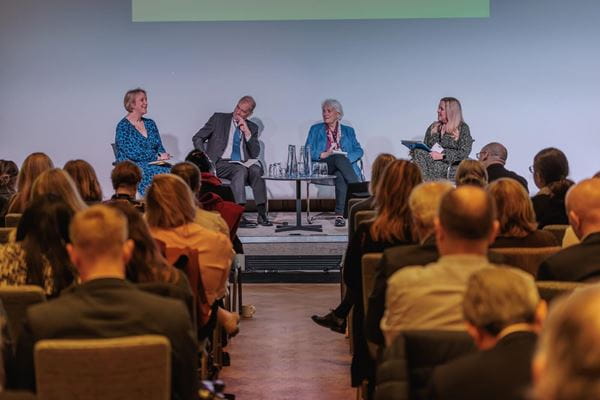
ICAEW Corporate Governance Conference 2026:




Further resources

Strategy for the board
Boards are responsible for determining their companies’ strategic direction and ensuring the long-term survival and health of the business.
See moreICAEW Community

Corporate Governance
Stay up to date with the latest news and developments in corporate governance, to help you in your role as a board member, NED or corporate governance professional. Membership is free and open to everyone
ICAEW support

Training and events
Browse upcoming and on-demand ICAEW events and webinars covering corporate governance and stewardship.
Events and webinars CPD courses and more