Q3: Banking, Finance & Insurance confidence returns to positive territory, supported by stronger profits growth.
- Business confidence in Banking, Finance & Insurance rose to +2.1 from -5.0 in Q2 2026, above the UK average but below the sector's historical average.
- Domestic sales and exports growth remained ahead of the UK average, and companies expect domestic sales growth to pick up over the coming year.
- Geopolitical risk and regulatory requirements were the most widely cited rising challenges, while concerns about competition in the marketplace were more prevalent than in any other sector.
- Input cost and selling price inflation remained the lowest of any sector, while profits growth was the strongest across the economy.
- Employment and pay growth slowed, and businesses have scaled back their hiring plans for the year ahead.
- Capital investment growth picked up, and R&D budget growth was the fastest in the sector since Q4 2013.
Business confidence in the Banking, Finance & Insurance sector
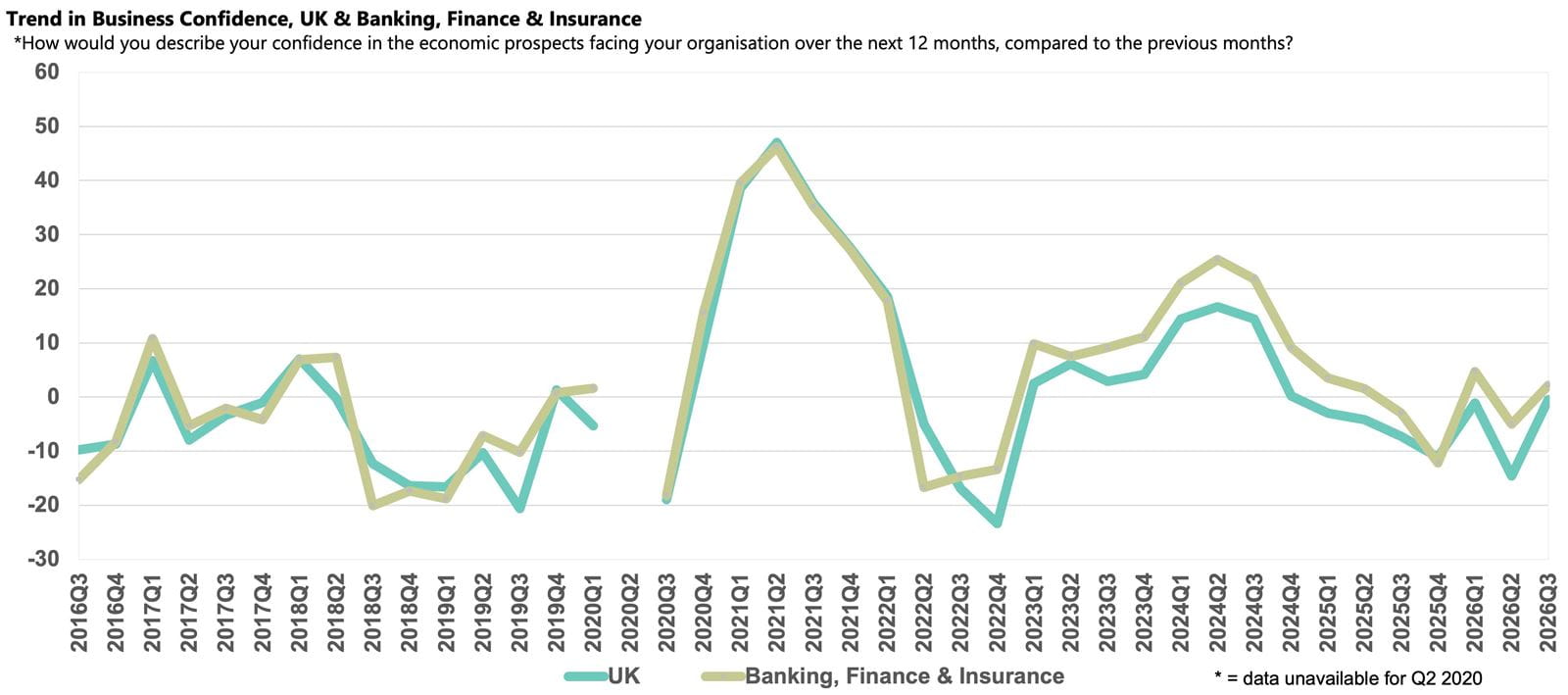
Sentiment in the Banking, Finance & Insurance sector returned to positive territory, with the Business Confidence Index rising from -5.0 in the previous quarter to +2.1 in Q3 2026. The sector was more confident than the UK average (-0.5), although its score remained below its historical norm (+6.5) for the seventh consecutive quarter.
The Bank of England Agents’ summary of business conditions for September 2026 reported rising business and financial services revenues, driven by fee increases and pockets of robust growth, although credit supply continued to outstrip demand. Following the announcement of new support for first-time buyers in late September, businesses in the sector will also be looking ahead to the new Chancellor’s first budget on 28 October.
Domestic sales and exports growth
Banking, Finance & Insurance companies reported that annual domestic sales expanded by 5.3% in Q3 2026, with growth outpacing both the national average and the sector's historical norm (both 3.6%). Businesses expect growth to pick up to 5.9% over the coming year and be notably higher than the UK projection (4.3%).
Exports growth slowed slightly in Q3 2026 but still outpaced both the UK average (2.8%) and the sector's historical norm (3.1%), with growth of 4.1%. Companies expect exports growth to ease to 3.8% over the next 12 months, with growth predicted to lag the 4.1% rise projected nationally.
Business challenges
Geopolitical risk was the most widely cited rising challenge among Banking, Finance & Insurance businesses in Q3 2026, reported by 71% of companies, marginally up from the previous quarter. This was well above the national average (58%), with only Transport & Storage (77%) citing the issue more widely, possibly reflecting the sector's exposure to volatile financial markets and the inflation outlook amid continued US-Iran hostilities.
Regulatory requirements were the second most widely cited challenge, with the share of businesses reporting them rising sharply to 59%. Despite being below the sector's historical norm (68%), this proportion was the sector’s highest since Q1 2025, with the concern more widely recorded than in any other sector and well above the UK average (46%). The increase may partly reflect uncertainty over forthcoming regulatory changes, with HM Treasury's consultation on reforms to ring-fencing rules running until 8 September.
Competition in the marketplace was also a more prominent concern than in any other sector, cited by 54% of businesses, the sector’s highest share since Q3 2018. This was well above both the sector's historical norm (40%) and the national average (34%). Labour costs were reported as a rising challenge by 47% of companies, less widely than across the UK (53%), while the tax burden was cited by 33% of businesses, below the national average (41%) but above the sector's historical norm (20%). In contrast, energy costs (27%) were a less pressing issue than reported nationally (45%).
Input and selling prices, and profits growth
Input price inflation in the Banking, Finance & Insurance sector eased to 2.9% in Q3 2026, the lowest rate of any sector and well below the UK-wide rise (3.9%). Businesses expect cost pressures to ease further over the coming year, forecasting input price inflation of 2.3%, below the UK projection (2.9%), though still above the sector's historical norm (2.0%).
Selling price inflation was also the lowest of any sector, edging down to 1.2% from 1.3% in Q2 2026, below the 2.2% national rate but above the sector's historical norm (0.7%). Companies expect price growth to slow to 0.8% over the next 12 months, the lowest projection of any sector and notably weaker than the expected UK average (2.1%).
Annual profits growth in the sector remained robust at 5.6% in Q3 2026, the strongest of any sector. This increase was well above both the national average (3.3%) and the sector's historical norm (4.1%). Businesses in the sector are also more optimistic about the year ahead, expecting profits growth to pick up to 6.3%, their strongest projection since Q2 2021 and well above the 4.5% rise expected nationally.
Labour market
Annual employment growth in the sector slowed to 1.3% in Q3 2026 but still matched its historical norm and remained well ahead of the national rate (0.7%). However, businesses have scaled back their hiring plans, expecting employment to rise by 0.9% over the next 12 months, their weakest projection since Q3 2020 and lower than the UK forecast (1.5%).
Annual wage growth in the sector also eased to 2.7% in Q3 2026, broadly in line with the UK average increase of 2.8%. Companies in the sector expect salary inflation to moderate further to 2.4% over the next 12 months, slightly below the UK average forecast of 2.6%, but still above the sector's historical norm (2.0%).
Investment
Investment has been edging up in the Banking, Finance & Insurance sector over recent quarters. This is consistent with the latest ICAEW pulse survey, which found that in response to rising business costs since the start of the year, more UK firms sought productivity and efficiency improvements. Investment growth rose to 3.0% in Q3 2026, exceeding both the sector's historical norm and the UK average (both 2.3%). While businesses plan to moderate investment growth to 2.3% over the coming year, this expectation is still above the predicted UK average (2.0%).
R&D growth strengthened to 3.5% in the year to Q3 2026, the sector's fastest pace of R&D expansion since Q4 2013. This was second only to IT & Communications (4.0%) and ahead of both the UK average (2.3%) and the sector's historical norm (1.5%). Companies plan to maintain solid R&D growth over the next 12 months, forecasting a rise of 2.7% and notably above the increase expected across the UK (1.9%).
UK results
The UK Business Confidence Index rebounded to -0.5, from -14.6 in Q2, but remained negative for a seventh consecutive quarter. Current sales and profits proved resilient, but firms downgraded their expectations for both over the next 12 months. Geopolitical risk remained the leading challenge, while elevated input and labour costs continued to put pressure on margins. Energy costs, regulations and the tax burden remain significant challenges. The rebound was broad but uneven: confidence rose in every sector, IT & Communications was the most positive, while Property and Construction remained deeply negative.
The latest quarterly findings are based on the period 13 July to 21 September 2026.