
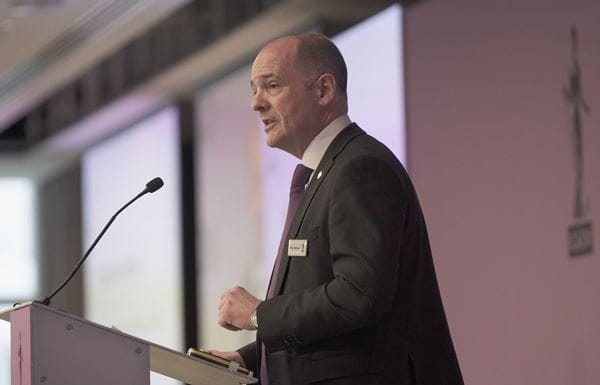
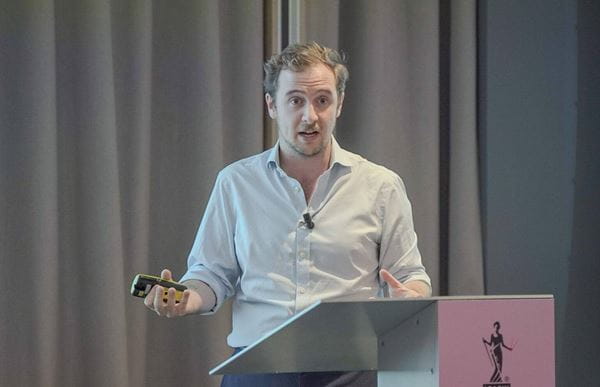
Huw Pill, Chief Economist and Executive Director for Monetary Analysis, Bank of England, speaking at ICAEW's Annual Conference 2025.
The Bank of England (BoE) will bring a range of innovations into its high-level decision-making from as soon as next month’s Monetary Policy Report, says its Chief Economist Huw Pill.
Speaking at ICAEW’s Annual Conference on 17 October, Pill, who also sits on the Bank’s Monetary Policy Committee (MPC), stressed that an innovative approach is vital at a time when global uncertainty is “not just increasing, but changing in character”.
Delivering a sequel of sorts to his speech at ICAEW’s Annual Conference last year, Pill reflected on concerns he outlined in 2024 that price- and wage-setting behaviour in recent years may have rendered underlying UK inflation more persistent. Mindful of the Bank’s CPI inflation target of 2%, Pill had warned against the risks of cutting rates too far or too fast.
“Unfortunately, headline consumer price inflation has proven much stickier than the MPC anticipated,” he said at this year’s event. It is now expected to rise to 4%, which is 1.5% higher than the MPC forecast a year ago.
The need for better data
Pill nodded to former US Federal Reserve Chair Dr Ben Bernanke’s recent independent review of BoE forecasting, published in April last year, which recommended that the Bank should improve its forecasting infrastructure and better equip the MPC and other staff to identify and quantify outlook risks. In the current environment, he said: “The agenda for monetary policy has all the features of what many social scientists call a ‘wicked problem.’”
He explained: “The defining characteristic of a wicked problem is that it’s never completely solved. All you can hope for is to take steps in the right direction. But you have to recognise that new challenges – including those arising from the steps you’ve just taken – will always emerge in the future.” In that light, he said: “Whenever I’m asked when the response to the Bernanke Review will be completed, I’m sorely tempted to answer, ‘Never.’”
To sketch out the nature of the current uncertainty challenge, Pill whisked delegates through three, distinct economic phases of the past 30 years:
1. The NICE Era (Non-Inflationary, Continuous Expansion), lasting roughly from the mid-1990s to the mid-2000s. The Cold War was over and the supply side of the world economy was stable and predictable. “These were the halcyon days of the inflation-targeting regime,” Pill said. “You could explain the MPC’s votes by looking at just one indicator: the PMI.”
2. The NASTY Era (Not-as-Tranquil Years), from the late 2000s to early 2020s. Inflation grew more volatile. The Bank was less able to rely upon markets anticipating its decisions and self-stabilising. Plus, its close relationship with the single indicator had begun to break down. To complicate matters, the UK economy was hit by a series of ‘lightning strikes,’ such as the global crash of 2008, Brexit and Covid.
3. The MESSY Era (not even an acronym – just a fact), covering post-Covid to the present. The Bank’s single-indicator model has more or less collapsed and the MPC is increasingly required to take greater responsibility, because markets are doing even less than they did in the previous era.
Against that backdrop, Pill noted, there are good reasons for the Bank to adopt an evolutionary approach with the data points it feeds into its forecasting.
“We’re dealing with important issues that deserve careful attention,” he said. “The world around us does not stand still. On the contrary, the pace of change in the global economy, and the uncertainty that brings to the UK outlook, seem to be increasing rather than diminishing. We must be sensitive to our rapidly changing environment and, as necessary, evolve our approach in parallel. That’s not a one-off action. And we need to draw lessons from others who are faced with the need to transform their business models in the face of economic change.”
Price stability ‘first, last and always’
As such, Pill added: “Our response to Dr Bernanke’s recommendations does not end with a specific date. Rather, it builds capabilities at the Bank, and a framework for the MPC, that allow for indefinite and continuous evolutionary improvement in the conduct of monetary policy. The pursuit of price stability is a never-ending journey.”
Amplifying that point, Pill characterised ‘Price stability first, last and always’ as a central BoE maxim. He pointed out: “That’s how monetary policy creates the stable environment which is conducive to the innovation, dynamism, growth and improved living standards that we’re all seeking – and were reflected in the previous discussion.”
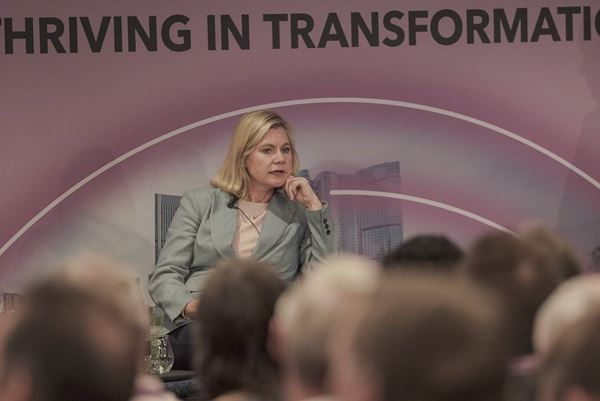
The discussion Pill referred to was the day’s opening session – a talk from ICAEW Member Rt Hon Justine Greening MP. In an interview with BBC Presenter Emma Vardy, who chaired the conference, Greening also explored the turbulent economic climate that the MPC is grappling with and, in that context, gave her view on the daunting challenges preoccupying the Chancellor.
She told delegates: “What Rachel Reeves is constantly facing, which a lot of you would have done many times in your careers – I certainly have – is a gap-closure exercise, and probably didn’t build enough contingency into her original Budget. So, each time the Office for Budget Responsibility updates the numbers, it’s like trying to land a helicopter on a handkerchief.
“The big challenge for her is that she’s got to get off that hook and start to be the architect of her own future, rather than being blown around by what is an incredibly uncertain, wider economic environment, or she’s never going to get in control.”
With social mobility one of Greening’s main concerns – as expressed through the Purpose Coalition and Social Mobility Pledge – she said that Reeves must use November’s Autumn Budget to clearly set out “what narrative she’s painting, in terms of how she’s delivering this different version of Britain.”
She stressed: “What the public needs to understand is why she’s doing all this. If it’s just, ‘I need more money,’ that’s not a tactical approach that you’re going to win elections on.”
ICAEW on the Budget

Further support
Resources

Business support
Thought leadership, insights, technical resources and professional guidance to support ICAEW members working in industry with their professional development.
Browse resourcesResources and support

How to grow
Support from ICAEW on starting, growing and renewing businesses in the UK, and supporting the government's mission of kickstarting sustainable economic growth.
More support Policy recommendationsICAEW support

Training and events
Browse upcoming and on-demand ICAEW events and webinars offering support on technical areas, such as assurance, reporting and tax, as well as personal development.
Events and webinars A-Z of courses