How to determine if your firm can use the ‘Chartered Accountants’ description
The Regulations Governing the Use of the Description of Chartered Accountants and ICAEW General Affiliates set out when a firm may describe itself as ‘Chartered Accountants’. They also set out the procedural rules for a principal who is not a chartered accountant who must become a general affiliate.
Please note the ‘use of description’ member firm definition is different to the definition in the Principal Bye-laws for an ICAEW member firm.
An accountancy practice (regulated or unregulated) may be part of a corporate group. A group entity (which may be a company or LLP) can only be described as ‘Chartered Accountants’ in the following circumstances.
- In the case of a parent entity, it is controlled by chartered accountants; and over 50% of the income of the group is derived from public practice (a holding company can be dormant).
- In the case of a subsidiary entity, it is engaged in public practice, majority owned by a parent company that is controlled by chartered accountants and part of a group where the parent company can use the description.
In the case of a company, 50% or more of the directors must be chartered accountants. Any directors in a parent or subsidiary company that uses the description, who are not chartered accountants, need to become affiliates.
Use our diagram to help you determine if your firm can use the ‘Chartered Accountants’ description
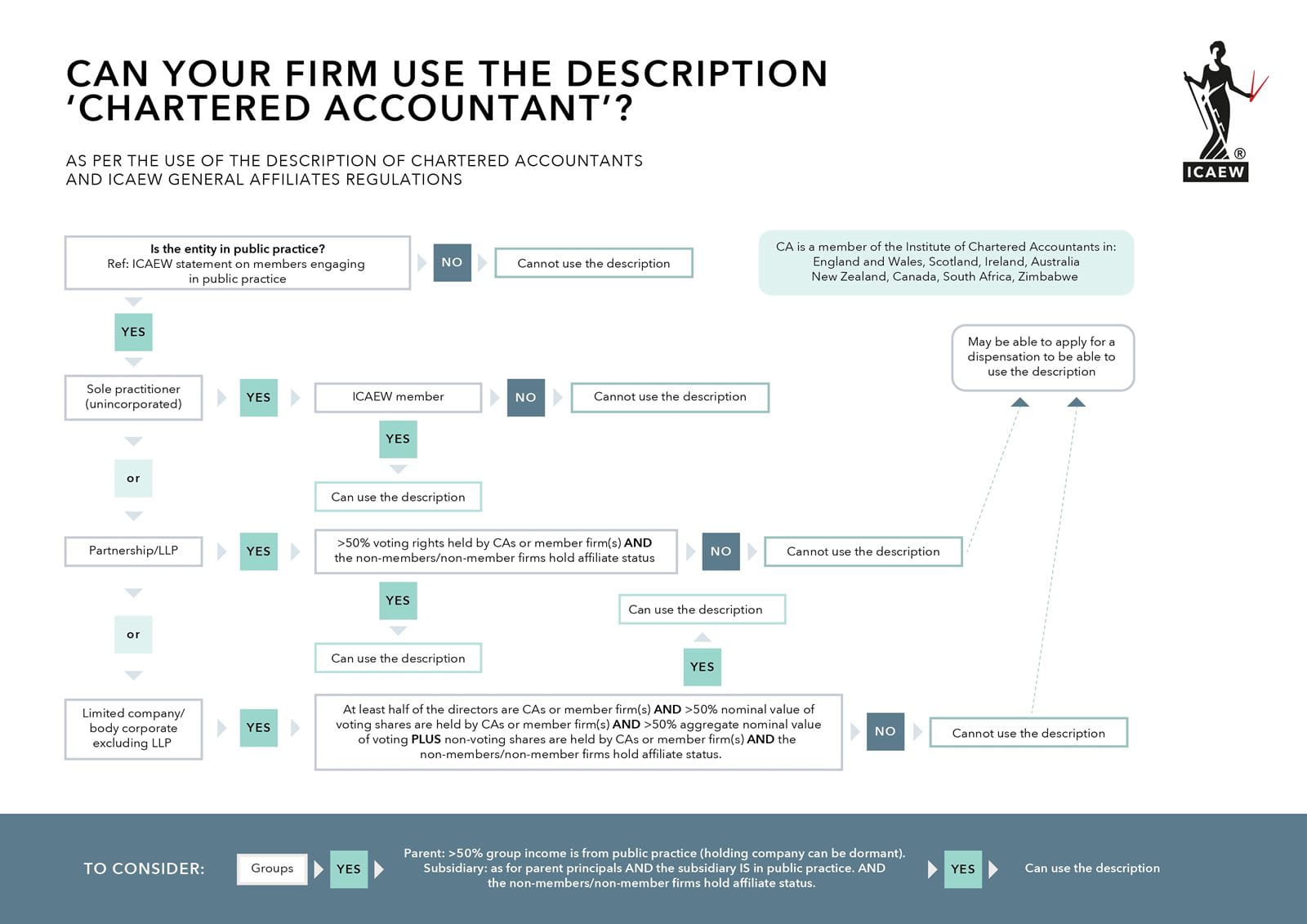
When might firms that can no longer comply with the regulations need to apply for a dispensation?
If your firm can no longer comply with the Regulations Governing the Use of the Description of Chartered Accountants and ICAEW General Affiliates, you may need to apply for a dispensation to continue to use the ‘Chartered Accountants’ description. There are also specific circumstances where a dispensation is not required, but you must resolve the issue within the allotted time period.
When a dispensation is not required
If the firm becomes ineligible to use the description due to a principal not holding affiliate status, you do not need to apply for a dispensation. However, your firm must regularise this position within three months. This time period is available provided you can demonstrate your intentions to meet the requirements.
If the requirements of regulation 12 are not met, a firm is entitled to continue to use the ‘Chartered Accountants’ description for up to three months, again, provided it can demonstrate its intentions to rectify the issue and meet the requirements.
Regulation 12 states that:
A member firm which engages in public practice is entitled to describe itself as Chartered Accountants provided that any partner, member (in the case of a limited liability partnership) or director (in the case of a company) who is not a Chartered Accountant or a member firm must:
-
hold affiliate status with ICAEW under its Designated Professional Body (Investment Business) Handbook, Licensed Practice Handbook, Audit Regulations, Local Audit Regulations, Legal Services Regulations, or Insolvency Licensing Regulations;
-
hold affiliate status with ICAEW under these regulations;
-
be registered for audit work by ICAEW;
-
be registered for local audit work by ICAEW;
-
be accredited for legal services work by ICAEW;
-
be licensed by ICAEW under its Designated Professional Body arrangements; or
-
be licensed by ICAEW under its Licensed Practice Handbook.
When your firm must apply for a dispensation to use the description
If a firm has previously been entitled to describe itself as ‘chartered accountants’ but it no longer meets the requirements of regulation 5, it must apply for a dispensation in accordance with regulation 7 and within 14 days of the change to its circumstances. It will then be entitled to continue to use the description for a maximum of three months while the issue is rectified.
Regulation 5 states that a:
Member Firm shall mean:
-
a member of ICAEW engaged in public practice as a sole practitioner; or
-
a partnership engaged in public practice of which more than 50 per cent of the rights to vote on all, or substantially all, matters of substance at meetings of the partnership are held by Chartered Accountants or by another member firm(s); or
-
a limited liability partnership engaged in public practice of which more than 50 per cent of the rights to vote on all, or substantially all, matters of substance at meetings of the partnership are held by Chartered Accountants or by another member firm(s); or
-
any body corporate (other than a limited liability partnership) engaged in public practice of which:
-
50 per cent or more of the directors are Chartered Accountants or another member firm(s); and
-
more than 50 per cent of the nominal value of the voting shares is held by Chartered Accountants or by another member firm(s); and
-
more than 50 per cent of the aggregate in nominal value of the voting and non voting shares is held by Chartered Accountants or by another member firm(s); and
provided that in the case of a firm that is a parent entity, more than 50% of the income of the group is derived from public practice and, in the case of a firm that is a subsidiary entity, more than 50% of the income of the group is derived from public practice and the subsidiary entity is engaged in public practice.
-
If your firm is not eligible to use the description 'Chartered Accountants', it can apply for permission (a dispensation) to use the description.
For structures with a parent and subsidiary, please also complete Appendix A in respect of the parent entity.
If there are holding companies between the trading subsidiary and the ultimate parent, please complete an Appendix A for each entity.
For LLPs with corporate principals, please complete a separate Appendix A for each principal.
Use of the ‘Chartered Accountants’ description
Check the regulations to find out if your firm can use the description. If ineligible, use our form to apply for permission (a dispensation) to use it.
View the regulationsAccess the form