
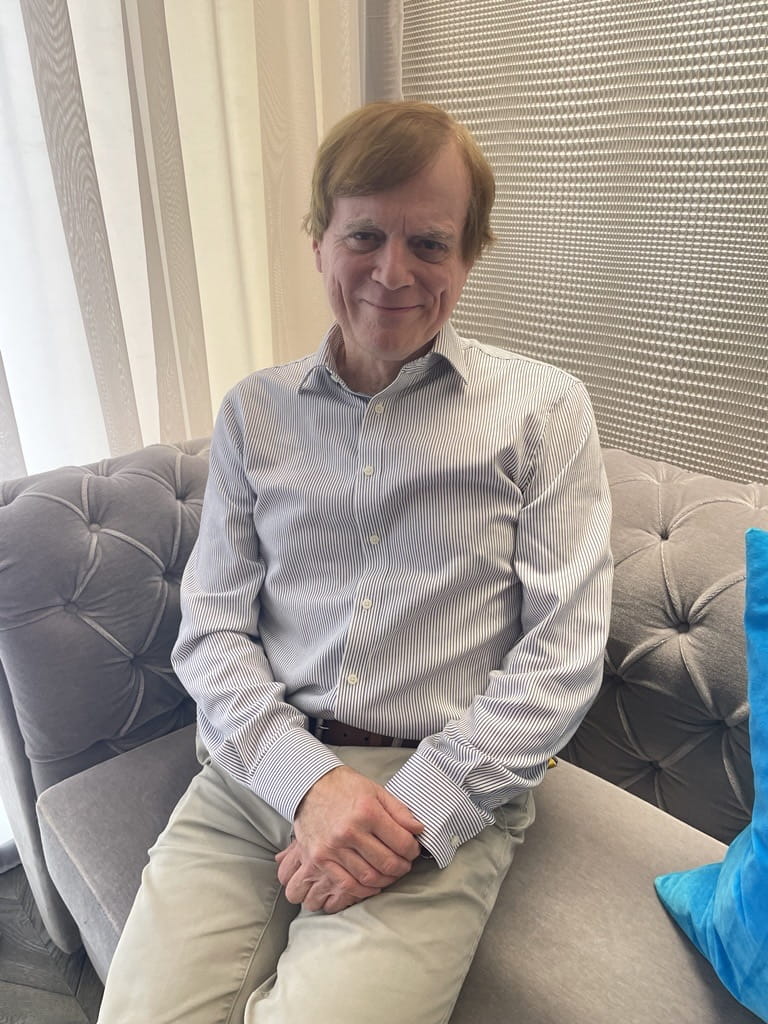
After more than a quarter of a century at ICAEW, Nigel Sleigh-Johnson, Director of Audit and Corporate Reporting, stepped out of Chartered Accountants’ Hall for the last time in January. Here he shares his insights on how the profession has transformed, what hasn’t changed nearly enough and looks towards the future.
Nigel Sleigh-Johnson steered the Audit and Assurance Faculty for eight years and played a leading role in the establishment of ICAEW’s Financial Reporting Faculty in the early 2000s. He sat down with Alex Russell, Head of Audit and Assurance Strategy, to reflect on the last 25 years.
The Institute Sleigh-Johnson entered in 1999 was still a largely paper-based operation. Email use was patchy, laptops chunky, and the agenda papers of the monthly National Technical Advisory Committee, which he managed in his early days, were literally stacked to the ceiling, waiting to be sent out by post.
“Things moved more slowly,” he recalls. “There was still a heavy dependence on written correspondence, including consultation responses."
Today there is better technology, hot desking and hybrid working (accelerated by the pandemic), which has reshaped the rhythm of working life, including in Chartered Accountants’ Hall, where Sleigh-Johnson was based. Working from home more, but with the same output, became a reality, he reflects. “Work is in your pocket, on your phone.”
The pandemic, while enormously challenging, showed both the audit and corporate reporting teams that Sleigh-Johnson led at their best. “The work was fast and furious,” he explains. “The guidance on remote auditing was excellent.
It changed how the profession worked.” Sleigh-Johnson adds. “Remote stocktakes would have been unthinkable 10 years ago. Now they’re normal.”
Other areas tackled during the pandemic included going concern, material uncertainties and new spins on other topics – such as signing audit reports electronically and reverse stress testing.
Audit reform: a “constant companion”
Sleigh-Johnson took on the Audit and Assurance Faculty in January 2018 - just two weeks before the collapse of Carillion. That moment, he says, defined the next eight years. Engagement with government intensified, and debates about market resilience, audit quality, managed shared audits and operational separation became part of daily life.
“Audit and corporate governance reform has been my constant companion,” he says. “Even though the legislative proposals recently evaporated an extraordinary amount has changed.”
Sleigh-Johnson lists perceptions of higher audit quality, the advent of quality management, the split between audit and advisory practices, new initiatives like the Financial Reporting Council’s (FRC’s) Scaleboxes and, in 2024, the establishment of the Centre for Public Interest Audit. But concerns persist, above all, about the public interest entity (PIE) audit market.
“We have been in a completely unprecedented situation in recent years with the amount of audit work exceeding capacity. Firms have been turning down audits and individuals have been reluctant to step up as PIE auditors. Many firms still don’t want to expand their involvement in that market and, while more PIE audits are now being undertaken by firms, it is still a big structural risk.”
Technology is another driver of change. The explosion of analytics, artificial intelligence (AI) and remote auditing has reshaped the profession faster than any audit reform bill could.
And then there’s sustainability reporting and assurance, which he describes as “a major new frontier”.
International influence
One of the dominant themes in Sleigh-Johnson’s reflections is the global nature of his role.
“I enjoyed the international travel enormously,” he admits. “Some of the personal relationships with regulators, standards-setters and policy makers - those have lasted 20 years or more.”
There were memorable European trips, including a whirlwind “IFRS review” tour of seven countries. He recounts presenting at the United Nations in Geneva (twice) on international financial reporting standards, and being “feted as a distinguished guest” in Romania. Nigel was flattered recalling newspaper adverts in Romania announcing his arrival as a guest speaker.
Further afield, Nigel discussed IFRS 15 with regulators in Japan, toured Australia and New Zealand, and spoke in Riyadh as part of Saudi Arabia’s modernisation programme.
Then there was attending Harvard Business School’s annual accounting conference. “I think I was the only non academic invited,” he says. “It was great fun.”
But these encounters weren’t just travel for the sake of travel - they helped extend ICAEW’s influence and reach. “There was a sense that we were the first port of call for policymakers. We contributed directly to legislation and to the development of standards.”
One memory captures this: when Philippe Maystadt, former deputy prime minister of Belgium, was tasked with reviewing IFRS from 2013 onwards, he reached into his briefcase at a conference on the topic in Riga and produced ICAEW’s report on IFRS’s first decade. “He waved it at me,” Sleigh-Johnson says with visible satisfaction. “It was tangible evidence we were having an impact.”
Sleigh-Johnson also recounts opportunities to meet and discuss policy matters with significant political figures during his tenure. He remembers meeting Margaret Thatcher at Chartered Accountants’ Hall and speaking to Tony Blair at a roundtable. He was also invited to be in the presence of the late Queen at the Royal Garden Party in 2019, in recognition of work with the Department for Business, Energy and Industrial Strategy (BEIS).
Leading corporate reporting and audit
If policy influence is one source of pride, another is the transformation and strengthening of the audit and corporate reporting teams.
“Both teams are known for being rigorous and competent,” he says. “They’re intelligent, cohesive and dynamic groups. It matters enormously for ICAEW’s reputation.”
The change to the Audit and Assurance faculty’s paywalls in January 2024 had a big impact, raising its reach from 7,000 members to over 30,000.
Advice for the next generation
To young professionals starting out in audit or corporate reporting, Sleigh-Johnson says: “Being a Chartered Accountant, for me, remains one of the most attractive careers a young person can pursue. Despite all the technological change, it is still a passport to endless opportunities. The variety is extraordinary.”
Audit, he insists, will become “even more satisfying” as firms harness technology more effectively. And for new staff joining ICAEW itself? “Being at the centre of policy debate, taking quality seriously, having time to craft powerful, influential responses - those are privileges. And they matter for the Institute’s reputation.”
His own contribution has been consistent: a deep belief in rigour, collaboration, international engagement, and the importance of well crafted, thoughtful work.
The profession Sleigh Johnson leaves behind is undeniably different to the one he entered. Faster, more global, technology-enabled and driven. The profession is more visible and, partly because of people like Sleigh-Johnson, a little more respected.
As he steps into a new chapter, we will certainly feel his absence. But his influence and legacy remain.
Book your place

