The latest national Business Confidence Monitor (BCM) shows that UK business confidence rebounded sharply in Q3 2026, but remained marginally negative as firms moderated their expectations for future sales and profits. The recovery was broad-based, yet weaker hiring, persistent cost pressures and geopolitical uncertainty point to a fragile rather than strong improvement.
Key points
- The Business Confidence Index rebounded to -0.5, from -14.6 in Q2, but remained negative for a seventh consecutive quarter.
- Current sales and profits proved resilient, but firms downgraded their expectations for both over the next 12 months.
- Geopolitical risk remained the leading challenge, contributing to slower export growth, while elevated input and labour costs continued to put pressure on margins.
- Firms are responding cautiously: employment growth fell to its weakest rate since Q1 2021, while labour costs remained a concern for 53% of businesses. Energy costs, regulations and the tax burden remain significant challenges.
- Despite the weaker outlook, businesses continued to invest in resilience: R&D growth reached its fastest rate since Q3 2022 as firms prioritised productivity and efficiency.
- The rebound was broad but uneven: confidence rose in every sector, IT & Communications was the most positive, while Property and Construction remained deeply negative.
Confidence overall
Underlying resilience has lifted sentiment, but confidence remains subdued.
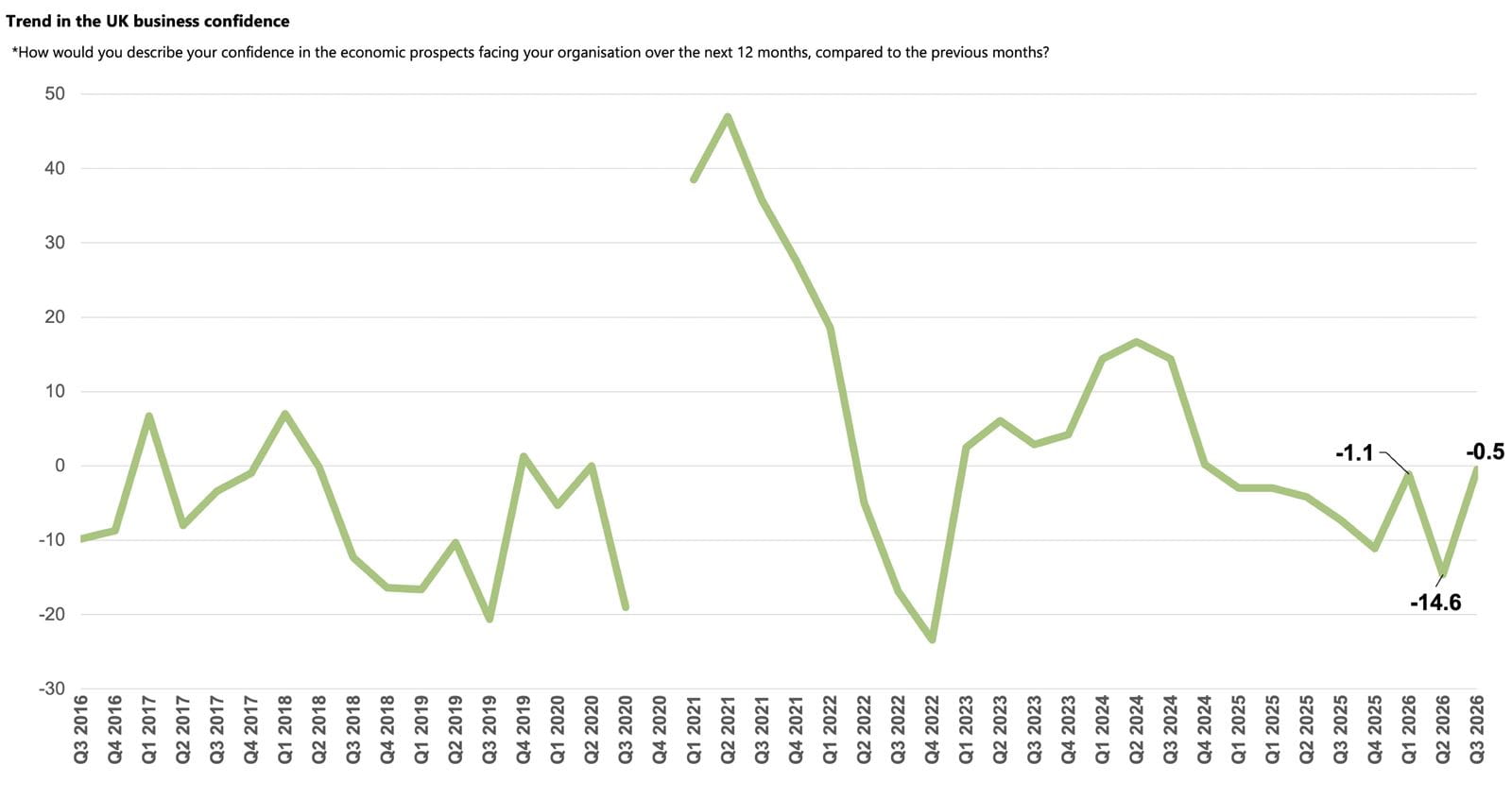
- Business confidence improved in Q3 2026 but remained negative for the seventh successive quarter.
- Amid heightened geopolitical concerns export growth slipped below its historical average, while companies remain cautious about the outlook, again lowering their expectations for domestic sales.
- Sentiment improved across all parts of the UK economy, but the recovery was uneven as sector differences remain significant.
The Business Confidence Index improved to -0.5 in Q3 2026, with the UK economy and businesses showing resilience to the disruption caused by escalating energy prices. However, the outturn marked the seventh consecutive negative quarterly score – matching the previous longest period recorded during the financial crisis – and lagging the survey average score of +4.3. Weekly data showed that sentiment declined at the end of the survey period in September as renewed US-Iran hostilities drove up oil and gas prices and heightened geopolitical uncertainty, weakening overall confidence.
Despite resilience to the ongoing US-Iran conflict, geopolitical risks remain the main growing challenge for businesses and exports growth slowed further to 2.8%, dipping below the survey historical average (3.0%). However, companies continue to expect external trading conditions to improve, predicting exports growth will rise to 4.1% in the year ahead. Domestic sales growth held steady at 3.6% in the year to Q3 2026, matching the previous quarter and above the historical norm (3.1%), but businesses again revised down their expectations for the coming 12 months to 4.3% from 4.7% predicted last quarter.
Sentiment lifted in all sectors in Q3 2026 but there are significant differences in confidence scores. Confidence was highest in IT & Communications (+14.5), Energy, Water & Mining (+11.4) followed by Manufacturing & Engineering (+8.0). Business services (+3.6) also returned to positive territory. In contrast, confidence was most negative in Property (-14.4), Construction (-8.2) and Transport & Storage (-4.7).
Business challenges
Geopolitical risk continues to dominate business challenges but labour cost concerns remain significant.
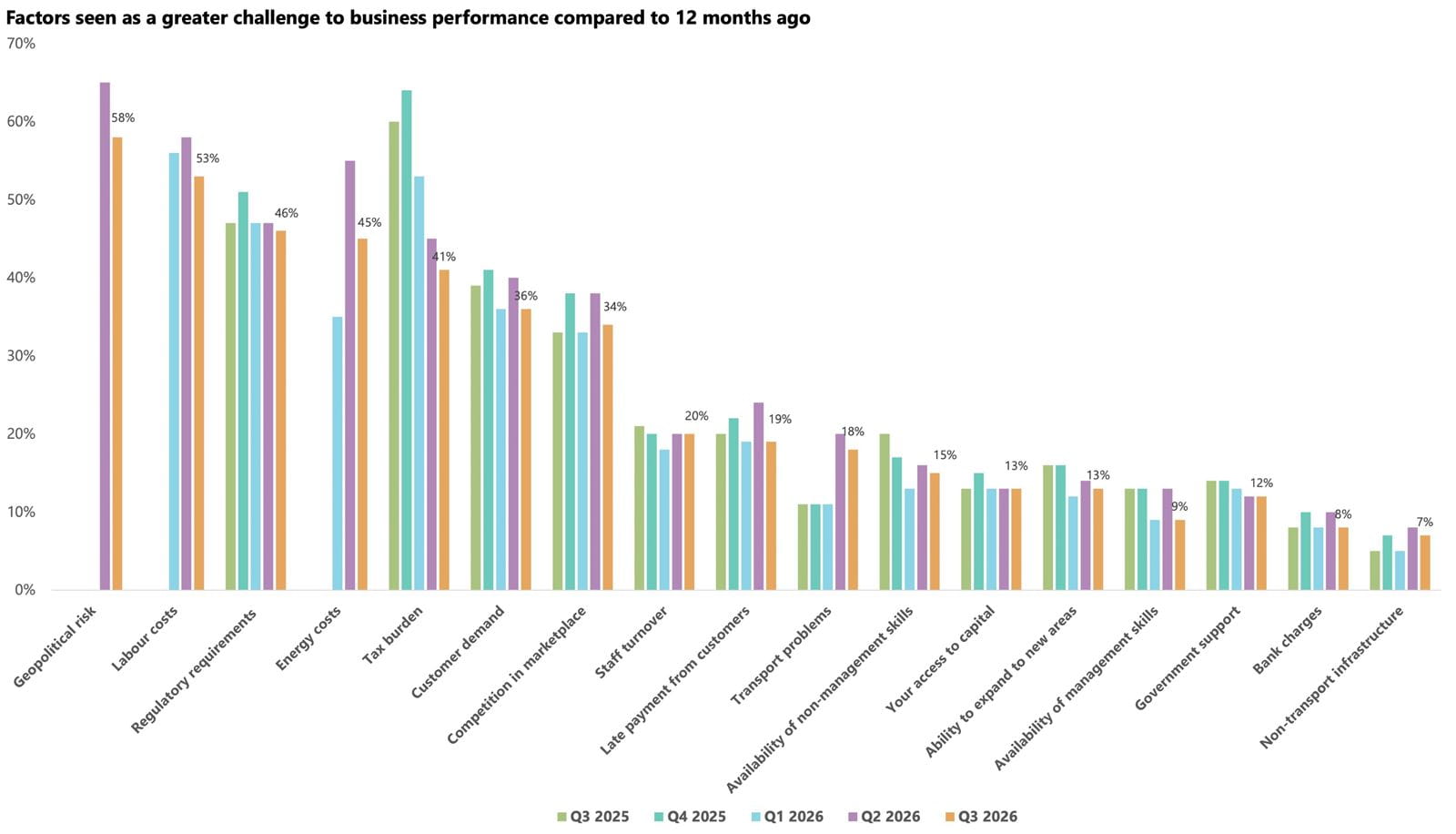
- Geopolitical risk was the main growing challenge for businesses amid continued US-Iran hostilities. Energy price challenges remain significant despite easing.
- Labour costs were the second greatest concern, reported by over half of businesses.
- Regulatory challenges remain prominent while the tax burden and customer demand eased.
Geopolitical risk remained the most significant challenge for businesses in Q3 2026, cited by 58% of companies. Although this share declined from the previous quarter, it remained high amid US–Iran tensions and disruption in the Strait of Hormuz. Elevated energy prices prompted 45% of companies to report the issue as a growing challenge, down from last quarter, but it is likely that the survey results do not fully capture the spike in wholesale gas and crude oil prices in September. Reports of transport problems also remain heightened compared to historical norms, at 18%.
Labour costs (53%) was the second most common growing challenge in Q3 2026, easing from last quarter but remaining greatest in Transport & Storage (67%), Retail & Wholesale (64%) and Construction (56%). They were the main concern for IT & Communications (56%) and Business Services (53%).
Reports of regulatory challenges were stable at 46% in Q3 2026 but rose sharply in Banking, Finance & Insurance (59%), Retail & Wholesale (50%) and Construction (47%) and remain prominent in Property (58%). Concerns about the tax burden edged down to 41% but remain over twice the historical norm (20%), while customer demand eased to 36% which is below the historical average (38%). However, heightened customer demand concerns in Construction and Transport & Storage help explain low confidence in those sectors.
Prices
Inflationary pressures eased and while further moderation is expected, there are significant upside risks to the outlook.
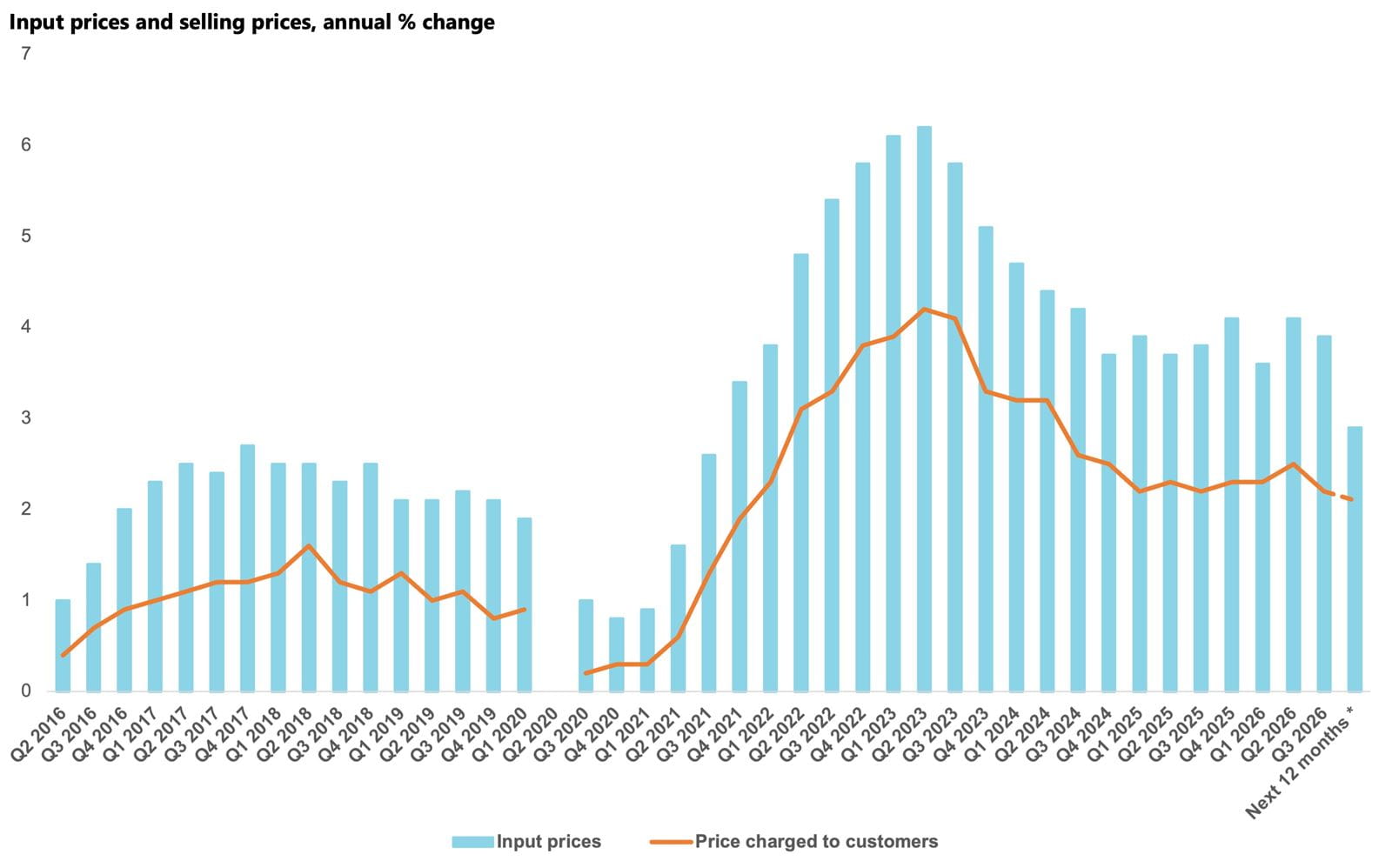
- Annual input price inflation slowed in Q3 2026 but remained markedly above the historical norm. Businesses expect inflationary pressure to ease over the next 12 months, although energy prices create a material upside risk.
- Selling price inflation also slowed, suggesting firms continue to absorb part of the cost pressure in their margins. Companies are planning to raise prices at a similar pace over the next 12 months, with Energy, Water and Mining businesses expecting the largest increases.
Annual input price inflation eased from 4.1% to 3.9% in Q3 2026, but it remains well above the historical norm (2.7%). Companies expect input price inflation to drop to 2.9% over the coming year, although significant upside risks remain. Soaring fuel prices pushed CPI inflation up to 3.1% in the 12 months to August, while Brent crude oil surpassed $100 per barrel in early September, suggesting inflation will rise further. These pressures prompted the Monetary Policy Committee to raise its near-term CPI inflation forecast from just over 3.0% at their July meeting to nearly 4.5% at their September meeting.
With trading conditions remaining challenging, companies are struggling to pass on the full extent of higher costs to customers. A recent ICAEW pulse survey showed that 57% of businesses have absorbed the increase in costs over the past year by lowering their profit margins. This response echoes the latest BCM data which shows that companies reduced the rate at which they increased their prices from 2.5% in the previous quarter to 2.2% in Q3 2026. This rise was the smallest annual uplift since Q4 2021 but was still markedly above the historical norm of 1.5%. Businesses have also lowered their expectations and now plan to raise selling prices by 2.1% over the next 12 months.
At the sector level, annual input price inflation was fastest in Transport & Storage at 4.9%, reflecting elevated petrol and diesel prices. Businesses in the sector passed some of these rises to customers, reporting the highest selling price increases alongside Energy, Water & Mining, at 3.6% and 3.1%, respectively. Most sectors expect selling price growth to moderate over the next year. However, Energy, Water & Mining companies forecast a comparatively strong 3.0% increase, likely reflecting Ofgem’s scheduled 4.0% energy price cap rise in October, with some commentators’ predicting a far larger increase to the cap in Q1 2027.
Employment
Hiring slows sharply as uncertainty and labour costs weigh on employers.
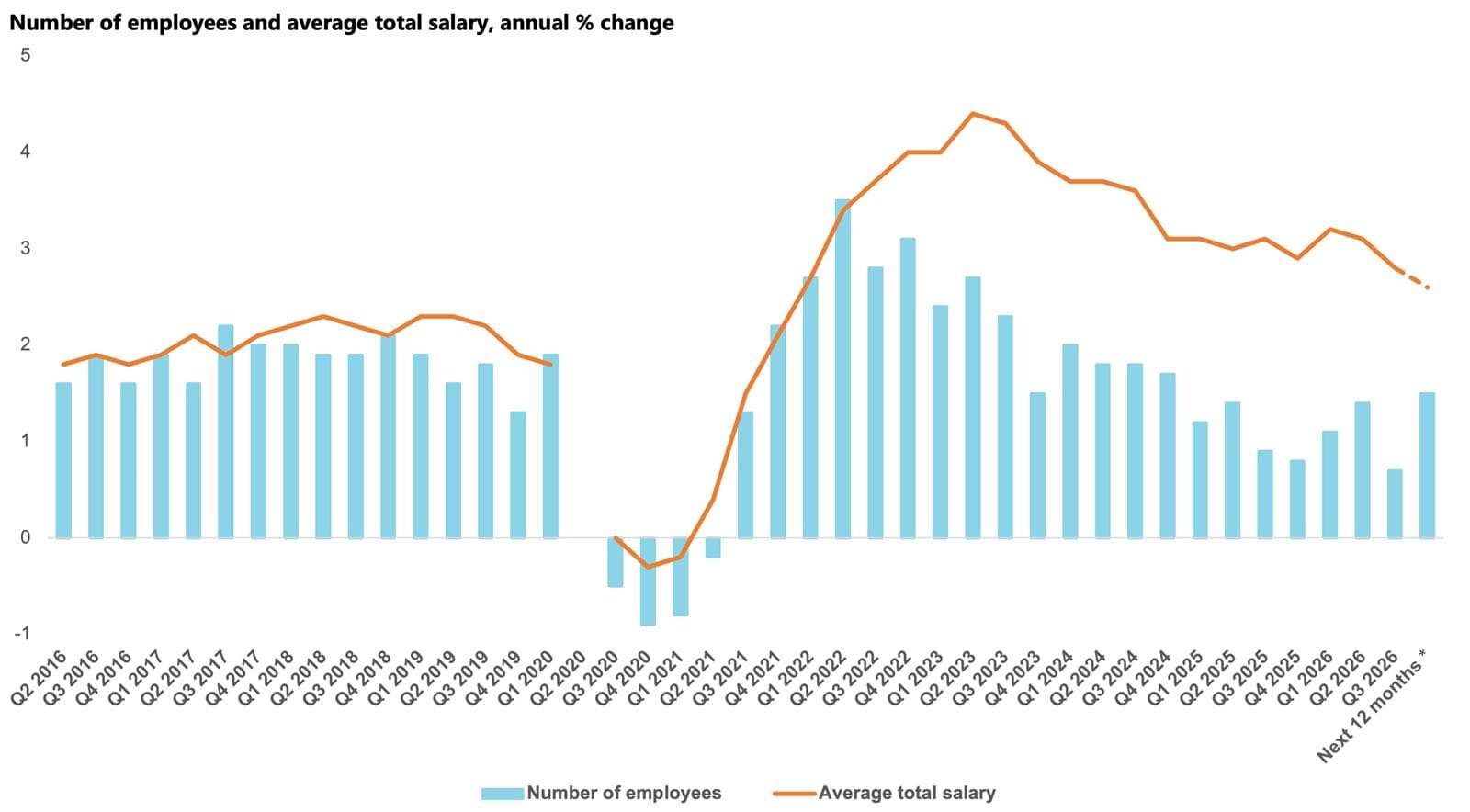
- Businesses reported their most sluggish employment expansion in four-and-a-half years in Q3 2026 but expect growth to outpace the historical norm over the coming year.
- Annual salary growth also softened but remained above the historical average, while companies expect some further moderation over the next 12 months.
- Jobs growth and employer expansion plans for next year vary considerably across sectors.
Following modest uplifts in the two previous quarters, annual employment growth slowed to 0.7%, as increased global uncertainty, elevated labour costs and increased automation led many employers to delay increasing their headcount in recent months. This was the lowest increase since Q1 2021, but recruitment was at that time distorted by the Covid-19 pandemic. Ignoring that period, jobs growth in Q3 2026 was the weakest recorded in BCM since Q3 2012. Despite turbulent macroeconomic conditions, companies intend to expand their workforce by 1.5% over the next 12 months, slightly ahead of the historical norm of 1.3%.
The slowdown in employment growth was reflected in annual salary inflation, which eased for the second consecutive quarter in Q3 2026. At 2.8%, salary growth was at its weakest since Q1 2022, although it remained above the historical average of 2.2%.
Employment growth has varied significantly across sectors and in the year to Q3 2026 was strongest in Construction (1.4%), Banking, Finance & Insurance and Business Services (both 1.3%) but weakest in Property (0.3%) and Transport & Storage (0.1%). Companies in Energy, Water & Mining (2.8%), Construction (2.7%) and Business Services (2.3%) plan the highest rates of jobs growth for the year ahead.
Profits and Investment
Uplift in R&D activity as profits growth rises to three-year high.
- Businesses reported the sharpest annual profits growth in over three years, rising above the historical norm, but they lowered their forecast for the year ahead.
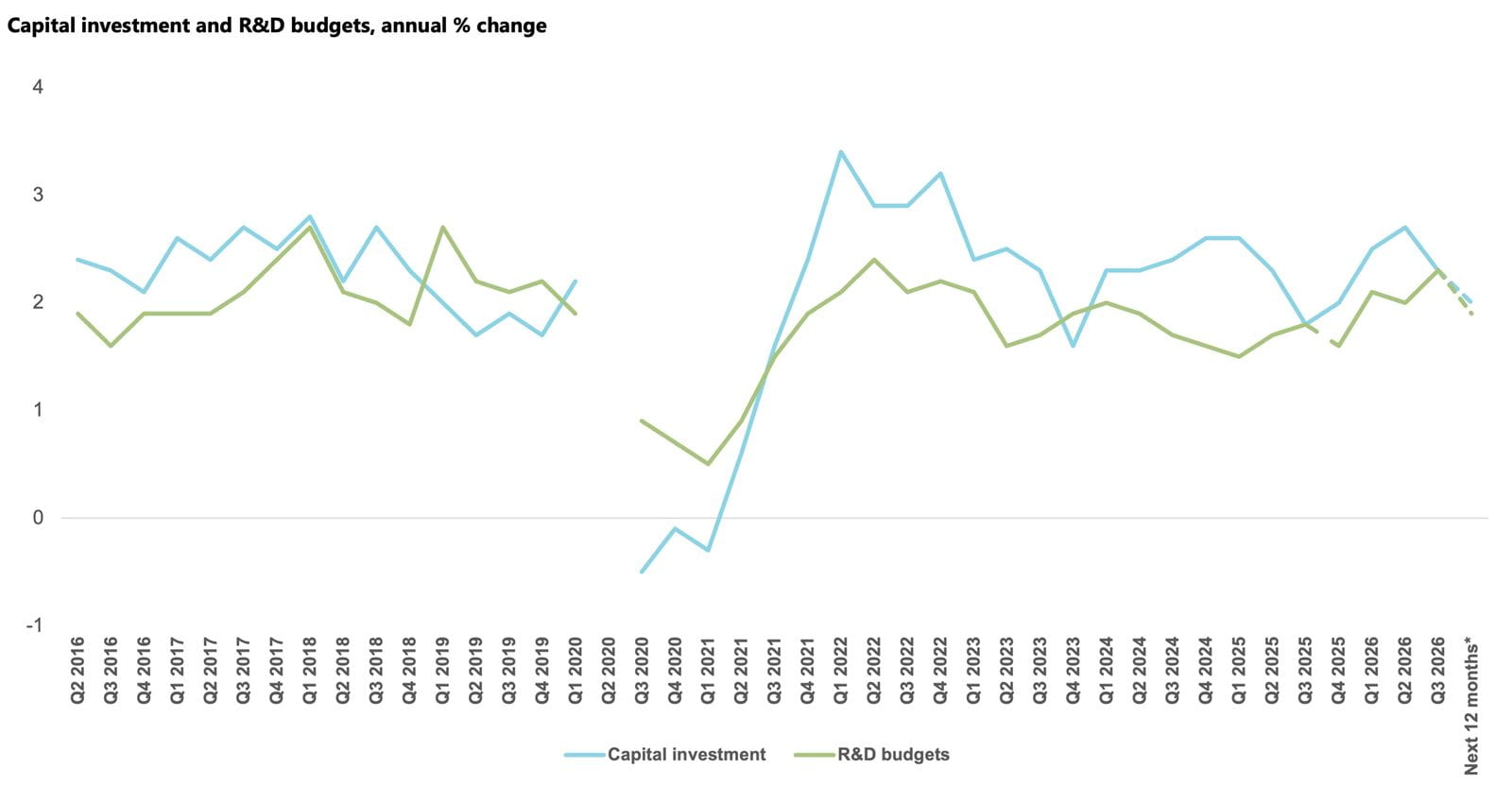
- R&D expanded at its fastest rate since Q3 2022, while capital investment remained above average, as businesses turned to innovation to improve their resilience against rising costs and uncertainty.
With domestic sales growth proving resilient, and input price and salary inflation both easing back, companies recorded their highest annual profits growth since Q1 2023, with an uplift of 3.3% in Q3 2026, a rate that also exceeded the historical norm (3.1%). Companies predict that input cost and wage inflation will continue to slow and expect stronger sales growth over the coming year. This optimistic outlook supports expectations that profits growth will improve over the coming year to 4.5%. The profits forecast is slightly weaker than last quarter, likely reflecting the downgraded projection for domestic sales.
Having reached its highest rate since Q4 2022 in the previous quarter, annual capital investment growth eased slightly to 2.3% in Q3 2026. Nevertheless, it remained above the historical average (2.1%). R&D activity also grew at its fastest rate since Q2 2022, rising by 2.3% and widening the gap to its historical norm of 1.9%. Separately, the latest ICAEW pulse survey found that in response to rising business costs since the start of the year, more businesses sought productivity and efficiency improvements (63%) than raising prices (54%) or mothballing expansion plans (25%). These findings help explain the motivation of businesses to maintain higher rates of investment growth and they have raised their forecast for capital investment growth over the next 12 months from 1.8% in the previous quarter, to 2.0%. Companies also lifted their plans for R&D growth to 1.9% from 1.8% in Q2 2026.
By sector, annual R&D growth was strongest in Q3 2026 in IT & Communications (4.0%), the fastest growth since Q1 2023, followed by Banking, Finance & Insurance (3.5%) which recorded its fastest pace of R&D expansion since Q4 2013. Energy, Water & Mining (4.0%) recorded the strongest capital expenditure growth and the sector plans the fastest growth for next year (5.5%).
Confidence by sector
The confidence rebound is broad, but the differences between sectors remain stark

- Sentiment improved across the board in Q3 2026, but significant disparities remain between sectors.
- IT, Manufacturing, Banking and Business Services all returned to positive territory and, while there were improvements in confidence among Construction and Property companies, sentiment remains deep in negative territory.
- The continued conflict in the Middle East means that geopolitical risk continued to be the primary challenge for most sectors in the quarter, particularly for companies in the energy-intensive Transport & Storage sector.
All sectors reported an uplift in business confidence in Q3 2026, with scores for most now in positive territory. The IT & Communications sector was the most optimistic, with its score rising from -8.3 in the previous quarter to +14.5, and ahead of its historical norm (+12.5). Confidence was supported by strong domestic sales and profits growth over the preceding 12 months and a positive outlook for the year ahead, itself likely bolstered by the continued adoption of AI across UK businesses. However, Business Services recorded the largest absolute improvement in its confidence score, as resilient sales and a less challenging operating environment lifted its score from -20.7 to +3.6 in Q3 2026, though this remains below its historical average of +7.8.
Strengthening exports growth helped to lift confidence in Manufacturing & Engineering into positive territory for the first time since Q4 2024. At +8.0, the sector score moved ahead of its historical norm (+4.6), with businesses optimistic of significant exports and domestic sales growth next year.
Despite broad improvements in sentiment across all sectors, a number remain in negative territory and none more so than Property, which recorded the lowest confidence score of any UK sector. Subdued residential and commercial real estate markets underpin the weak domestic sales and profits growth reported by Property businesses in the year to Q3 2026 and weighed on expectations for the year ahead. As a result, the sector’s score of -14.4 is its eighth successive negative score, and significantly below the sector norm (+0.9).
Construction (-8.2) is similarly downbeat, reporting the weakest domestic sales growth and profits growth of all sectors in Q3 2026, with businesses in the sector facing a raft of headwinds linked to heightened uncertainty and cost pressures.
Alongside Property, Transport & Storage (-4.7) and Retail & Wholesale (-3.7) have also suffered eight consecutive quarters of negative sentiment scores. For Transport & Storage, geopolitical risk was more widely reported by companies than in any other sector, due to their greater exposure to the impacts of the prolonged closure of the Strait of Hormuz and higher fuel costs. As a result, businesses have significantly lowered their expectations for domestic sales and exports growth over the next 12 months compared with the previous quarter. Retailers also pointed to heightened geopolitical risks but cited labour costs of equal importance, with regulations and the tax burden also mounting concerns weighing on confidence in Q3 2026.
Confidence by region and nation
Confidence improved across most regions, but the recovery remains uneven
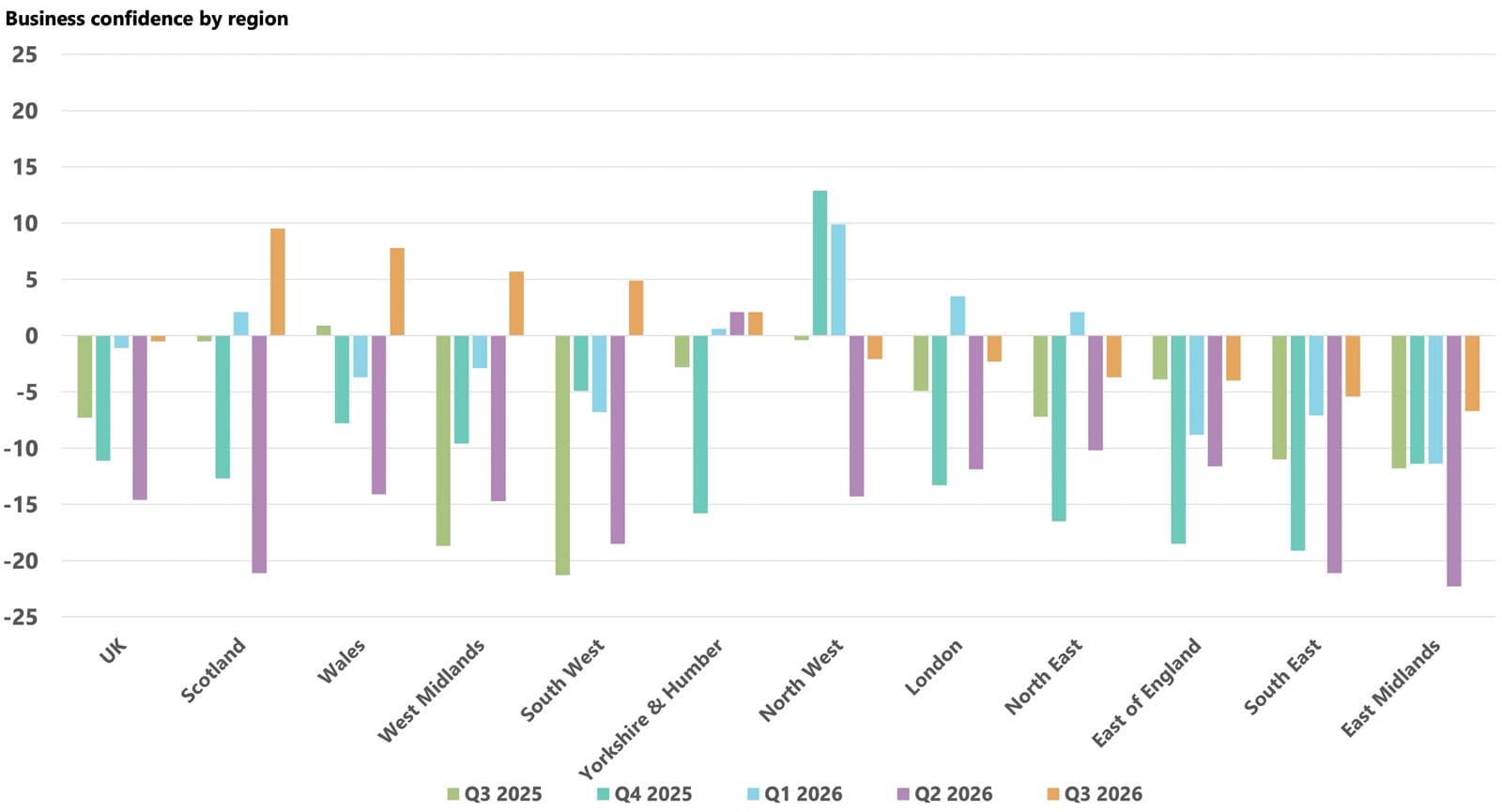
- Confidence improved in most UK regions, with Yorkshire & Humber the only exception as positive sentiment in the region continued.
- Scotland and Wales were the most optimistic regions, while the East Midlands and the South East remained the least confident areas.
Sentiment rose across 11 of the UK’s 12 nations and regions in Q3 2026, as the economy proved more resilient to the effects of the Middle East conflict than many commentators had expected. Yorkshire and the Humber was the sole exception, with confidence remaining positive and unchanged at +2.1. Scores for Scotland (+9.5), Wales (+7.8), West Midlands (+5.7), and the South West (+4.9) all returned to positive territory, making them the most confident parts of the UK. In contrast, East Midlands (-6.7), South East (-5.4) and East of England (-4.0) recorded the lowest confidence scores.
Further analysis of confidence for each region and nation is available in their respective reports on ICAEW Business Confidence Monitor.
Confidence by business size
Sentiment improved across all company types and sizes in Q3 2026, with companies listed outside the UK now the most optimistic.
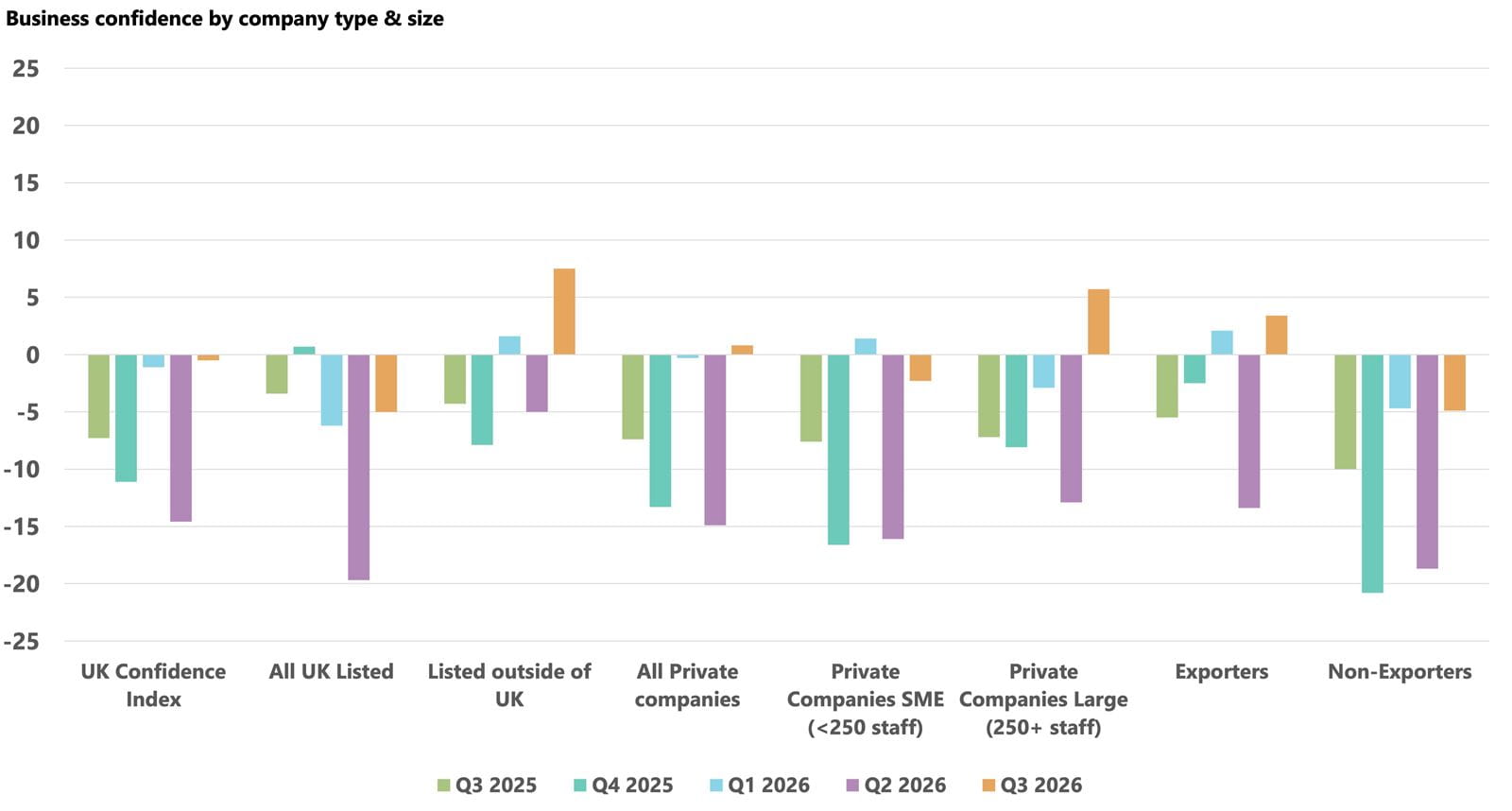
- Sentiment improved across all company types and sizes in Q3 2026, with businesses listed outside the UK Listed the most optimistic, though the sharpest improvement was recorded in large private companies.
Business confidence rose across all company types and sizes in Q3 2026. Large private companies recorded the strongest improvement in sentiment, with their Confidence Index rising from -12.9 in Q2 to +5.7. However, companies listed outside the UK were the most optimistic, recording an index score of +7.5 and exceeding their historical average of +6.1. The improvement was underpinned by broadly stable growth in domestic sales, exports and profits, while these companies also raised their expectations for the year ahead, anticipating stronger performance across all three metrics.
Economic and political environment during the survey period
Economic resilience but Middle East disruption continues to drive the inflation outlook
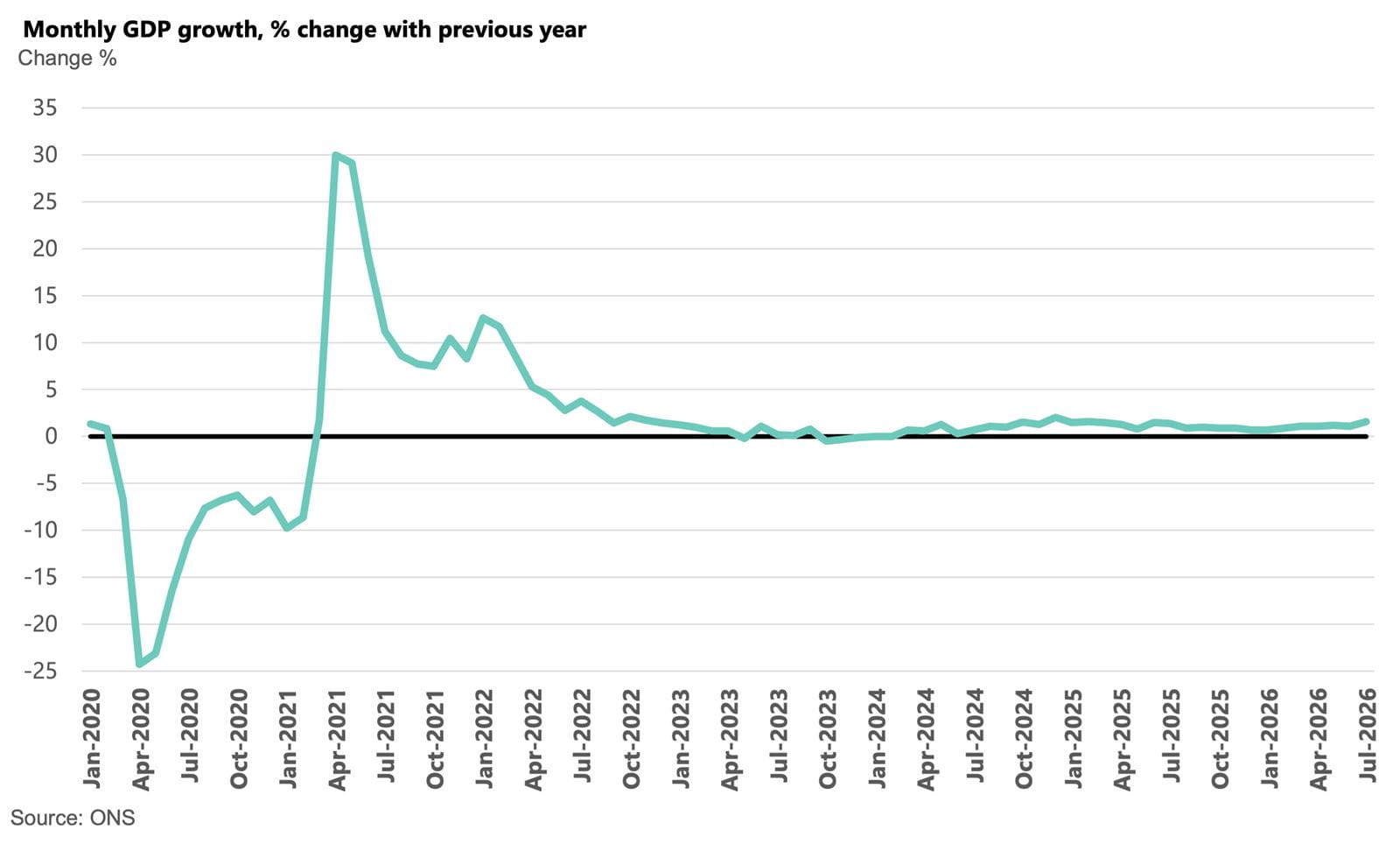
- UK economic activity has so far been largely resilient to the impact of the Middle East conflict with GDP expanding by 0.4% in Q2 2026.
- CPI inflation climbed to a five-month high in August as fuel prices increased. The MPC held rates at 3.75% but warned sustained energy pressures could require rate rises.
- The labour market continued to cool with a gentle decline in payroll employment and stable earnings growth.
The UK economy grew by 0.4% in Q2 2026, exceeding expectations despite disruption from the Middle East conflict and surging energy prices. The services sector drove the expansion, while production output stagnated. The survey period began with confirmation that Andy Burnham would be the new UK Prime Minister. Taking office on 20 July, he pledged immediate cost-of-living support and a new 10-year plan for Britain to be published later this year.
Higher fuel prices pushed CPI inflation to 3.1% in August, its highest rate in five months and further above the 2.0% target. Rising petrol and diesel prices drove the increase. In September, the Bank of England’s Monetary Policy Committee held Bank Rate at 3.75% for a tenth consecutive month. However, renewed increases in wholesale gas and crude oil prices prompted the committee to signal that sustained price pressures could require rate rises.
UK labour market conditions continued to cool despite the economy’s headline resilience. Payroll employment fell by 26,000 in August, its seventh consecutive monthly decline, leaving employment 145,000 lower than a year earlier. Private-sector regular earnings growth remained at 2.9% in the three months to July.