
ICAEW has issued updated engagement letter templates incorporating several significant new schedules designed to reflect recent regulatory, operational and technological developments.
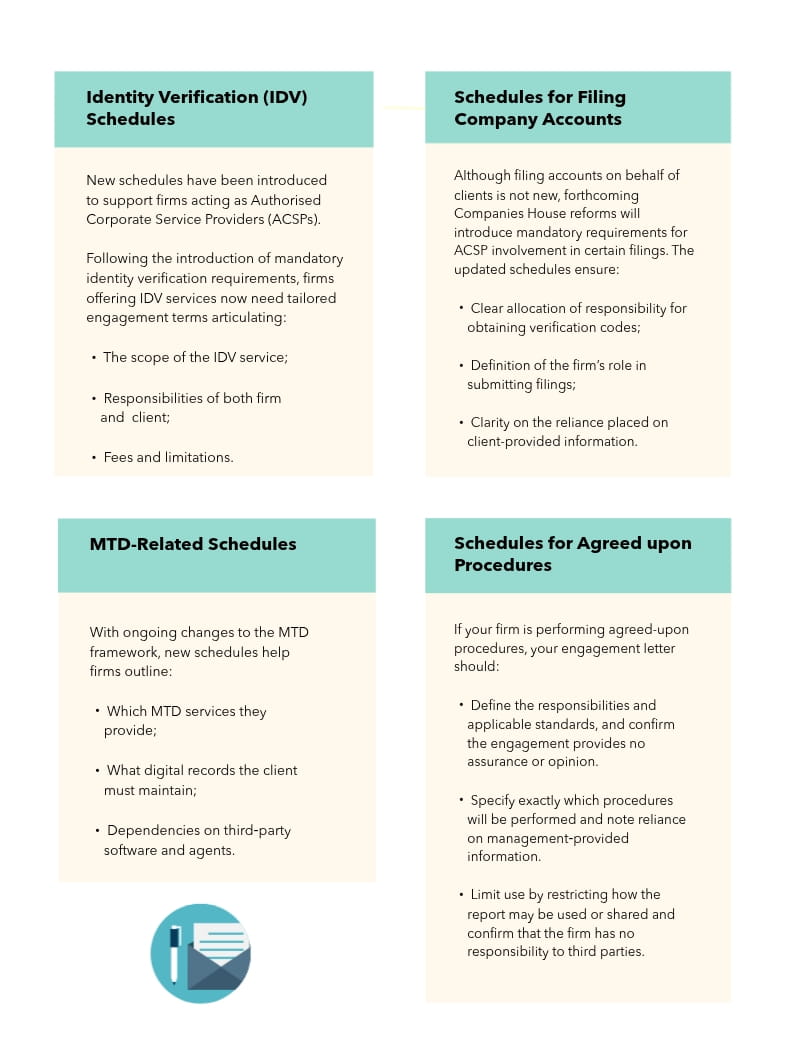
The revisions include dedicated schedules covering identity verification (IDV), filing of company accounts on behalf of clients, Making Tax Digital (MTD) services and agreed upon procedures. Guidance has also been provided on the use of artificial intelligence (AI).
Overview of new Engagement Letter schedules
Guidance on the use of AI
In addition to the new schedules, the Terms of Business have been updated to refer to the use of AI, and new guidance surrounding the terms of use of AI has been added, covering:
- Whether AI or other software tools will be used in service delivery
- Limitations of these tools and their potential impact on outputs
- Responsibilities for data protection, confidentiality, and due diligence on technology providers
Access the new schedules
A series of sample wordings to help you draft your own engagement letters.
Hot Topics webinar
ICAEW’s April 2026 Practice Hot Topics session will be devoted to the Engagement Letter with key reminders on taking on new clients, issuing Engagement Letters for the first time and disengagement.
We will go through some of the updates to the ICAEW Engagement Letter templates, including schedules on ID verification and filing accounts on behalf of clients, MTD schedules and the use of AI, together with guidance on how to effectively tailor the template for your use.
Tailoring the Engagement Letter
Firms should ensure that ICAEW’s engagement letter templates are carefully tailored to reflect their specific service structure, internal processes and the precise scope of work agreed with each client. A generic, unmodified engagement letter may fail to capture the nuances of the services being provided, leaving both the firm and the client without adequate clarity or protection.
Key reminders when taking on new clients
When taking on a new client, firms should follow ICAEW’s recommended acceptance procedures, undertaking appropriate due diligence to assess the client’s identity and integrity, understand the nature of the proposed engagement, confirm that the firm has the necessary competence and capacity to carry out the work, and identify any conflicts of interest.
Before commencing any services, an engagement letter should be issued that clearly sets out the agreed scope of work, specifies the client’s obligations, including the provision of information and completion of any IDV requirements, and incorporates all relevant schedules from the outset. Where a previous adviser is involved, firms must also follow professional enquiry procedures to identify any ethical or professional issues that could impact the acceptance decision.
Ongoing clients: Engagement Letter considerations
For existing clients, firms should not assume that engagement terms remain valid indefinitely. Cerys Freemantle, Senior Professional Consultant in ICAEW’s Technical Advisory Services, often emphasises, engagement letters should be reviewed regularly, ideally each year or whenever the scope of work changes. “Any significant developments, such as new regulatory requirements, the introduction of additional services, or the adoption of new digital tools, should prompt an update to the terms agreed with the client,” she says.
Cerys also highlights the importance of asking clients to sign and return updated letters, and of keeping clear evidence that revised terms have been issued and communicated. If a client is slow to return a signed copy, she notes that firms should follow up while maintaining a proper record of the version provided. She advises that “Your engagement letter is your contract for services and if you find yourself needing to rely on enforcing that contract you need to ensure it is up to date so it can provide you with the appropriate protections”.
Common pitfalls with Engagement Letters
Firms should be aware of common pitfalls when issuing engagement letters. A frequent issue is leaving the scope of work ambiguous - either by not being explicit about what is included, or by failing to state clearly what is outside the engagement. This can lead to misunderstandings and unmet expectations if responsibilities on both sides are not fully defined.
Another pitfall is over reliance on unmodified templates. While template wordings provide a useful starting point, ICAEW guidance emphasises that they must be tailored to the specific client and circumstances; relying on them unchanged risks omitting important terms or including provisions that are inappropriate for the engagement.
Firms should also avoid assuming that terms are agreed simply because a letter has been issued. An unsigned or partially updated engagement letter offers limited protection in the event of a dispute, underscoring the importance of ensuring that updated terms are properly documented and agreed before work begins.
Disengaging a client
When ending a client relationship, firms should follow a structured and professional disengagement process. A disengagement letter should confirm that the firm will no longer act, specify the effective date of disengagement, and outline any outstanding work and related deadlines, any ongoing issues that require resolution by the former client, and any upcoming obligations the former client should be aware of. The firm should return client records promptly, subject to any statutory or contractual rights of retention, and clearly indicate any deadlines or responsibilities that the client will assume following disengagement. A well drafted disengagement letter helps protect the firm, supports compliance with ethical requirements and ensures the client understands the implications of the termination.
- Who is buying accountancy practices and how the market is changing
- AI for Growth and ICAEW: a practical partnership to support AI adoption across the finance profession
- Macro trends and growth: confidence, discipline and selective ambition
- Using AI with confidence: how to validate AI content
- AI and complaints – keeping the process human, proportionate and professional
