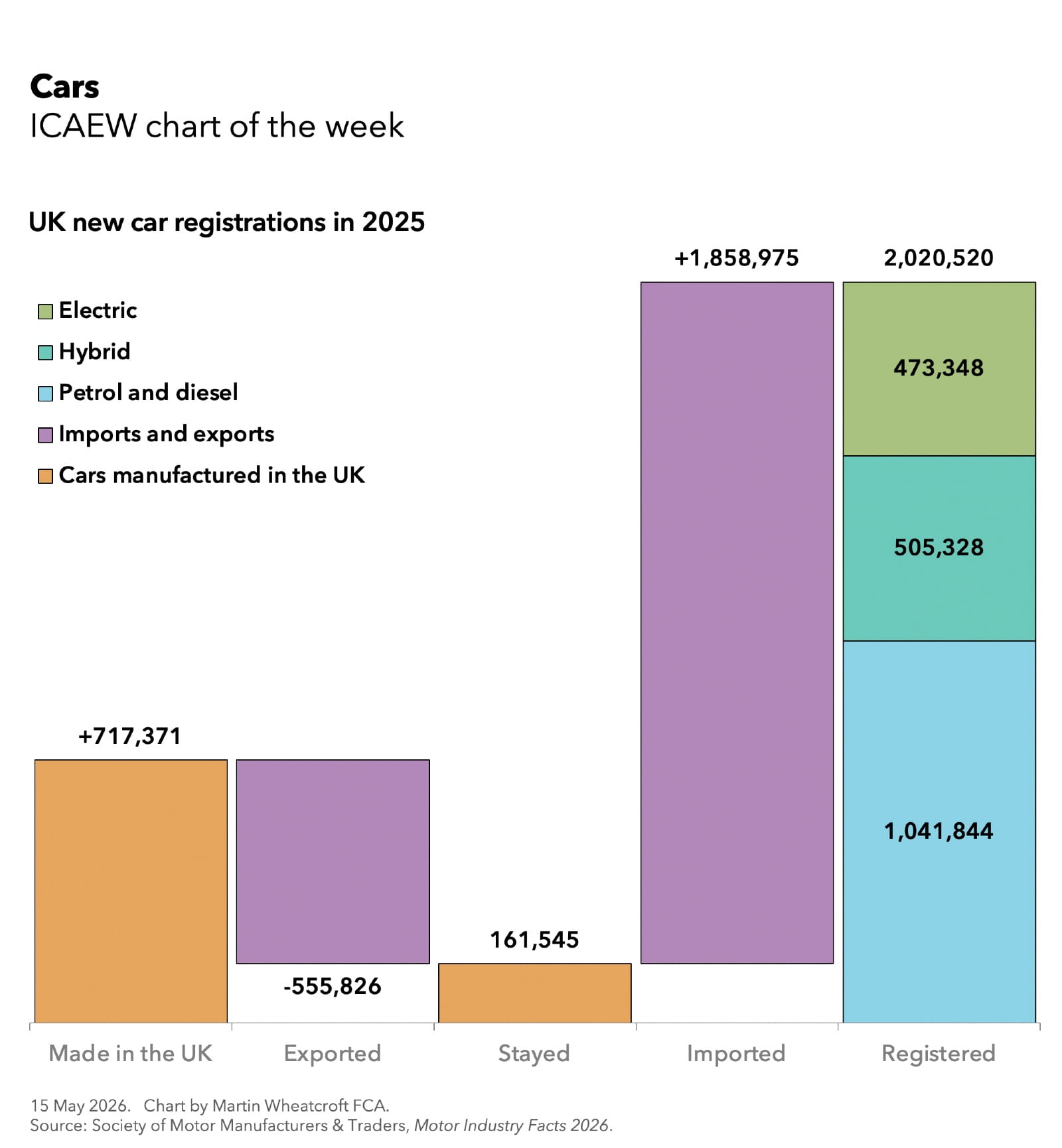
According to the Society of Motor Manufacturers & Traders (SMMT), 717,371 cars were manufactured in the UK in 2025.
Of the 717,371 cars made in the UK, 273,322 were built by Nissan (including 172,641 Qashqai and 100,446 Juke models), 194,115 by Jaguar Land Rover (including 70,609 Range Rover Sport), 124,271 by BMW (all Mini), 89,369 by Toyota (all Corolla), 9,943 by Bentley, and 26,351 by other manufacturers.
Our chart this week illustrates how, after accounting for the export of 555,826 cars in 2025 (74% of total production), the remaining 161,545 cars made in the UK, combined with 1,858,975 imports, resulted in a total of 2,020,520 new car registrations in the UK.
Car registrations
Our chart also illustrates how the 1,041,844 petrol and diesel cars registered in 2025 is 52% of the total, with the rest comprising 505,328 hybrid cars (25%) and 473,348 electric cars (23%).
The proportion of diesel car registrations is relatively small at 103,771 (5% of the total), while the number of electrified cars (hybrid and electric) registered in the UK increased from 72,744 in 2015 to 978,676 in 2025 – equivalent to compound growth of around 30% a year over the past decade.
Electric car registrations in 2025 were 24% higher than in 2024, while those of plug-in hybrids were up 38% (to 225,143) and non-plugin hybrids were up 7% (to 280,185).
According to SMMT, 59.1% of new car registrations in 2025 were to fleet buyers, 2.3% to other businesses, and 38.6% were to private buyers.
The top 10 models newly registered in the UK in 2025 were the Ford Puma (55,488), Kia Sportage (47,788), Nissan Qashqai (41,141), Vauxhall Corsa (35,947), Nissan Juke (34,773), Volkswagen Golf (32,478), Volvo XC40 (30,404), MG HS (30,191), Volkswagen Tiguan (29,857) and Hyundai Tucson (28,613).
These numbers do not include the 7.8m used cars that were sold in the UK in 2025.
Our number three export
The total number of cars manufactured in the UK was down 8% from the 779,584 built in 2024, with exports down by a similar percentage. The decline in output reflected a cyber attack that halted production at Jaguar Land Rover for nearly four weeks, new tariffs on exports to the US, and supply chain disruptions.
This continues a long-term decline in UK car production that has seen the number of cars made in the UK fall from its peak at over 1.9m cars manufactured in 1972, the 1,671,452 manufactured in the year 2000, the 1,587,677 in 2015 and the 1,303,135 made in 2019, prior to the pandemic and the UK’s exit from the EU single market and customs union.
The 555,826 cars exported in 2025 included 315,175 exported to the EU (57%), 83,196 to the US (15%), 35,017 to China (6%), 29,672 to Turkey (5%) and 15,901 to Japan (3%).
According to the Office for National Statistics (ONS), cars generated £29.3bn in exports in 2025 (8% of the £384.4bn total), in third place in goods exports behind mechanical power generators (£45.4bn) and medicinal and pharmaceutical products (£38.7bn).
Combining the ONS and SMMT statistics implies an average export value of £52,700 per car (£29.3bn in exports/555,826 cars exported).
The SMMT says that automotive products generated £43.5bn in exports in 2025. However, this number includes a further 21,754 commercial vehicles were exported from the UK (out of total domestic production of 47,344, leaving 25,590 in the UK) and also includes around 59% of the 1,608,100 vehicle engines built in the UK in 2025 that were exported.
Our number one import
The ONS reports that cars were the biggest good imported into the UK in 2025 at a cost of £46.5bn (7% of total goods imports of £627.4bn), ahead of mechanical power generators (£32.6bn) and medicines and pharmaceutical products (£27.7bn).
Combining the ONS and SMMT statistics implies an average import value of £25,000 per car (£46.5bn in imports/1,858,975 cars imported).
The ONS also reports that imports of road vehicles other than cars amounted to £23.5bn in 2025 (4% of the total).
On the road
According to SMMT’s Motorparc, there were 42.5m vehicles on the road at the end of 2025, comprising 36.7m cars, 5.2m vans, 0.6m trucks and 71,300 buses and coaches.
Of these, 10.7m vehicles were manufactured in Germany, 5.1m in the UK, 3.7m in Spain, 2.4m in France, 2.2m in Japan, 2.2m in Czechia, 1.4m in South Korea, 1.3m in Slovakia, 1.0m in Poland and 0.9m in Belgium.
An uncertain but greener outlook
UK car production was originally expected to increase in 2026 following the disruptions of 2025, especially as the UK ‘benefits’ from a 10% tariff on cars exported to the US (capped to 100,000 cars per year) while the UK economy looked to be picking up at the start of 2026.
The US-Israeli war with Iran has changed the situation, with the resulting energy supply shock starting to disrupt global supply chains, drive up costs for manufacturers, and to lower consumer and business confidence in the UK and around the world.
Although the new car market now looks likely to shrink in 2026 (in the UK and around the world), electric cars are likely to be a beneficiary of the spike in the cost of petrol and diesel, providing a further incentive for consumers and businesses to switch away from fossil fuels towards electric vehicles.
Latest charts
Further resources
ICAEW Community

Public Sector Community
The go-to place for guidance on issues affecting finance professionals working in and with the public sector. With a range of dynamic services, ICAEW provides valuable tools, resources and support tailored to the public sector.
Resources

Economy explainers
ICAEW experts offer simple guides to help understand the technical, economic jargon that is discussed when talking about public finances and the economy.
Find out moreICAEW support

Training and events
Browse upcoming and on-demand ICAEW events and webinars offering support on technical areas, such as assurance, reporting and tax, as well as personal development.
Events and webinars A-Z of courses