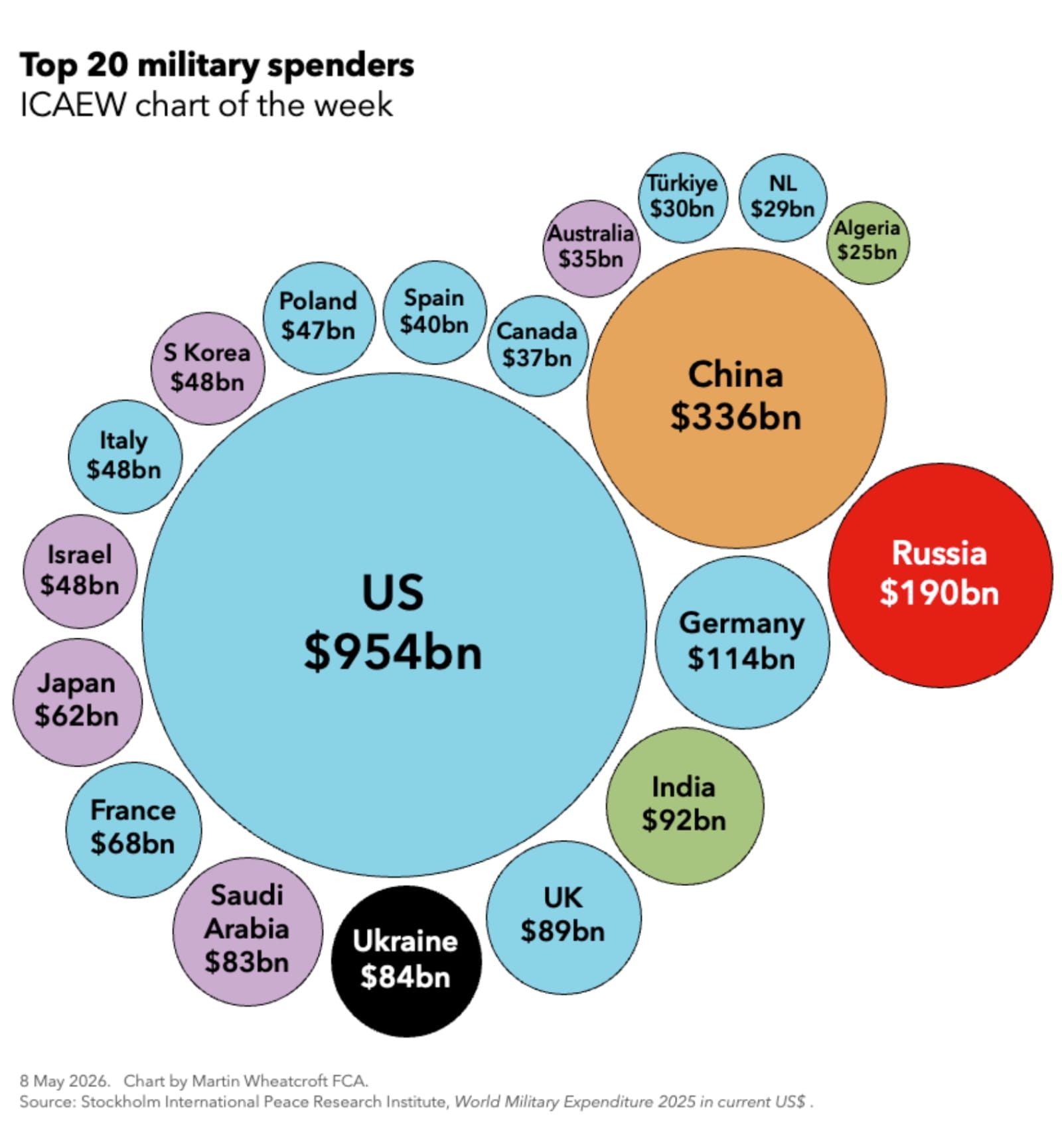
According to analysis from the Stockholm International Peace Research Institute (SIPRI), global military expenditure amounted to $2.9tn in 2025, of which $2.5tn was spent by the top 20 military spenders.
Our chart this week illustrates how the top 20 spenders (in current US$ in 2025) are the US ($954bn) , China ($336bn), Russia ($190bn), Germany ($114bn), India ($92bn), the UK ($89bn), Ukraine ($84bn), Saudi Arabia ($83bn), France ($68bn), Japan ($62bn), Israel ($48bn), Italy ($48bn), South Korea ($48bn), Poland ($47bn), Spain ($40bn), Canada ($37bn), Australia ($35bn), Türkiye ($30bn), the Netherlands ($29bn) and Algeria ($25bn).
This adds up to $2,459bn or 85% of the $2,887bn global total for military expenditure. In practice, the global total is likely higher than this because SIPRI was unable to source data on military spending by North Korea, the United Arab Emirates, Qatar, Libya, Sudan, Djibouti, Eritrea, Afghanistan, Turkmenistan, Uzbekistan and Cuba.
Not shown in the chart are the next 20 biggest military spenders in 2025, who spent a further $259bn. These comprise Brazil ($24.0bn), Taiwan ($18.2bn), Singapore ($17.4bn), Norway ($17.0bn), Sweden ($16.5bn), Indonesia ($15.0bn), Denmark ($14.9bn), Belgium ($14.5bn), Colombia ($14.5bn), Mexico ($13.6bn), Pakistan ($11.9bn), Vietnam ($10.5bn), Romania ($9.7bn), Greece ($8.4bn), Kuwait ($8.1bn), Kuwait ($8.1bn), Finland ($8.1bn), Switzerland ($7.6bn), Iran ($7.4bn), Czechia ($7.1bn), and Iraq ($6.4bn).
According to SIPRI, the amounts the top 20 countries spent in 2025 as a percentage of each country’s GDP were as follows: US 3.1% , China 1.7%, Russia 7.5%, Germany 2.3%, India 2.3%, the UK 2.4%, Ukraine 39.6%, Saudi Arabia 6.5%, France 2.0%, Japan 1.4%, Israel 7.8%, Italy 1.9%, South Korea 2.6%, Poland 4.5%, Spain 2.1%, Canada 1.6%, Australia 1.9%, Türkiye 1.9%, the Netherlands 2.2% and Algeria 8.8%.
The percentages for the next 20 countries were: Brazil 1.1%, Taiwan 2.1%, Singapore 3.0%, Norway 3.3%, Sweden 2.5%, Indonesia 1.0%, Denmark 3.3%, Colombia 3.2%, Mexico 0.7%, Pakistan 2.9%, Vietnam 2.2%, Romania 2.3%, Greece 3.0%, Kuwait 4.7%, Finland 2.6%, Switzerland 0.8%, Iran 2.1%, Czechia 1.8% and Iraq 2.4%.
The US$ amounts shown are based on 2025 exchange rates and so don’t reflect differences in purchasing power between nations, with China’s $336bn going further than the USA’s $954bn. They also don’t reflect movements in exchange rates, in particular the recent strengthening of sterling against the US$.
The yet-to-be-published UK government defence review is expected to highlight how the UK’s military capabilities need strengthening significantly to defend against an increasing array of threats. Based on SIPRI’s numbers, total military expenditure of £71bn in 2025 for the UK would need to increase by just under 50% to £106bn to meet the new NATO commitment to spend 3.5% of GDP on defence.
Finding an extra £35bn a year is not going to be easy for the Chancellor given how tight the public finances are already.
Latest charts
Further resources
ICAEW Community

Public Sector Community
The go-to place for guidance on issues affecting finance professionals working in and with the public sector. With a range of dynamic services, ICAEW provides valuable tools, resources and support tailored to the public sector.
Resources

Economy explainers
ICAEW experts offer simple guides to help understand the technical, economic jargon that is discussed when talking about public finances and the economy.
Find out moreICAEW support

Training and events
Browse upcoming and on-demand ICAEW events and webinars offering support on technical areas, such as assurance, reporting and tax, as well as personal development.
Events and webinars A-Z of courses