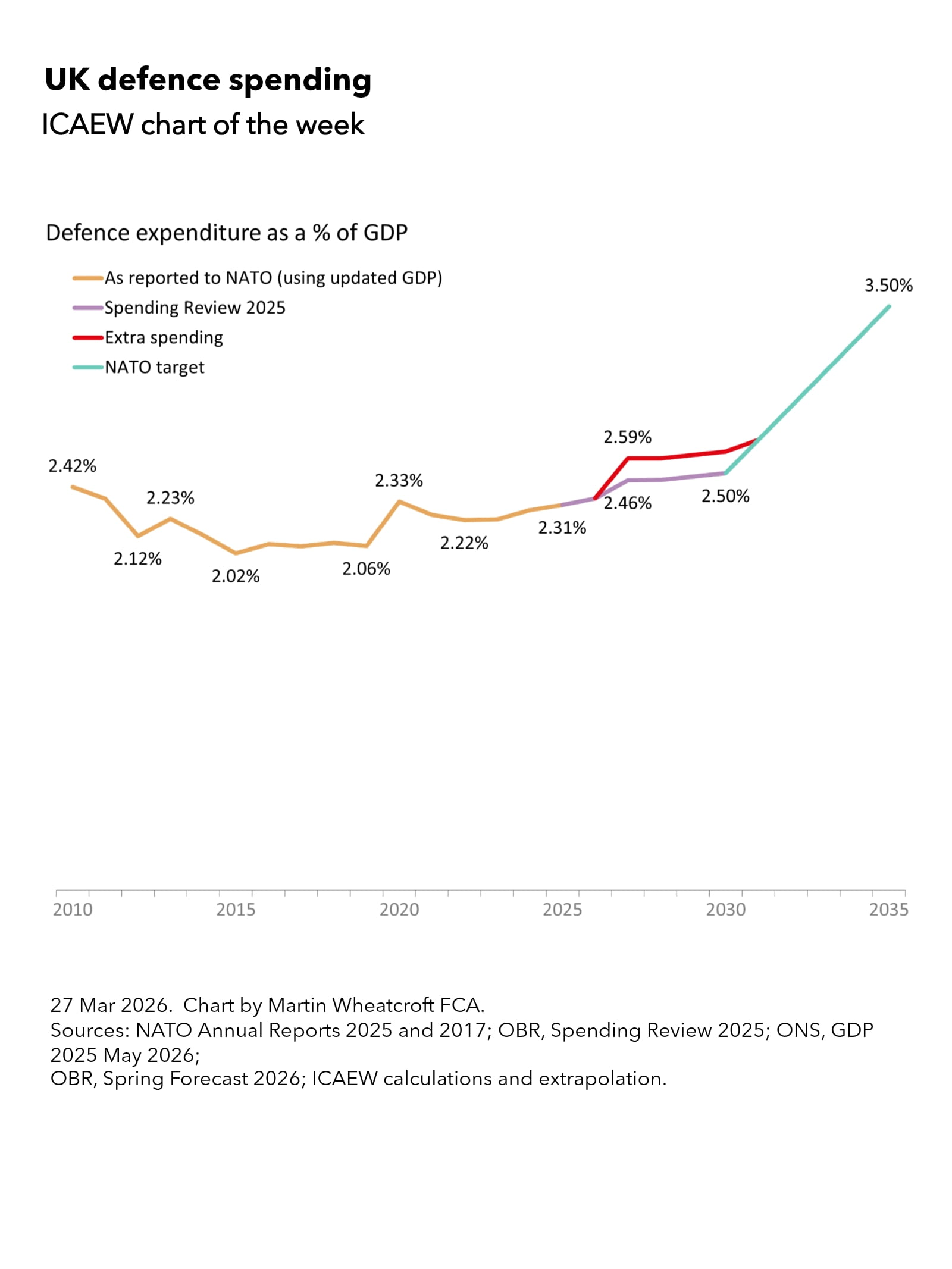
Our chart of the week recalculates defence spending as a percentage of GDP based on the amount reported by the UK to the North Atlantic Treaty Organisation (NATO) between 2014 and 2025 divided by the most recent GDP numbers reported by the Office for National Statistics (ONS).
As illustrated, defence spending/GDP fell from 2.42% in 2010 to 2.12% in 2012, rose to 2.23% in 2013, fell to 2.02% in 2015, bounced around a bit to 2.06% in 2019 and then rose to 2.33% in 2020 (when GDP fell during the pandemic), fell to 2.22% in 2022 and then rose to 2.31% in 2025 (as defence and security spending increased).
Based on the Spending Review 2025 and extrapolating the latest GDP numbers, defence spending is expected to increase to 2.46% by 2027 (just under the 2.5% committed to by the government) and to 2.5% of GDP by 2030 (assuming that defence spending continues to increase following the end of the spending review period).
Extra money is a drop in the Royal Navy
The announcement of an extra £18bn over four years is equivalent to an additional 0.13% of GDP over that time, increasing planned defence spending to 2.59% of GDP in 2027.
However, as our chart shows, this still leaves a steep rise in defence spending required to meet the 3.5% of GDP target for core defence spending set by the members of NATO at their summit in June 2025. This becomes a 5% of GDP target once wider security and resilience spending (eg, on transport infrastructure) is included.
In practice, the additional money is not likely to go very far. The £18bn over four years (£4.5bn a year on average) should in theory plug the shortfall of £42.5bn over 10 years (£4.25bn a year) identified in 2023, but the world has become more dangerous since then. Rapid developments in drone technology and AI are also changing battlefield requirements significantly.
The extra money is expected to be accompanied by a 10-year defence investment plan showing how the UK will approach the 3.5% NATO target. This was supposed to have been published last autumn with Budget 2025 but was delayed as the government wanted to focus on maximising its reported fiscal headroom.
Recent events have highlighted how understrength the UK armed forces are in an increasingly turbulent world. This is therefore likely to be just one of several increases in defence spending over the next few years as the government and its allies adjust to a new reality.
For the Chancellor, this adds to her fiscal headache as she attempts to work out how to support the country through an emerging energy crisis, grow the economy, and build up our defences all while retaining the confidence of the bond market.
Latest charts
Further resources
ICAEW Community

Public Sector Community
The go-to place for guidance on issues affecting finance professionals working in and with the public sector. With a range of dynamic services, ICAEW provides valuable tools, resources and support tailored to the public sector.
Resources

Economy explainers
ICAEW experts offer simple guides to help understand the technical, economic jargon that is discussed when talking about public finances and the economy.
Find out moreICAEW support

Training and events
Browse upcoming and on-demand ICAEW events and webinars offering support on technical areas, such as assurance, reporting and tax, as well as personal development.
Events and webinars A-Z of courses