Key takeaways
- Mandatory UK international sustainability reporting standards adoption: The FCA, which is responsible for regulating listed companies' disclosure requirements, has finalised rules requiring in-scope listed companies to report against UK SRS on a ‘comply or explain’ basis for accounting periods beginning on or after 1 January 2027.
- UK SRS and IFRS Sustainability Disclosure Standards: Based on IFRS S1 and IFRS S2, UK SRS comprises two standards: S1, General Requirements for Disclosure of Sustainability-Related Financial Information; and S2, Climate-Related Disclosures.
- In-scope entities for UK SRS: The rules require reporting on a ‘comply or explain’ basis for companies listed in the following categories: commercial companies, non-equity shares and non-voting equity shares, the transition category, secondary listings and depositary receipts.
The Financial Conduct Authority (FCA) has finalised sustainablity reporting rules based upon UK Sustainability Reporting Standards (UK SRS), applying a ‘comply or explain’ approach across climate-related and wider sustainability-related financial disclosures.
The announcement follows a consultation period in which the FCA received responses from businesses, professional bodies and other organisations.
ICAEW’s CEO Alan Vallance welcomed the announcement as “an important milestone” in the mandatory transition to international IFRS sustainability reporting standards in the UK.
"By introducing UK Sustainability Reporting Standards through a mandatory 'comply or explain' regime, the UK joins a growing number of jurisdictions implementing ISSB-based reporting requirements while reflecting domestic market circumstances," he said.
What this means for businesses
UK SRS comprises two standards:
- S1: General Requirements for Disclosure of Sustainability-Related Financial Information; and
- S2: Climate-Related Disclosures.
S1 requires the disclosure of material information about sustainability-related risks and opportunities that could reasonably affect an entity’s cash flows, access to finance or cost of capital over the short, medium and long term. Entities must:
- explain oversight and management responsibilities;
- identify risks and opportunities across the value chain;
- describe effects on the business model, decision-making and resilience; and
- report current and anticipated financial effects.
Information is material, according to the standard, if omitting, misstating or obscuring that information could reasonably be expected to influence decisions of primary users of general financial reports. The definition of material information is aligned with that used in IFRS Accounting Standards.
UK SRS S2 covers climate-specific disclosure requirements, including physical risks, transition risks and climate-related opportunities. It requires entities to explain:
- oversight;
- management processes;
- impacts on the business model and value chain;
- transition plans;
- resource allocation; and
- current and anticipated financial effects.
S2 requires the disclosure of Scope 1, Scope 2 (operational emissions) and Scope 3 (indirect emissions across organisation’s wider value chain) greenhouse gas emissions, together with methods, assumptions and information about data quality.
Data around physical and transition risks, climate-related capital deployment, and performance of climate targets are also included, among other metrics.
In its consultation response, ICAEW stressed that materiality must remain the central principle guiding sustainability disclosures, as opposed to compliance-driven behaviour.
Who is in scope?
For accounting periods beginning on or after 1 January 2027, with first reporting due in 2028, companies in the following listing categories must report against UK SRS on a ‘comply or explain’ basis, subject to transitional reliefs:
- Commercial companies (equity shares).
- Non-equity shares and non-voting equity shares.
- Transition equity shares.
- International commercial companies with a secondary listing).
- Certificates representing certain securities (depositary receipts).
Given UK SRS’s value chain requirements, its impact is likely to extend well beyond the listed entities described above.
'Comply or explain’ approach for Scope 3
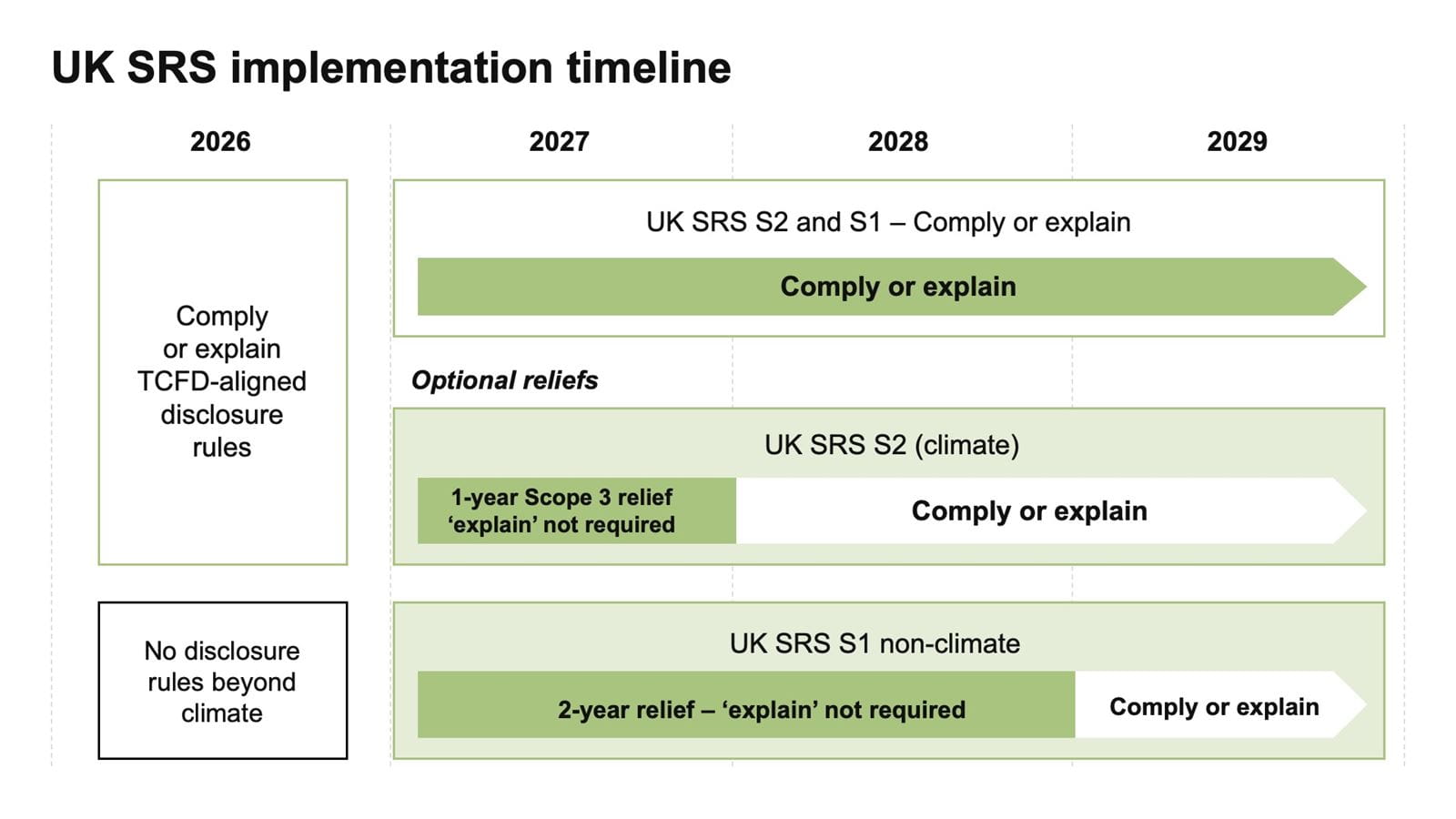
The final rules apply a ‘comply or explain’ approach to both UK SRS S1 and S2, rather than just Scope 3 greenhouse gas emissions and S1 disclosures in the FCA’s original proposal.
Where companies do not provide all the required disclosures, they must identify and summarise the S2 disclosure requirements with which they have not complied, or the relevant sustainability-related risks and opportunities not disclosed under S1.
Alongside this summary, companies must explain why those disclosures have not been included and outline the steps they plan to take to provide them in the future. There is currently no mandatory timeframe for full disclosure.
Transition reliefs
Reporting under the new rules will start in 2028. Companies can use optional transitional relief of one year for Scope 3 greenhouse gas emissions and two years for non-climate disclosures under S1. They must state which transitional relief they are using, but do not need to provide the corresponding ‘explain’ disclosures during those relief periods.
"Whether a company complies with the standards or explains why a disclosure has not been provided, it will need clear governance, sound processes and evidence to support its decision, helping mainstream sustainability reporting to be on a par with financial reporting," said Vallance.
"High-quality sustainability information supports investor confidence, better decision-making and efficient capital allocation. The new requirements will help improve sustainability-related information available to the market.”
The need for assurance
The FCA’s final rules require companies to disclose whether they have obtained third-party assurance and, where they have, provide details, including:
- the assurance provider;
- the information covered;
- the level of assurance; and
- the assurance standard used.
Where the assurance report is published, companies must also state where it can be accessed. Obtaining assurance remains voluntary under these rules.
"The FCA's decision to promote transparency around sustainability assurance arrangements is also encouraging,” said Vallance. “Greater clarity on whether assurance has been obtained, together with disclosure of the provider, scope, level and standards applied, will provide useful information to investors.
“However, work will be needed to work towards a proportionate and balanced mandatory UK sustainability assurance regime that reinforces trust while remaining practical and scalable for businesses."
Sustainability summit
This two-day virtual summit (6 hours) provides a chance to hear from policymakers, regulators, businesses and practitioners on reporting, assurance and how to remain resilient.

Further resources
Guidance

Buyers Guide to Sustainability Assurance
ICAEW has worked with the World Business Council for Sustainability Development to provide a free guide on what to look out for when prodcuring assurance services for sustainablity data.
Get the guideICAEW Certificate

Sustainability Assurance
Equip yourself to provide assurance that builds trust in sustainability reporting with this elearning programme.
Find out moreICAEW support

Training and events
Browse upcoming and on-demand ICAEW events and webinars focused on ESG and sustainability.
Events and webinars CPD courses and more