Key takeaways
- Budget buys breathing space: fiscal discipline means UK is off global bond markets' radar for now, clearing way for policymakers to gradually raise interest rates.
- Growth in August: despite expectations of a contraction UK economy grew by 0.1% in August.
- Business confidence remains low: latest ICAEW research confirms confidence has in been in negative territory for longest time since 2008 crisis.
- Innovation to combat costs: ICAEW research also suggested that businesses are embracing R&D to reduce costs.
- Jobs market facing tough end to 2026: unemployment fell in three months to August, but firms are being put off making hires due to financial pressures.
UK economy grew again in August
Official figures revealed that the UK economy grew by 0.1% in August 2025, down from growth of 0.4% in July, but ahead of expectations of a contraction.
The main driver of economic growth during the month was the manufacturing sector, which grew by 1.2%, while oil and gas extraction and energy supply also performed strongly.
The services sector, which accounts for the largest share of the UK economy, was flat during the month, while construction output contracted by 0.2%.
UK business confidence stuck in negative territory
ICAEW’s Business Confidence Monitor (BCM) for Q3 2026 revealed that sentiment during the quarter was on course to return to positive territory for the first time since Q4 2024. Better-than anticipated economic conditions, supported domestic sales and had lifted profits growth to a two-year high.
However, confidence fell from +7.3 at the end of August to -0.5 (see Chart 1) at the end of the 10-week survey period in September, as renewed US-Iran hostilities – responsible for driving up oil and gas prices – weakened overall sentiment.
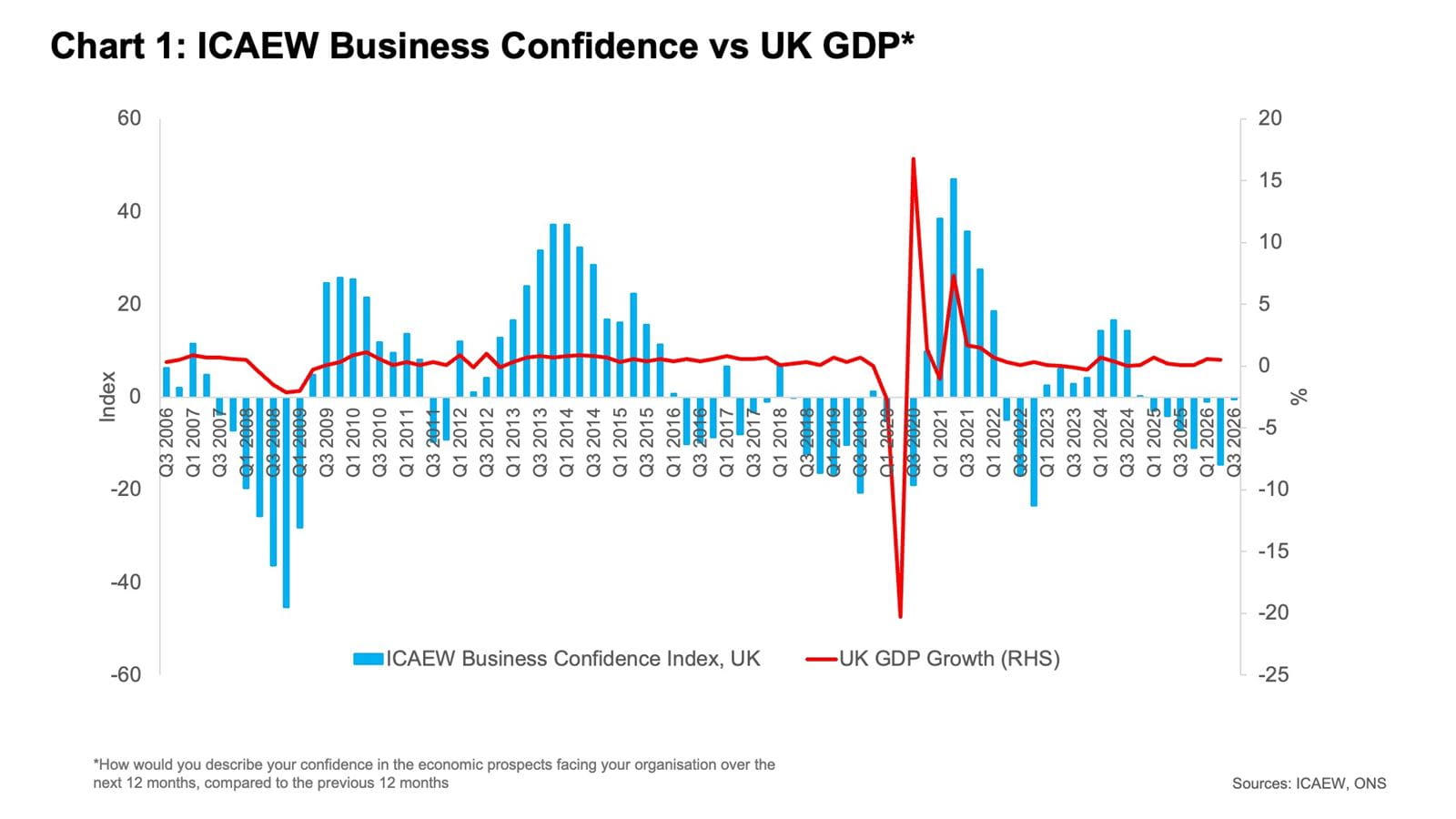
Despite improving significantly from a reading of -14.6 in Q2, confidence has been in negative territory (more businesses pessimistic than optimistic) for seven successive quarters, the joint-longest period on record, alongside the 2008 global financial crisis.
Geopolitical risks remained the biggest challenge to business performance, amid continued tensions in the Middle East, affecting 58% of firms. Labour costs (53%) were the second biggest challenge.
Businesses innovating to combat rising costs
ICAEW’s BCM also found that research and development (R&D) activity grew at its fastest rate since Q3 2022 as firms stepped up investment in productivity improvements and efficiency gains, likely supported by greater adoption of AI and other technologies.
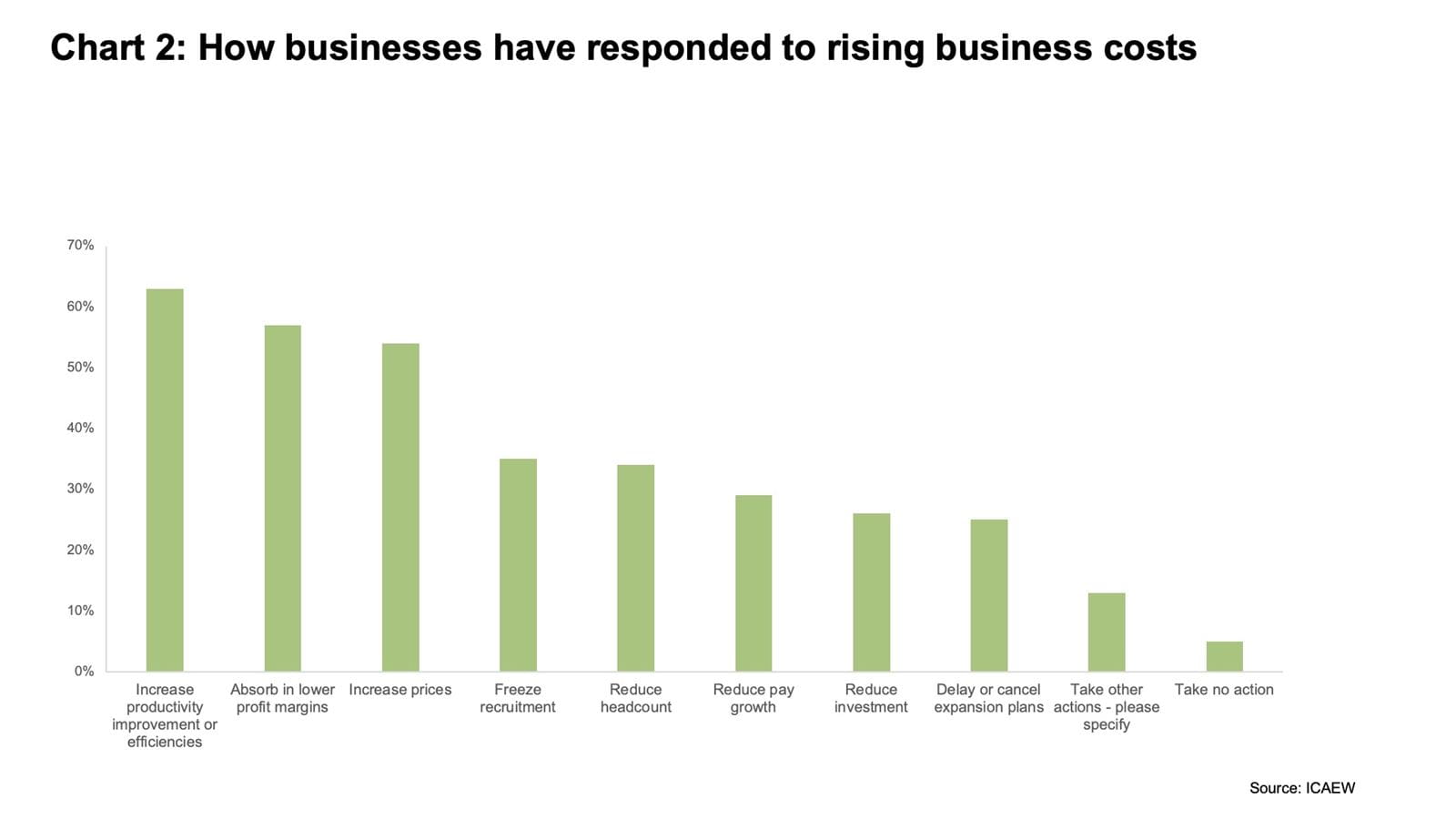
Separate ICAEW research (see Chart 2) found that in response to rising business costs since the start of the year, more firms sought productivity and efficiency improvements (63%) than raising prices (54%) or mothballing expansion plans (25%).
By sector, R&D growth was strongest in IT and communications (4.0%), the fastest growth since Q1 2023, followed by financial services (3.5%), where R&D expanded quicker than at any point since Q4 2013.
UK inflation highest in almost a year
UK CPI inflation stood at 3.5% in September 2026, up from 3.1% in August. It is the highest rate since October 2025 and well above the Bank of England’s 2% target.
The largest upward pressure on the headline rate came from increased fuel prices. Fuel costs were again the main driver, with the cost of diesel at its highest level since July 2022.
Inflation is set to continue rising as September's increase was likely followed by another rise in October. Higher energy prices and the 4% increase in Ofgem's Energy Price Cap are pushing inflation towards 3.8%.
A further increase in household energy bills in January could then lift inflation close to 4.5%.
UK labour market ‘running-on-idle’
The UK’s unemployment rate fell to 4.7% in the three months to August 2026, the lowest rate since July 2025. However, vacancies, a good indicator of demand for labour, fell by 21,000 in the three months to September to 691,000, with small firms highlighting labour costs as a key factor in scaling back hiring.
Vacancies decreased in 14 of the 18 sectors, with the largest industry decrease in construction (down 7,000 roles).
The UK jobs market is facing a tougher end to the year with unemployment likely climbing back above 5% as the financial squeeze from rising energy costs and greater automation restrains hiring.
OBR’s mixed assessment of UK’s growth prospects
Alongside the budget, the Office for Budget Responsibility (OBR) published its latest economic outlook which revealed a mixed assessment of the UK’s growth prospects.
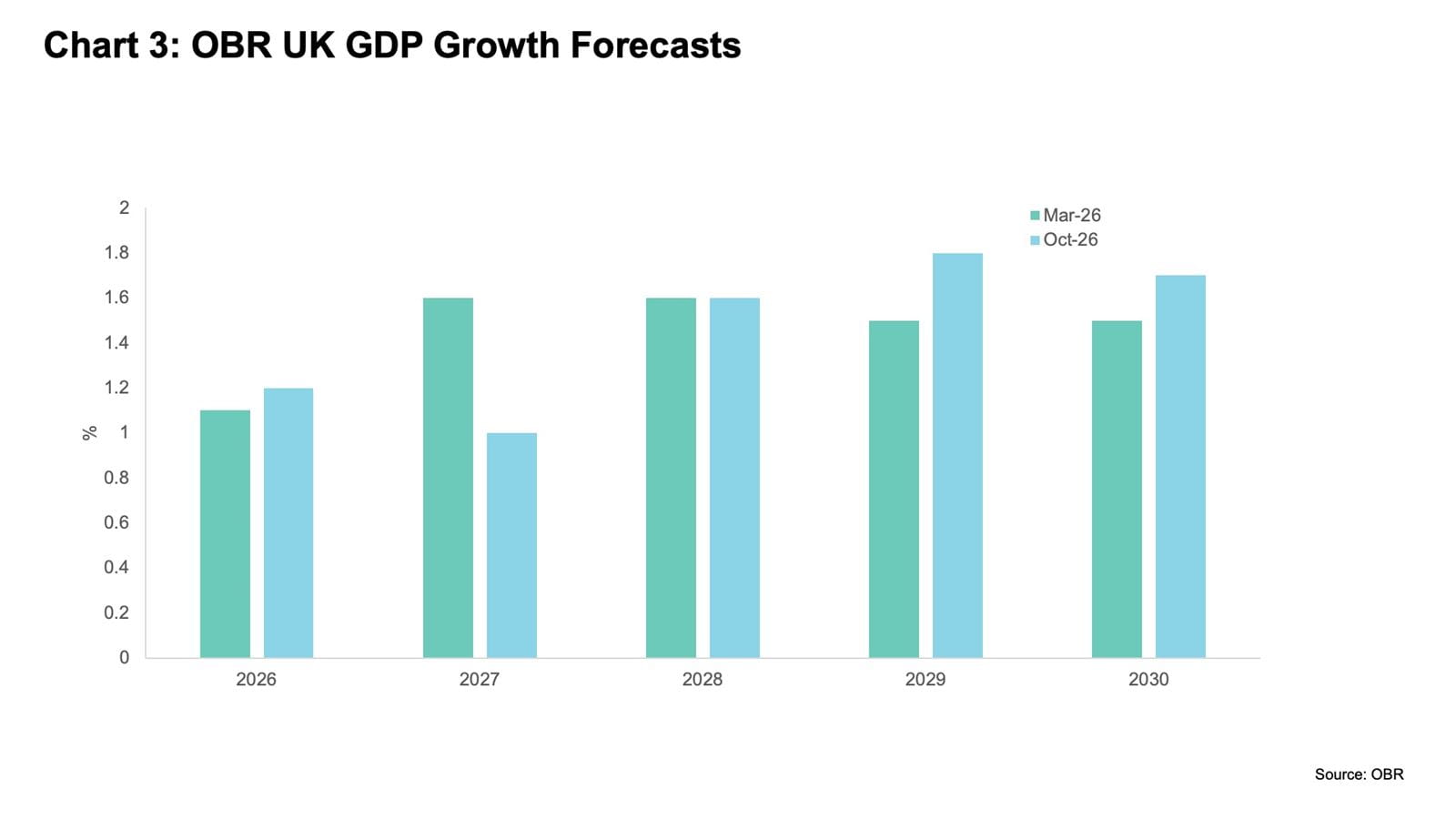
The OBR modestly upgraded its growth forecast in this year to 1.2%, from its previous estimate of 1.1% (see Chart 3). However, the OBR sharply lowered its growth forecast for 2027 from 1.6% to 1.0%, amid the squeeze from higher inflation and rising interest rates.
The OBR also predicts that UK inflation will peak at 3.75% early next year, driven by rising household energy costs.
Real household disposable income per person, an indicator of living standards, is expected to be just 1% higher than its pre-pandemic level in 2029-30.
Implications for accountants, business owners and the economy
While the budget contained several short-term fixes, the lack of significant measures to tackle the structural barriers holding back economic growth leaves the UK vulnerable to external shocks at a time when fiscal headroom remains under pressure.
This relatively low-key budget appears to contain enough fiscal discipline to keep the UK off global bond markets' radar for now, clearing the way for policymakers to begin gradually raising interest rates.
What to watch for next month:
- On 5 November, the Bank of England’s Monetary Policy Committee are likely to raise interest rates to 4.00%. Alongside their November policy decision, the bank will publish its latest economic forecasts for the UK economy.
- The quarterly GDP data to be released on 12 November, could confirm that UK GDP growth was strong in the third quarter of 2026, following 0.5% growth in Q2 2026.
- The inflation figures for October 2026 due out on 18 November should see a rise in the headline rate from September’s reading of 3.5% as the 4% rise in Ofgem’s Energy Price Cap kicks in.
ICAEW on the budget

Further support
Resources

Economy
Expert analysis on the latest national and international economic issues and trends, and interviews with prominent voices across the finance industry alongside data on the state of economy.
Visit the hubStay up to date

Subscribe to ICAEW podcasts
ICAEW podcasts help you to dissect the latest headlines and offer expert analysis on the key issues from across the world of business, finance and accountancy.
ICAEW support

Training and events
Browse upcoming and on-demand ICAEW events and webinars looking at the global economy and trade.
Events and webinars A-Z of CPD Courses