
Students who started the ACA from 1 July 2025, or have been switched to the Next Generation ACA, will follow the updated professional skills. In 2026, many employers will be preparing to review these skills with trainees for the first time. This blog is designed to help you understand what’s new, what to expect in the first six-monthly review and how to have a meaningful discussion with your trainees.
Why professional skills matter
Being an ICAEW Chartered Accountant is about far more than technical knowledge. While exams remain essential, success in the workplace depends on a broader set of capabilities: working effectively with clients and colleagues, communicating clearly, applying professional judgement and scepticism, building resilience, thinking strategically and demonstrating leadership at the right time.
The ACA recognises this. Alongside exams, students must complete a minimum of 450 days of professional work experience and develop a defined set of professional skills in the workplace. These skills ensure trainees are not only technically capable, but are able to contribute meaningfully to modern business environments.
Professional skills are the connecting piece ensuring that technical knowledge gained through exams is matched by sound judgement and clear communication in the workplace.
What's changed?
If you’ve trained ACA students before, the professional skills have been updated and streamlined from the previous seven professional development ladders made up of 52 skills.
There are now 25 professional skills, grouped under five key competency areas. This revised structure:
- Reflects feedback from employers and students.
- Removes overlap and provides flexibility.
- Is more relevant to today’s workplace.
- Introduces the concept of lifelong learning.
- Celebrates students' unique learning journey.
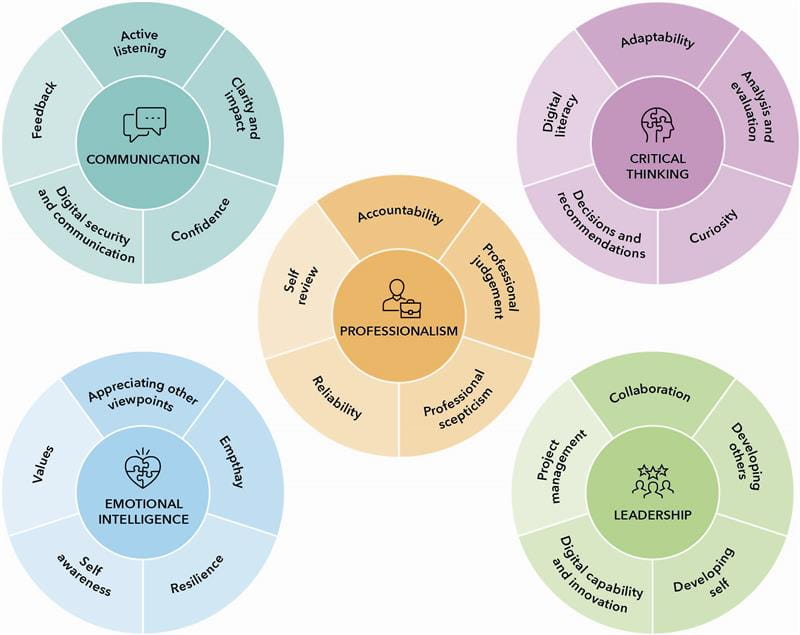
While the framework has changed, the purpose has not. Professional skills remain at the heart of the ACA, supporting meaningful development and leading to capable, well-rounded trainees who can apply their technical knowledge effectively in the workplace.
Reflecting real development and lifelong learning
Professional skills are assessed across three proficiency levels:
- Aware
- Experienced
- Accomplished
Progression is not linear and does not follow a fixed pathway. This reflects real working life. Skills develop at different speeds depending on role, exposure and opportunity, and it is entirely possible for a trainee to move forwards or backwards between levels as circumstances change. The emphasis is on continuous development, reflection and learning over time – not a checkbox exercise.
Recognising individual strengths
One of the key benefits of the new approach is recognition that no two trainees develop in exactly the same way. Some individuals may naturally demonstrate strong emotional intelligence, while others may excel in digital or analytical skills. The ICAEW professional skills model reflects this natural variation in strengths.
By the end of their training agreement, ACA students must:
- Be experienced in all 25 skills.
- Be accomplished in at least five skills.
This approach allows students to build on their areas of strength while still developing across all areas. For employers, it provides valuable insight into where trainees add the most value, how they might best be deployed on projects and where further development or stretch opportunities could be beneficial.
Encouraging meaningful conversations
The non-linear structure of professional skills creates space for more meaningful review discussions. Ahead of each six-monthly review, students are encouraged to reflect on what they have achieved over the past six months. The review meeting then builds on that reflection, focusing on:
- Where progress has been made.
- Where further support may be needed.
- What development opportunities might come next.
This approach helps move the conversation away from a checkbox exercise and towards genuine coaching, development and support.
What to expect at the first six-monthly review
The first six months of ACA training are often about settling into the workplace. Learning how a business operates, working with colleagues and clients and beginning to apply professional judgement.
Every trainee’s journey will look slightly different, particularly in the early stages. However, after six months it would be reasonable for many students to be developing awareness or experience in areas such as:
- Communication – actively listening, beginning to use digital communication effectively.
- Professionalism – reliability, meeting expectations and early exposure to professional scepticism.
- Critical thinking – developing analytical and evaluation skills through work and exam studies, alongside digital literacy.
- Emotional intelligence – building resilience and awareness of different perspectives, including diversity and inclusion.
- Leadership – while formal leadership may come later, some students may be developing early collaboration skills.
The key is not to over-complicate the process. Start with what you see day-to-day: where is the trainee performing well, where do they need support, and what experiences have they had so far?
In advance of the six-monthly review meeting, students should reflect on their progress and update their proficiency levels in their online training file. The review meeting is an opportunity to discuss your student’s progress and look forward to opportunities for development over the next six months. Finally, a declaration is made in the training file that the proficiency levels have been agreed and the review discussion has taken place. You are not required to write detailed notes in the training file, but many find it helpful to capture key points from the discussion. Students can also view their personalised professional skills overview via the student dashboard, helping them visualise their progress.
Further support
Find more guidance in the employer professional skills guide and the student version to support assessment and review conversations. The ACA handbook provides more information on how to log the professional skills review in the online training file.
Read more about professional skills or contact your Business Development Manager for support.
Develop future-ready talent

Last updated: July 2026