The changes include ID verification checks on company directors and persons of significant control (PSCs). The checks can be carried out on a voluntary basis at the moment, moving to a mandatory requirement from autumn/winter this year. Our guidance highlights why you may wish to register as an ACSP, what to consider before deciding whether to add on ID verification services and the corresponding timeframes for both options. You have plenty of time to register as an ACSP, particularly if you do not wish to provide ID verification services.
Registering as an authorised corporate service provider
You need to register as an ACSP if you want to offer ID verification services, with ID verification for directors and PSCs being mandatory since November 2025. You will also need to be an ACSP to file statutory information from November 2027. You can register to be an ACSP at any time, and you do not have to wait until November 2027 if you will only be a 'presenter' (ie, filing statutory information).
Important information for individuals who are both director and PSC
While individuals only need to verify their identity once, where they are both a director and a PSC, their personal code must be provided separately for each role.
Director ID verification: what to advise your clients
As part of the process for firms to register to be an ACSP, directors and PSCs are being contacted by Companies House to ask them to verify their identify. At the moment, this is a voluntary process but it will be a mandatory requirement for new directors and PSCs from 18 November 2025. A 12 month transition period will follow for existing directors and PSCs. These people will need to verify as their firm’s confirmation statements are due, and by November 2027.
Directors and PSCs should be able to verify themselves via Companies House’s OneLogin system which is the easiest route. Alternatively, they can go in person to a Post Office.
In most cases, individuals will only need to verify their identity once. Once they have successfully verified their identity they will receive a personal code from Companies House. From 18 November 2025, users will need to provide their personal code and a verification statement confirming they have successfully verified their identity for each company role they hold.
There are some people that OneLogin (and the Post Office) will not be able to process (such as politically exposed persons, or those without the right sort of documents). These individuals may want to ask an ACSP (such as an accountant or a solicitor) to provide this service.
Useful information for your clients
- Verifying your identity for Companies House
- Read more about the identity verification process: making it simple, secure and trusted
Persons of Significant Control (PSC) verification
While individuals only need to verify their identity once, where they are both a director and a PSC, their personal code must be provided separately for each role. This additional PSC step can be easily overlooked, particularly where the director and PSC are the same person.
Companies House is emailing the companies where one or more directors or PSCs had not yet completed their identity verification requirements. It is important that these communications from Companies House are passed on to the relevant company or individual so they can take any action required, even where intermediaries receive multiple similar emails.
Therefore, please ensure:
- emails received are reviewed by the directors and PSCs associated with the company;
- relevant person(s) check their identity verification status on the register; and
- individuals that are both directors and PSCs complete the requirements for each role they hold.
If a director or PSC is no longer associated with the company, ensure its register information is updated with Companies House as soon as possible.
Offering a service to verify the identity of your clients
Your firm may want to consider offering ID verification (IDV) services to your clients, especially if clients are asking for help with the process. As well as registering to become an ACSP, you would also need to decide how your firm would comply with the requirements of IDV. There is a strict process which can either be done manually by trained staff, or via IDV technology. IDV comes with some risks, so we recommend considering carefully if you wish to move into this area.
The consequences of making a mistake with IDV could be serious. From 2026, you will need to be registered as an ACSP to file statutory information. If you make a mistake with IDV, you could lose your status as an ACSP and therefore not be able to file. In addition, any individual that you have previously verified would have to repeat the process with another ACSP, risking reputational damage to your firm.
Recognising anti money risks and considerations
Our firms also need to recognise the anti money risks associated with ACSP work, and in particular IDV.
Directors are able to verify their own identity directly at Companies House and, for many individuals, it will be easy enough to do it themselves. Therefore, you always need to ask yourself why an individual has come to you to verify their identity, because there's a risk that those who don't want to reveal their identity might try to exploit ACSPs.
You should also note that IDV is not the same as your AML customer due diligence checks (CDD). The IDV process is fixed for everyone, whereas CDD checks should be risk-based, so will vary from client to client.
Companies House timeline
The Companies House reforms under the Economic Crime and Corporate Transparency Act are set to the following timeline:
The ACSP registration process
To register as an ACSP you must be supervised by a UK anti-money laundering (AML) supervisory body, such as ICAEW. Just being an ICAEW member or being regulated by us, does not automatically mean we are your AML supervisor, so you should check this first.
You will be required to supply specific and accurate details about your firm to Companies House. This includes its name, address and email, as well as your company number if you’re a limited company, the name of your AML supervisory body and your AML membership number or ID (see below for how to identify the correct reference number).
Key information for sole practitioners
If you are a sole practitioner, you need to use the ‘firm name’ that ICAEW records, which you can find on your annual return.
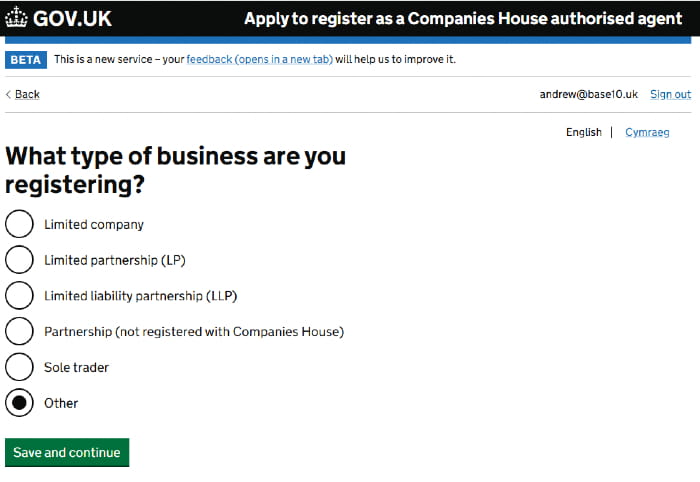
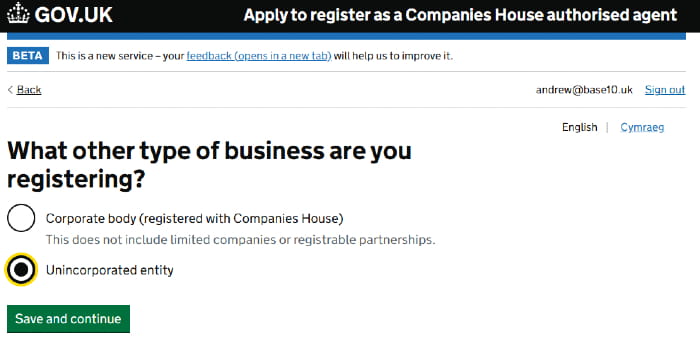
Make sure you pick the correct type of business if you are a sole practitioner. A ‘sole trader’ on the Companies House website is not the same as a ‘sole practitioner’. You must select ‘other’ and then ‘Unincorporated entity’.
Ensure your application is not rejected
The table below explains the information you need to supply so that Companies House can match their records with ICAEW’s, and some examples of the incorrect information that is causing applications to be rejected.
| What information do you need to have ready | Do not submit |
| Your ICAEW firm number starting C0 (zero) or, for a very small number of firms, starting A0. You can find this on your firm’s annual return |
L0 numbers (that's the reference number ICAEW gives to office addresses and locations) |
| Personal ICAEW member numbers (ICAEW doesn't provide those to Companies House) | |
| The firm name that ICAEW has on its records. You can find this on your firm’s annual return |
Trading names (We don't share trading names with Companies House) |
The next milestone on the Companies House timeline is November 2027, when firms will need to be registered as an ACSP to file statutory information. We anticipate this will be the driver for many of our firms to want to become an ACSP. There is plenty of time to register.
Read ICAEW’s article: ACSP registration: when, why and how?
Further ICAEW resources
You can also watch relevant AMLbites below:
Frequently asked questions
-
Do I need to register as an ACSP?
There is no mandatory requirement to register as an ACSP now. From spring/summer 2026, you will need to register as an ACSP if you want to file information for your clients at Companies House (eg, confirmation statements). You must register as an ACSP if you want to offer identity verification (IDV) services for your clients. IDV will rollout from 18 November 2025 over a 12 month period.
-
What does registration involve?
To register as an ACSP you will also be asked for your firm number so that Companies House can check that your firm is supervised for anti-money laundering. See our guidance: the ACSP registration process. You will also be asked to complete IDV for your own firm via the Companies House One Login process, as part of the application and to pay a £55 registration fee.
Companies House guidance on the registration process
-
Why was my application rejected?
Please check with Companies House. We recommend ensuring you have provided the right information, see the section above on the ACSP registration process.
-
Who is my firm’s AML supervisor?
To register, you must be supervised by a UK anti-money laundering (AML) supervisory body, such as ICAEW. You are supervised by ICAEW if you meet the definition of an ICAEW member firm or have a contract in place for AML supervision. If you are supervised by ICAEW, we will have shared your firm’s details with Companies House.
-
What will I receive to confirm I am an ACSP?
Once registered, you’ll receive a new digital account and unique identity number, which will allow you to file information, as well as complete IDV for your clients if you wish to. The person registering the firm as an ACSP can add other employees to the ACSP account once it’s registered and approved.
-
My client has received an email from Companies House telling them to verify their identity. What should I do?
You can explain that there are two routes for directors and PSCs to verify their identity at Companies House. Most people will be able do it directly through Companies House using the One Login system, and this is the easiest route. If your client cannot do this, they can go in person to a Post Office. The final option is to verify via an ACSP, such as an accountant or solicitor, who is authorised by Companies House to verify the identity of individuals.
-
Is there more information for directors and PSCs on identity verification?
Yes, you can share the Companies House guidance: Verifying your identity for Companies House
-
What is the IDV standard?
Once registered as an ACSP, you will be expected to verify individuals to the same standard as those verifying directly through the Companies House service. To support the process, Companies House has produced comprehensive guidance on how to meet the verification standard and comply with your legal responsibilities as an ACSP. How to meet Companies House identity verification standard.
-
What are the ways my firm can comply with the IDV standard?
The IDV standard is a strict process with specific steps to carry out. It can either be done manually by trained staff, or via ID verification technology (IDVT).
-
What training do I need to do manual checks?
If the documentation/evidence is being checked by a person rather than IDVT, they must be trained in detecting false documents by a specialist training provider. This could be any organisation that follows the Home Office best practice guide (Companies House Guidance on examining identity documents). Neither Companies House nor ICAEW holds a list of approved providers for IDV training, but you can search online for appropriate organisations.
-
What is ID validation technology?
Identity document validation technologies (IDVT) are forms of technology that can assist you to establish the authenticity of documents presented for identity verification purposes, including passports, biometric residence permits, diving licences, and identity cards. You must only use IDVT if you are using software or equipment that can validate the cryptographic features of the document.
-
My client has verified their identity on Companies House and sent me their personal code. What is this?
When a person has successfully verified their identity, they receive a unique identifier known as a Companies House personal code. This personal code connects all the individual’s company roles together and allows the individual to verify once, even with multiple directorships. A director or PSC needs their personal code when they file their confirmation status, or are appointed as a director or PSC in another company. If your client sends you this code, you should store it in line with how your record and hold other personal data. You will need it if you are filing their accounts as an ACSP.
-
Do we know the exact dates when the changes will become mandatory?
Companies House has confirmed that identity verification roll out will start from 18 November with a 12-month transition period.
Prefer to listen?
Two AMLbites videos are available for you to listen to and our recent webinar with Companies House is available on demand.
View resources