The eight-step model
Sharks are incredible creatures. Sometimes referred to as ‘living fossils’, they’ve been around for over 400m years, which is before trees existed. They are so resilient, in fact, that they’ve survived all five major extinction events.
I’ve been lucky enough to have seen sharks in their natural environment – while snorkelling on holiday, I was barely wet when I had my first encounter with a majestic Blacktip reef shark. Naturally, I wasted no time heading back to the safety of my air-conditioned room but by the end of the holiday, buoyed with confidence from my daily swim, I was seeking them out.
What have sharks got to do with improving project return on investment (ROI)? Sharks are survivors and, like sharks, humans are programmed for survival. That drives our behaviour and, most acutely, our overwhelming desire to avoid threats and maximise rewards (Gordon, 2000). If you move out of your natural environment, as was the case on my initial Blacktip encounter, then things become less predictable and that introduces a perceived risk to your survival.
Implementing a change project requires people to move out of their comfort zone, which triggers a threat response, and neuroscience shows that the capacity to make decisions, solve problems and collaborate with others is generally reduced when we’re responding to a threat (Elliot, 2008).
That means when we are going through a change, our ability to plan, reason, solve problems, control our emotions and be mindful of our social skills reduces. That isn’t ideal for a productive office environment or the successful delivery of a change project.
Luckily, there are things we can do to help facilitate people going through change, helping them move from their current state to a future state, by reducing uncertainty while increasing a sense of reward, and therefore the cognitive thinking we need in the workplace.
Programmes, Projects and People
All that sounds a little difficult and time-consuming, doesn’t it – so shouldn’t we just focus on delivering our new system to time, cost and quality? There’s a tendency when implementing a system or organisational change – say an IT project delivering brand new software or hardwear – to focus on the project’s milestones, costs, risks and issues. However, new IT systems are outputs, it’s the people who deliver the outcomes and, therefore, the ROI you’re seeking.
There’s an increasing amount of data showing that the success of a project is directly connected to how well the people side of the change is managed. Based on benchmarking data from Prosci’s Best Practice in Change Management, only 15% of respondents of a study with ‘poor’ change management met or exceeded their objectives. That compares to 42% of respondents with ‘fair’, 76% with ‘good’ and 94% with ‘excellent’ change management meeting or exceeding project objectives.
The better your ability to help people through the change the faster it will be adopted, the greater the number of people adopting it and the higher the level of proficiency they will have. All that results in a quicker and higher ROI.
Not supporting people through change can lead to project delays, designs being reworked, increased costs and missed milestones. If this happens consistently across multiple projects then issues can arise at the organisational level, where productivity can plunge and your best people can become a flight risk.
Leading Successful (People) Change
Many of you will have read John Kotter’s book, Leading Change, where he takes us through his eight-step change model (see ‘The influential Kotter theory of change management’, on page 9). It’s a useful tool for leaders of change (is there any other kind of leader these days?!) and it addresses some of the threat responses people feel from the uncertainty of change. Setting out a strategic vision (step three), for example, helps to create some certainty and predictability. Further, creating short-term wins (step six) introduces a sense of reward and, therefore, a move away from a threat response.
Building a guiding coalition (step two) is arguably one of the most important steps for projects as the lack of an active and visible senior sponsor is often cited as one of the most common reasons for a project to fail.
There’s been some discussion among neuroscientists as to whether creating a sense of urgency (step one) might have a negative effect on the change you’re seeking because a ‘burning platform’ could lead people into a threat-response where their cognitive reasoning is reduced. It’s better to keep the narrative positive and focused on the rewards for changing. More carrots, less sticks.
Practical Steps for Planning Change
If Kotter helps us with leading change, the Prosci ADKAR® model provides some simple but effective steps for the practitioners who are planning it:
- awareness of the need for change;
- desire to support the change;
- knowledge of how to change;
- ability to demonstrate skills and behaviours; and
- reinforcement to make the changes stick.
Planning people change isn’t just about ensuring people are trained on a new system. You must first help answer some key questions to make them ‘aware’ of the need for change and to create a ‘desire’ for them to engage in it.
Awareness
The following strategic questions are best answered by the people who set the strategy – so get the board members involved:
- Why are we changing and why now?
- What’s wrong with what we’re doing today?
- What will happen if we don’t change?
- What will we achieve if we do change?
- How does the change align with the organisation’s vision and business direction?
Desire
These questions need answers tailored at the local level and will need to come from middle managers or line managers of the people affected by the change:
- What’s in it for me?
- What’s in it for my team?
- How will the change impact colleagues and our team?
- How will the change affect our day-to-day responsibilities?
Knowledge and Ability
Once people have the awareness of the strategic drivers and can see how they or their teams will benefit then you can start building knowledge of how to change and the ability to be able to change or adopt the new system.
Reinforcement
You’ll need to demonstrate that you are serious about wanting to achieve the outcomes of your project so continually reinforcing the messages about the benefits of the change is important, over and over until the change becomes part of your normal business.
It’s said that people need to hear messages on a change to the business five to seven times before it sinks in. This is where having a well-considered communications and engagement campaign will really help, together with a stakeholder map identifying the important and influential people that will need tailored engagement.
From my experience, the hardest step in the Prosci ADKAR® model is in achieving a desire in others to want to support the change. Individuals are motivated by different things, which is why change management is often described as a process that happens one conversation at a time. But neuroscience can help point us is the right direction here too …
Influencing People
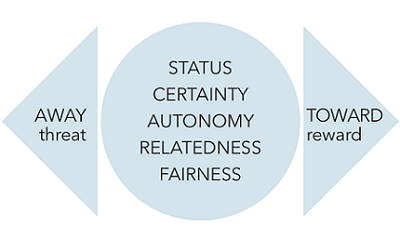
David Rock, in his publication SCARF: a brain-based model for collaborating with and influencing others notes that, as mentioned above, motivation is driven by our desire to minimise threat and maximise reward and our social needs are treated in much the same way in the brain as the need for food and water.
His SCARF model builds upon these two core behaviours in five ‘domains of human social experience’: status, certainty, autonomy, relatedness and fairness:
- status is about relative importance to others;
- certainty concerns being able to predict the future;
- autonomy provides a sense of control over events;
- relatedness is a sense of safety with others, of friend rather than foe; and
- fairness is a perception of fair exchanges between people.
These five domains trigger either ‘primary reward’ or ‘primary threat’ responses in us. For example, removing a choice (our autonomy) in ‘how’ we should achieve the benefits of a change project creates the same response in our brain as, well, swimming with a shark for the first time.
We want people in the water, embracing the new environment, not swimming for the safety of their room. That’s why carrots are better than sticks and why it requires line managers to help their staff through the change – they are more likely to understand what approach (what rewards) will motivate each individual member of their team.
Conclusion
Project or programme ROI is achieved by people, not just by delivering a system on time and to budget. The better the change management, the better the ROI. However, people-centric change can seem daunting and it’s not easily planned into the timeline of project deliverables, although you’ll often see references to people or ‘the business’ in the risks and issues log.
Recognising the powerful influence a threat or reward can have on us can help with understanding the best approach for getting colleagues on board. That requires both senior managers providing a compelling narrative on why a change is required as well as middle managers helping their staff to understand how, at the local level, they and their teams will benefit from it.
You’re unlikely to implement a successful change project alone. Start early to influence the supporters you’ll need, ensuring that you’re helping them to explain to others the rewards of a clear and positive future – one conversation at a time.
About the author
Neil Harrison is business change manager at ICAEW.
Related resources
More support on business
Read our articles, eBooks, reports and guides on finance transformation
Finance transformation hubFinancial management eBooks