Here is a subject which appears remote from our normal work as business valuers. It may however resonate with those who use the Black Scholes Option Pricing Model (BSOPM), (with the Merton extension for continuously compounding dividends) in business valuation work.
Common uses of BSOPM in business valuation are:
The central pivot of BSOPM is the concept of dynamic hedging: providers of put and call options over shares in the public markets are shielded from price changes in the underlying. They can retain that position through a process known as dynamic hedging. This involves providers of options holding varying proportions of the underlying share and a risk-free asset.
The price movement within the model is known as the drift. Due to dynamic hedging there is no equity risk premium in the model: the provider of the option is protected from risk by a perfect hedge. In consequence the drift is the risk-free rate.
A major challenge in applying BSOPM in circumstances other than the public markets is that dynamic hedging is not possible.
The PRA has modified BSOPM for a circumstance (deferred interests in residential property) when dynamic hedging is not possible. This is of potential relevance for us when dealing with shares in private companies.
Equity Release Mortgages
Homeowners post-retirement may enter into equity release mortgages. Such arrangements are often provided by insurance companies. The following terms typically apply:
- A capital sum is received by the homeowner, based on the value of the property, with a mortgage being granted over that property;
- Interest is charged on the capital sum but is not paid; the interest rolls up and is settled from the eventual property proceeds;
- This arrangement continues until the death of the homeowner or the permanent move into a care home;
- At that point the property is realised, the mortgage redemption sum is deducted from the proceeds and the balance, if any, is part of the estate of the deceased;
- The insurance company offers a no-negative equity guarantee (“NNEG”). This means that the mortgage redemption sum is restricted to the sales proceeds, and there is no risk of an additional sum being required from the estate of the deceased.
The NNEG is essentially a put option: the homeowner can, in essence, require the insurance company to purchase the property for the mortgage redemption sum.
The Black Scholes Merton Formulae
Before considering the challenges of valuing the NNEG, it is worth while examining the call and put option formulae as adjusted for continuously compounding dividends. The standard equation for a call option under BSOPM Merton is:
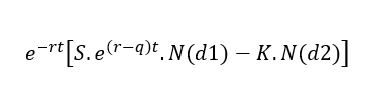
The additional term is “q” for the continuously compounding dividend. We can see the relationship to the basic BSOPM call option formula. If “q” is nil, the above formula simplifies to:

The d1 and d2 terms are also modified to include the q value as shown below:

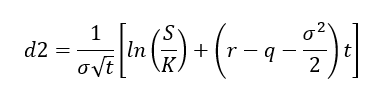
We can see that we have the basic BSOPM d1 and d2 functions if q is nil.
The challenge
There are a great many variables for the equity release mortgage industry to consider: two of these are the likely longevity of the homeowners and the extent of their repair and maintenance expenditure. Happily, we can put these problems to one side.
In brief, longevity is managed by running the model on the assumption of death at each age post-retirement. The outputs are then weighted according to life tables.
Our focus is on the challenge of the absence of dynamic hedging when considering housing.
We develop this further in Part 2.
Andrew Strickland
Consultant
