Q3: South East business confidence rebounds, but remains subdued amid weak sales and geopolitical risks.
- Business confidence in the South East rose to -5.4 from -21.1 in Q2, its highest score since Q4 2024, but remained in negative territory and below the UK average.
- Domestic sales growth edged up but continued to lag the national rate, while exports growth slowed and businesses scaled back their sales expectations for next year.
- Geopolitical risk remained the main concern, while regulation, the tax burden and customer demand were more widely cited in the South East than nationally.
- Employment and salary growth slowed, and companies are more cautious about their recruitment plans.
- Input price inflation remained elevated, but businesses limited their selling price rises, while profits growth picked up but remained below the UK rate.
- Capital investment growth strengthened, and businesses plan to maintain above-average R&D growth over the next 12 months.
Business confidence in South East
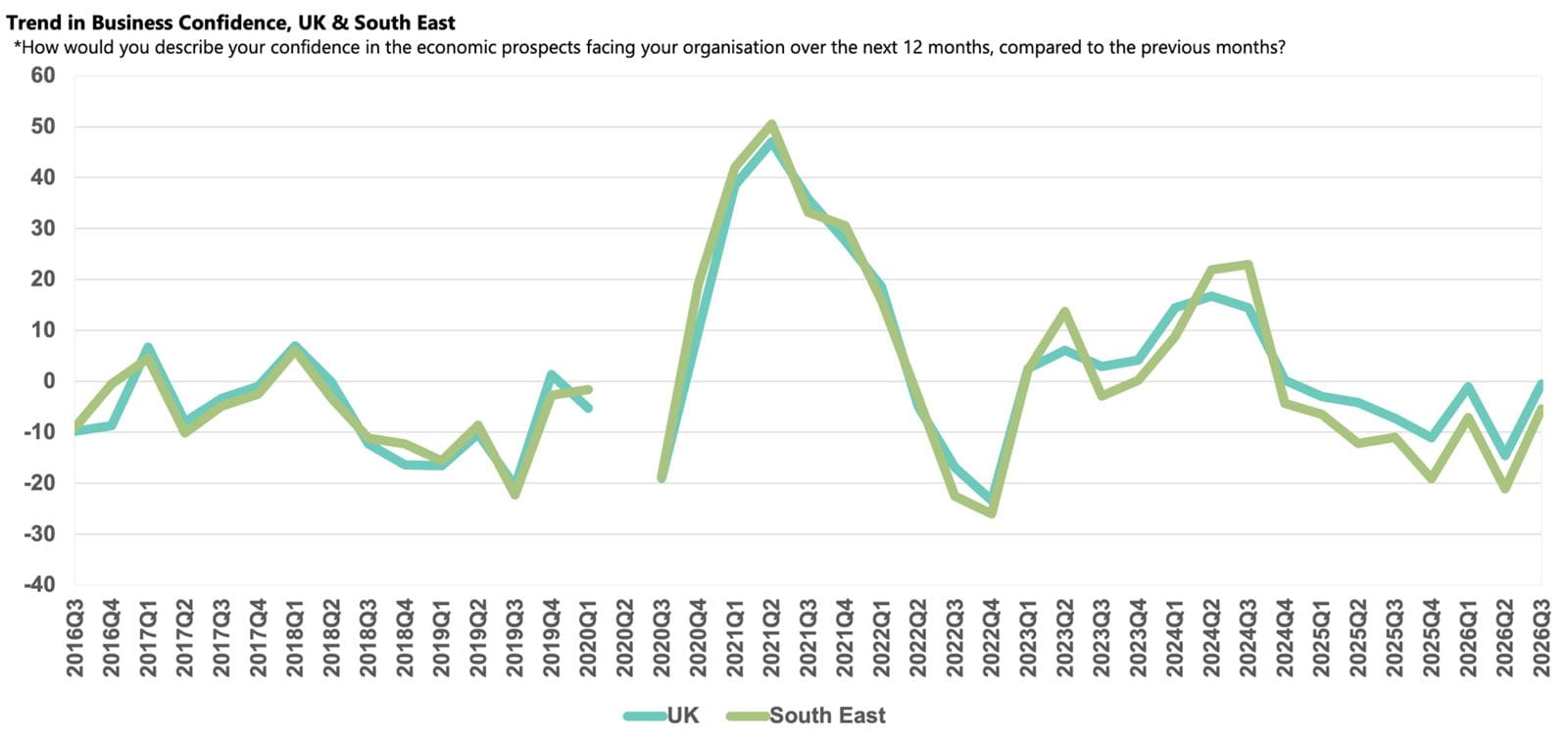
Business sentiment in the South East improved sharply, with the Business Confidence Index rising from -21.1 in Q2 2026 to -5.4 in Q3 2026, the region's highest score since Q4 2024. Nevertheless, confidence remained in negative territory for the eighth consecutive quarter, below the region's historical norm (+4.2), and continued to lag the UK average (-0.5).
The uplift reflects improvements across most of the UK, as the economy proved more resilient than expected to the Middle East conflict. Profits growth recovered from its weak Q2 2026 rate, capital investment strengthened, and input price inflation is expected to ease. However, South East businesses face greater domestic pressures than the national average, particularly from regulation, taxation and weak customer demand. Domestic sales growth remains subdued, prompting firms to lower their 12-month sales and profit expectations. Renewed US–Iran hostilities in September, which raised oil and gas prices, also pose downside risks.
Domestic sales and exports growth
Businesses in the South East reported that annual domestic sales growth edged up to 2.6% in Q3 2026, but the rate remained below the region's historical norm (3.2%) and the 3.6% rate recorded nationally. The continued underperformance perhaps reflects the region's exposure to the Construction and Property sectors, which nationally remained deep in negative territory for confidence and reported weak sales growth this quarter. Companies in the region have also lowered their expectations, predicting growth of 3.2% over the coming year, the weakest projection since Q3 2020 and below the UK forecast (4.3%).
Annual exports growth in the South East slowed to 1.9% in Q3 2026, its weakest rate since Q3 2021, lagging both the national rate (2.8%) and the region's historical norm (3.2%). Heightened global uncertainty and the continued disruption in the Strait of Hormuz likely weighed on overseas sales. Businesses expect exports growth to improve to 3.3% over the next 12 months, though this is a more cautious outlook than last quarter and sits below the UK average forecast (4.1%).
Business challenges
Geopolitical risk remained the most widely cited growing challenge for South East businesses in Q3 2026 amid continued US-Iran tensions. The share of companies reporting the issue eased from the previous quarter to 57%, close to the national average (58%). Concerns about energy costs also moderated, cited by 44% of businesses in the region compared with 45% nationally, although the survey results may not fully capture the spike in wholesale gas and crude oil prices in September. Transport problems (19%) remained above their historical norm (15%).
Domestic concerns also continue to weigh on the region. Regulatory requirements ranked as the second most common rising challenge, affecting 53% of businesses ̶ up from the previous quarter. This was among the highest in the UK and well above both the historical norm of 41% and the national average of 46%. Concern about labour costs eased, although 49% of businesses still identified them as a challenge, compared with 53% nationally. Meanwhile, 44% identified the tax burden as a concern, above the UK average (41%) and more than double the historical norm (21%).
Consistent with the region's subdued sales performance, customer demand was cited by 42% of South East businesses, unchanged from the previous quarter and more widely reported than the historical norm (39%) and the national average (36%). Competition in the marketplace (38%) was also more prevalent than nationally (34%). In contrast, reports of late payments eased to 18%, below the historical norm (21%) and the UK average (19%).
Labour market
Annual employment growth in the South East slowed to 1.2% in Q3 2026, close to the region's historical norm (1.3%) and ahead of the 0.7% rate recorded nationally. However, businesses are cautious about recruitment and plan to slow headcount growth to 1.1% over the next 12 months, below the 1.5% anticipated across the UK.
Salary growth in the South East also eased, with businesses reporting pay increases of 2.5% in the year to Q3 2026. This remained above the region's historical norm (2.2%) but below the national average (2.8%). Companies expect pay growth to moderate further to 2.1% over the coming year, lower than the UK average projection of 2.6%.
Labour availability pressures appear limited, with non-management skills (15%) and staff turnover (14%) both cited less widely as challenges than their historical norms (18% and 19%, respectively).
Input and selling prices, and profits growth
South East businesses reported that annual input price inflation edged up to 4.3% in Q3 2026, among the highest rates in the UK and above both the national average (3.9%) and the region's historical norm (2.7%). Companies expect input price growth to slow to 2.8% over the next 12 months, similar to the UK projection (2.9%), although renewed rises in oil and gas prices in September present upside risks.
Despite elevated cost pressures, businesses in the region moderated their selling price rises to 1.9% in the year to Q3 2026, the slowest pace since Q3 2021 and below the 2.2% rate recorded nationally, though still above the historical norm (1.4%). With customer demand concerns elevated, companies appear to be absorbing a greater share of rising costs, echoing the recent ICAEW pulse survey finding that 57% of businesses nationally had lowered their profit margins in response to higher costs. Businesses plan to raise prices by 1.8% over the coming year, below the UK projection (2.1%).
Annual profits growth in the South East edged up to 2.6% in Q3 2026, recovering from the weak rate reported last quarter, but remained below the national rate (3.3%) and the region's historical norm (3.2%). Nationally, Construction reported the weakest profits growth of all sectors and Property also recorded weak profits growth, which likely continued to weigh on the region. Firms in the region expect profits growth to improve to 3.3% over the next 12 months but their outlook is weaker than for the UK as a whole (4.5%).
Capital investment and R&D
Annual capital investment growth in the South East strengthened to 2.9% in Q3 2026, its highest rate since Q2 2024 and above both the UK average (2.3%) and the region's historical norm (2.0%). Businesses plan to ease investment growth to 1.9% over the next 12 months, close to the national projection (2.0%).
Annual R&D growth rose to 3.2% in Q3 2026, the highest since Q2 2014 and well ahead of both the national rate (2.3%) and the South East norm (1.9%). This sharp increase is consistent with the national finding that businesses are turning to productivity and efficiency improvements to mitigate rising costs. Companies intend to expand R&D by 2.4% over the coming year, outpacing the UK average of 1.9%.
UK results
The UK Business Confidence Index rebounded to -0.5, from -14.6 in Q2, but remained negative for a seventh consecutive quarter. Current sales and profits proved resilient, but firms downgraded their expectations for both over the next 12 months. Geopolitical risk remained the leading challenge, while elevated input and labour costs continued to put pressure on margins. Energy costs, regulations and the tax burden remain significant challenges. The rebound was broad but uneven: confidence rose in every sector, IT & Communications was the most positive, while Property and Construction remained deeply negative.
The latest quarterly findings are based on the period 13 July to 21 September 2026.