Q3: Business confidence in Construction improves but remains in negative territory as sales and profits stall.
- Business confidence in Construction rose to -8.2 in Q3 from -15.5 in Q2 but remained negative and well below the UK average.
- Domestic sales growth slowed to its weakest rate since Q2 2021 as customer demand concerns intensified, though construction companies expect sales to strengthen next year.
- Input price inflation eased and companies raised selling prices more slowly, while profits were flat in the year to Q3 2026.
- Geopolitical risk, energy costs and labour costs remain the main growing challenges, with concerns about customer demand and regulations rising.
- Capital investment and R&D growth slowed, and Construction firms have the weakest outlook for both for the coming year.
Business confidence in the Construction sector
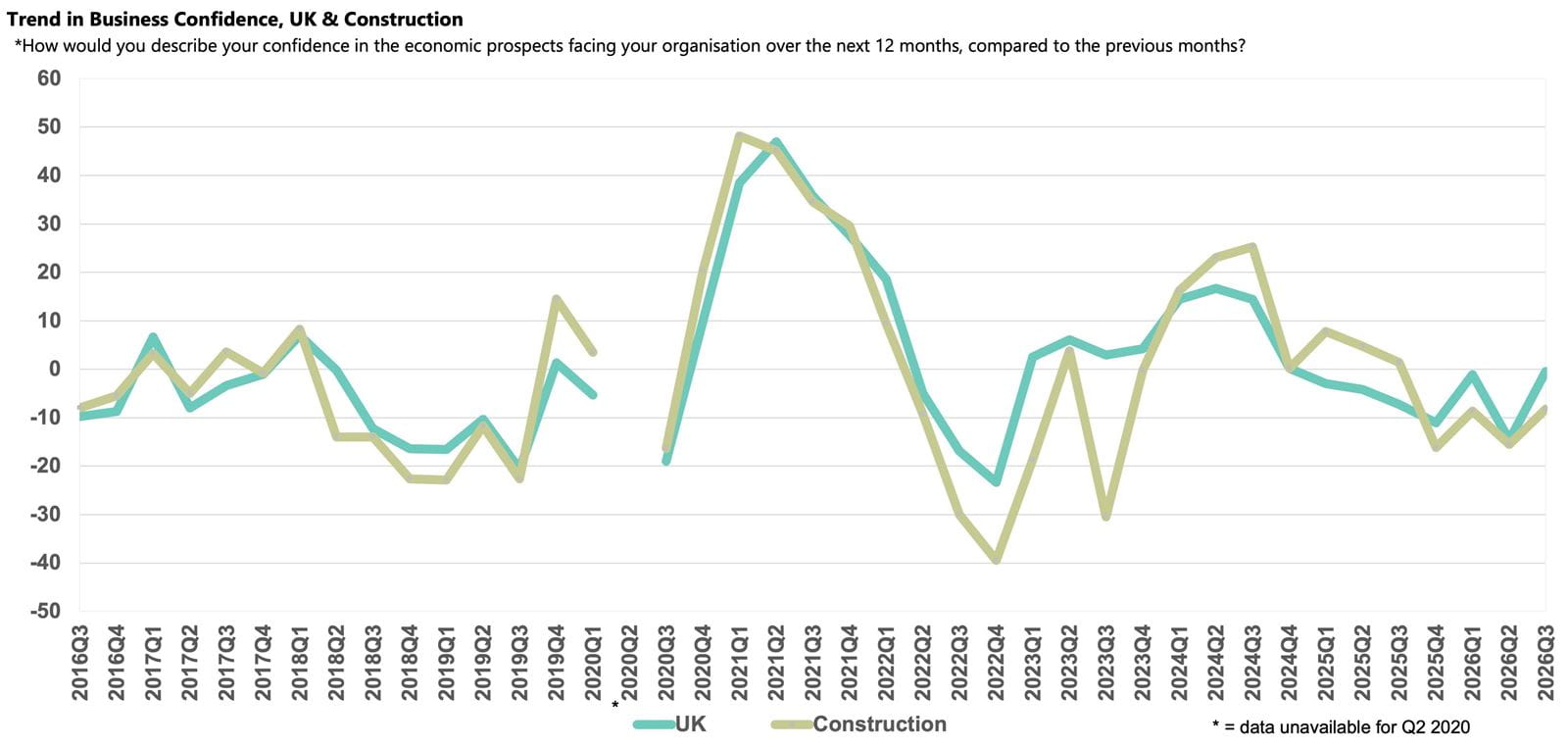
Business sentiment among Construction companies has improved, with the Business Confidence Index rising from -15.5 in Q2 2026 to -8.2 in Q3 2026. Despite the uplift, the score remained in negative territory for the fourth consecutive quarter and well below both the UK average (-0.5) and the sector’s historical norm (+3.1).
Confidence in the sector improved in line with the national picture as concerns about geopolitical risks and energy and labour costs eased, although they remain widespread. However, domestic sales growth slowed sharply, and profits were flat over the past year, both the weakest performances of any sector, while concerns about customer demand and regulation intensified. The Bank of England Agents’ September 2026 summary also noted continued weakness, particularly in housebuilding, although its July summary highlighted strong pipelines for public-sector, defence and major infrastructure projects.
Domestic sales and exports growth
Construction firms reported that annual domestic sales growth slowed markedly to 1.1% in the year to Q3 2026, the weakest rate since Q2 2021, and fell well short of both the sector norm (2.7%) and the 3.6% figure recorded nationally. Despite these recent struggles, companies remain optimistic that sales will improve over the coming year, projecting growth of 4.6%, slightly above the 4.3% rise forecast nationally, although this is a downgrade from expectations last quarter.
Customer demand was cited as a rising challenge by 47% of businesses in Construction, up from 39% in Q2 2026. This proportion was higher than in any other sector, ahead of the national average (36%) and the sector's historical norm (42%).
Input and selling prices, and profits growth
Annual input price inflation in the Construction sector eased in Q3 2026, slowing to 3.7% from 5.1% in the previous quarter, slightly below the UK average (3.9%) but still above the sector's historical norm (3.2%). Companies predict further moderation over the next 12 months to 3.4%, but this expectation is higher than the 2.9% rise forecast nationally.
With sales growth weakening, Construction businesses raised their prices more slowly, reporting annual selling price growth of 1.7% in Q3 2026, below the UK average (2.2%), though slightly above the sector's historical norm (1.5%). Companies expect to raise their prices at a faster pace in the coming year, projecting 2.1%, which is in line with the rise forecast nationally.
Weak sales and elevated costs continue to squeeze profit margins in the sector. Construction businesses reported flat annual profits in Q3 2026 (0.0%), following a marginal decline in the previous quarter. This was the weakest outturn of any sector, lagging well behind the 3.3% rate recorded nationally and the sector's historical norm (2.3%). Companies forecast a notable acceleration to 5.2% over the next 12 months, ahead of the 4.5% rise forecast nationally.
Business challenges
International uncertainty and energy costs remained at the forefront of concerns for Construction businesses in Q3 2026 amid the ongoing US-Iran conflict and disruption in the Strait of Hormuz. Geopolitical risk was cited as a growing challenge by 70% of businesses, a significantly larger proportion than the national average (58%). At the same time, energy costs were reported by 61% of companies, down from 73% last quarter but again considerably above the UK average (45%). The more widespread concern reflects the relatively high exposure to fuel and materials prices.
Labour costs were cited as a rising challenge by 56% of Construction firms, down from 63% in Q2 2026 but above the national average (53%). Regulatory challenges rose to 47%, above the sector's historical norm (37%) and broadly in line with the national average (46%). In contrast, concern about the tax burden eased further to 30% from 45% in the previous quarter, below the national average (41%) and the lowest share of any sector, although still above the sector's historical norm (21%).
There were signs that financial stress in the sector eased this quarter, as reports of late payments as a growing challenge fell to 26%, matching the historical norm. However, this remained the highest share of any sector and above the national average (19%). Access to capital was cited by 19% of companies, above both the sector norm (17%) and the UK average (13%).
Employment and labour market challenges
Despite low levels of confidence, Construction businesses reported the fastest jobs growth of any sector in Q3 2026 at 1.4%, although this was down from the previous quarter. Growth was double the 0.7% rate recorded nationally and slightly exceeded the sector's historical norm (1.2%). Companies plan to increase headcount by 2.7% over the next 12 months, well above the rise forecast nationally (1.5%) and the sector norm. Concerns about the availability of non-management skills eased, reported by 21% of businesses in the sector, dropping below the sector's historical norm (26%), but still above the national average (15%).
Salary growth also slowed in the sector. Construction businesses reported that annual pay rose by 2.8% in Q3 2026, the sector’s weakest rate since Q2 2025. This matched the national average and remained above the sector's historical norm (2.2%). Companies predict wages growth will moderate over the next 12 months to 2.5%, broadly similar to the 2.6% rise projected UK-wide.
Investment growth
Investment growth weakened in Q3 2026, with companies in the sector reporting that annual capital investment growth slowed to 1.0%. This was the weakest rate of any sector and below both the 2.3% rate recorded nationally and the sector's historical norm (1.6%). Businesses plan to slow expansion further to 0.5% over the next 12 months, the lowest of any sector and well below the 2.0% rise expected nationally.
Annual R&D growth also softened to 0.7% in Q3 2026, below the sector norm (1.1%) and lagging the UK average (2.3%). Companies plan a modest increase of 0.5% next year, a turnaround from the cut planned last quarter, but this is the weakest outlook of any sector and well below the 1.9% expansion expected nationally.
UK results
The UK Business Confidence Index rebounded to -0.5, from -14.6 in Q2, but remained negative for a seventh consecutive quarter. Current sales and profits proved resilient, but firms downgraded their expectations for both over the next 12 months. Geopolitical risk remained the leading challenge, while elevated input and labour costs continued to put pressure on margins. Energy costs, regulations and the tax burden remain significant challenges. The rebound was broad but uneven: confidence rose in every sector, IT & Communications was the most positive, while Property and Construction remained deeply negative.
The latest quarterly findings are based on the period 13 July to 21 September 2026.