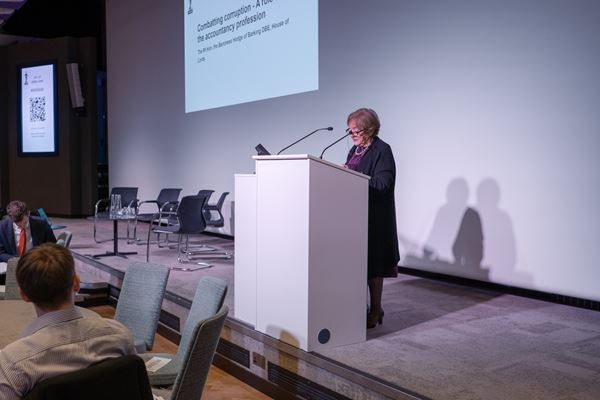
According to the Prime Minister’s Anti-Corruption Champion Baroness Hodge, accountants are the “army of professionals” best placed to tackle bad behaviour in business. “If you work ethically, [you] can help us identify and challenge the corruption that is too embedded in our society. Few other professionals have that reach, leadership and training,” she told a recent ICAEW event to mark Global Ethics Day.
But alongside championing accountants’ key role, the event set out an array of measures and approaches that organisations can apply to build robust ethical cultures.
Establishing dialogue
With speak-up procedures the focus of the first event panel, Anna Myers, Executive Director of Whistleblowing International Network, set the tone by defining whistleblowing as “the free flow of information for the responsible exercise of institutional authority”.
In that spirit, Kate Caulkin, People and Operational Management Insights Director at the National Audit Office (NAO), shared some thoughts on good practice from research that her organisation published two years ago. “First, create the right environment that allows people to speak up,” she said. “It’s not just about one-off events. How do you talk about this all the time? Are you doing storytelling around issues that were raised and what happened next?”
Second, ensure that those who speak up feel supported. “One point that came up a lot in our research was anonymity. It’s so important to establish dialogue.”
Third, she said, organisations must actively harness the information that comes out of speak-up cases to learn and improve.
Katherine Bradshaw, Founder of business ethics consultancy Gowpen, stressed that organisations must help people overcome three barriers to speaking up:
- fear: the individual’s worry that they may lose their job;
- futility: their suspicion that nothing will happen anyway; and
- stigma: their concern that senior figures will regard them as a troublemaker.
“Seeing what happens as a result of speaking up will influence other people’s willingness to do so, whether for good or bad,” she said.
When the government published its Bribery Act guidance in 2010, whistleblowing was mentioned twice. In its Failure to Prevent Fraud guidance, whistleblowing is mentioned 34 times. Policymakers have a growing expectation for entities to have robust speak-up procedures, said Neil Swift, Peters & Peters Partner.
Nurturing growth
Panel two looked at how leaders should promote an ethics-based culture. David Grosse, Founder and Lead Consultant at BehavOR, noted that whenever organisations consider human behaviour, they typically focus on internal drivers rather than social groups and norms, environments, systems, processes and policies.
“Ethics programmes must reflect those external influences,” he stressed. “If we think only about bad apples, we’ll never tackle the systemic, root causes of unethicality. We must understand both people’s vulnerabilities and dilemmas and those factors that drive behaviour.”
As Founder of CoSteer, Perrin Carey has developed a governance technology platform that enables organisations to track and course-correct misalignments between culture, decision-making and operational performance.
“Governance is meant to nurture the growth of organisations,” he said. “It is not, and never should be, a compliance exercise. Governance is about decision-making and doing the right things for the right reasons. Instead of being suffocated by structure, an organisation becomes fluid, dynamic and full of life.”
For Ololade Adesanya, HSBC Managing Director, Global Head of Audit – Insurance, Asset Management Branding and Marketing, equity, diversity and inclusion (EDI) dovetails with ethics because it goes to the heart of human relationships. She warned organisations to manage tensions between tokenism and transformation. “Some EDI efforts become symbolic, like hiring one or two individuals from underrepresented groups, while leaving core structures unchanged,” she said. “That risks hollowing out trust and fostering cynicism.”
To counter resistance to EDI ethically, do not avoid discomfort, she said. “Anticipate it, hold open dialogue and guard against reactionary retrenchments.”
Hardwiring ethics
In the third panel, speakers explored how to hardwire ethics into the use of artificial intelligence (AI). Dr Sam De Silva, Partner at law firm CMS, explained how organisations can enshrine ICAEW’s ethical principles into contracts when procuring bespoke AI solutions. For example:
- Integrity: “Contractually, you can embed this by requiring the supplier to make clear, testable statements, and by giving yourself remedies if those statements prove untrue,” De Silva said.
- Objectivity: “Require the supplier to show evidence that its solution has undergone a bias and fairness testing programme and the results are referred to in the contract.”
- Professional competence: “Ensure the supplier provides details in the contract on their governance framework – plus, how they classify model risk, manage change, respond to incidents and apply responsible AI principles.”
Moore Kingston Smith Director of Innovation Jared Goodrich outlined the ethical safeguards that his firm established while developing its internal Generative AI platform AssureRight. “We are ISO 27001 (information security) certified and have begun the pathway to ISO 42001 (AI management systems). We’re penetration tested, no client data is used to train any AI models, and all data is encrypted in both transit and at rest,” he noted. “Data security is our top priority.”
Finally, Nick Dale, Director of Intelligence at Stop the Traffik, set out the key ethical considerations behind its platform, which scrapes web data to detect evidence of human trafficking. “Explainability is absolutely critical,” he said. “We need to understand how the tool identifies and analyses the information. Having a human in the loop is vital too, and bringing lived experience into the development process is essential.”
Leadership style
Bringing proceedings to a close with a powerful keynote, Flora Page KC of 23ES Chambers and Chair of the Institute of Business Ethics, drew on lessons from her work as a victims’ advocate in the Post Office Horizon Inquiry. For Page, blame for ethical failings throughout the saga rests squarely on its leadership style.
“Most of the Post Office witnesses who came to the Inquiry were so schooled in Post Office culture that they appeared completely disconnected from their own consciences,” she said. “That was indicative of the rot across the whole institution, and it came absolutely from the top down.”
In Page’s assessment, the Post Office board was focused obsessively on reputation management at all costs. “They never created space for themselves to step back and ask if they were doing the right thing,” she added. “That was the culture.”
More support
Resources

ICAEW Code of Ethics
ICAEW's Code of Ethics applies to all members, students, affiliates, employees of member firms and, where applicable, member firms, in all of their professional and business activities, whether remunerated or voluntary.
Guidance Download the CodeICAEW support

Training and events
Browse upcoming and on-demand ICAEW events and webinars considering ethics and professional standards for accoutants.
Events and webinars CPD courses and moreeLearning

ICAEW Ethics CPD course
This online course is designed to help you apply the ICAEW Code of Ethics to everyday situations and counts towards your verifiable CPD hours.
Find out more