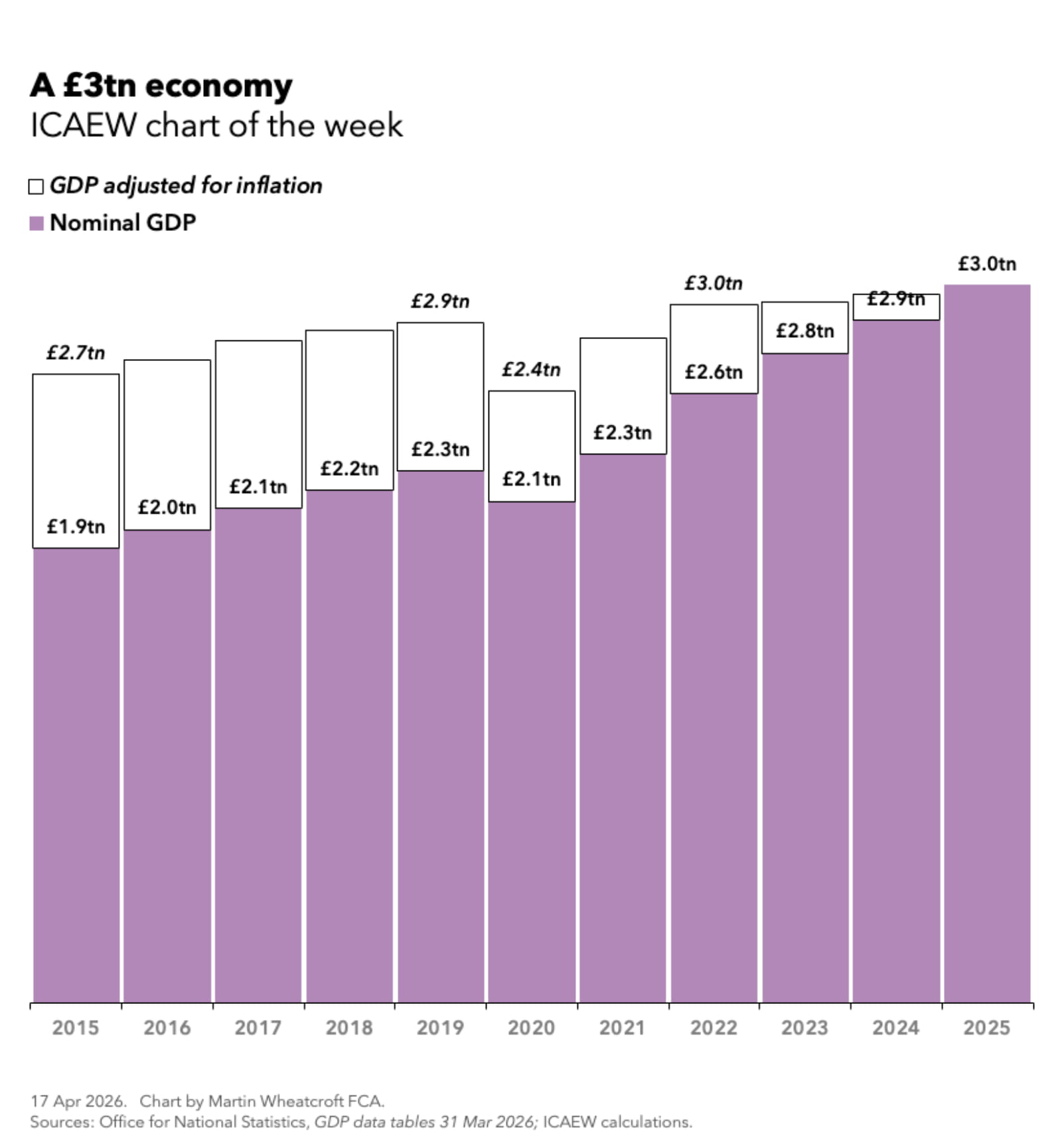
Our chart of the week is on gross domestic product (GDP), the principal measure used by statisticians and economists to assess the size of the economy.
The chart shows how nominal GDP (GDP at market prices in current values) was £1.9tn in 2015, rising to £2.0tn in 2016, £2.1tn in 2017, £2.2tn in 2018 and then £2.3tn in 2019. Nominal GDP fell to £2.1tn in 2020 (the first year of the pandemic) and then rose to £2.3tn in 2021, £2.6tn in 2022, £2.8tn in 2023, £2.9tn in 2024 and then £3.0tn in 2025.
This is a cumulative increase of 58% over 10 years (or 4.7% a year on average), based on nominal GDP of £1,928bn in 2015 and £3,040bn in 2025.
The chart also shows the increase is much less dramatic using GDP adjusted for inflation (GDP at market values on a chained volume basis or ‘real GDP’). Recalculated into 2025 values, GDP adjusted for inflation was £2.7tn in 2015, £2.9tn in 2019, £2.4tn in 2020 and just under £3.0tn in 2022.
As ever with economic statistics these numbers are all subject to revision as the ONS obtains new or updated data and, every so often, revises its methodology.
Analysing the increase
The 58% increase in nominal GDP over the 10 years to 2025 can be analysed as a cumulative 38% increase from inflation (using the GDP deflator ‘all economy’ measure of inflation) and cumulative economic growth of 14%, with the latter being further analysed into a cumulative 7% increase in the size of the population, and a cumulative 7% increase in average economic activity per person.
This is equivalent to a 4.7% per year average annual increase in nominal GDP over the decade, comprising 3.3% per year in average annual inflation and 1.3% per year in economic growth. The latter comprises a 0.7% per year annual rise in population and a 0.7% increase in average per capita economic activity.
Economic growth has been particularly weak over the past three years in particular, with a cumulative increase of 17.8% in nominal GDP comprising cumulative inflation of 14.6% and a cumulative increase of 2.8% in GDP adjusted for inflation (from £2,958bn in 2022 adjusted to 2025 prices to £3,040bn in 2025).
As the population is estimated to have increased by 2.7% between 2022 and 2025, per capita economic activity over the same period has in effect been flat over the last three years.
Unfortunately, the outlook for the economy is far from rosy given recent international developments and there is now a risk that nominal GDP could fall back below £3.0tn in 2026, despite what is likely to be a higher rate of inflation than previously anticipated.
Economy hub
Expert analysis on the latest national and international economic issues and trends, and interviews with prominent voices across the finance industry, alongside data on the state of the economy.

Latest charts
Further resources
ICAEW Community

Public Sector Community
The go-to place for guidance on issues affecting finance professionals working in and with the public sector. With a range of dynamic services, ICAEW provides valuable tools, resources and support tailored to the public sector.
ICAEW support

Training and events
Browse upcoming and on-demand ICAEW events and webinars offering support on technical areas, such as assurance, reporting and tax, as well as personal development.
Events and webinars A-Z of coursesLocal government finance

Skills for the future
Improving financial skills is critical in balancing the books and delivering value for citizens. As backstop dates for audited accounts come into force, ICAEW explores how local authorities can strengthen their approach to financial management.
Browse resources