
Key takeaways
- UK economic growth: May 2026 saw a small return to growth in the UK, largely driven by the services sector.
- Contraction in some sectors: construction and manufacturing sectors experienced a fall in growth across the same period.
- UK business confidence and geopolitical risk: geopolitical risks, such as the Iran war, have impacted UK business confidence.
- UK employment rate and labour costs: the employment is showing signs of slowing down in the UK, as businesses struggle with labour costs.
UK economy returned to growth in May 2026
UK GDP rose by 0.1% in May 2026, according to official figures, after a decline of 0.1% in April. This increase largely reflected stronger activity from a few industries within the services sector notably:
- professional, scientific and technical activities (including scientific research and development, and accountancy);
- health and social work; and
- administrative and support services (see chart 1).
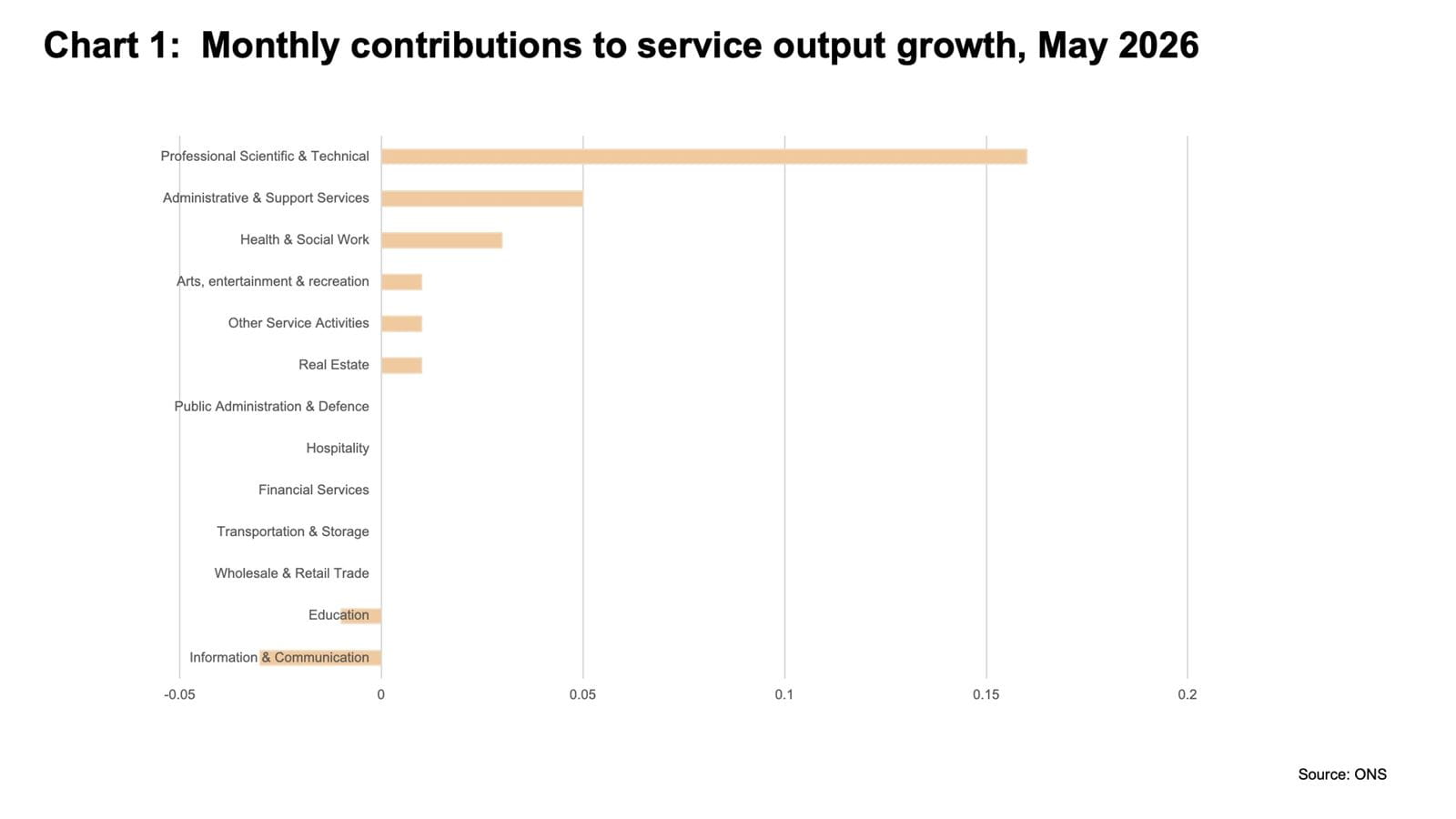
The service sector grew by 0.3% in May. In contrast, construction (-0.8%) and industrial production (-0.5%) fell in the same month.
May’s overall uptick is unlikely to have prevented slowing GDP growth across Q2, with the intensifying squeeze on incomes from elevated energy costs likely to hit June GDP, even with the World Cup boost to retail and hospitality.
UK business confidence falls to near four-year low
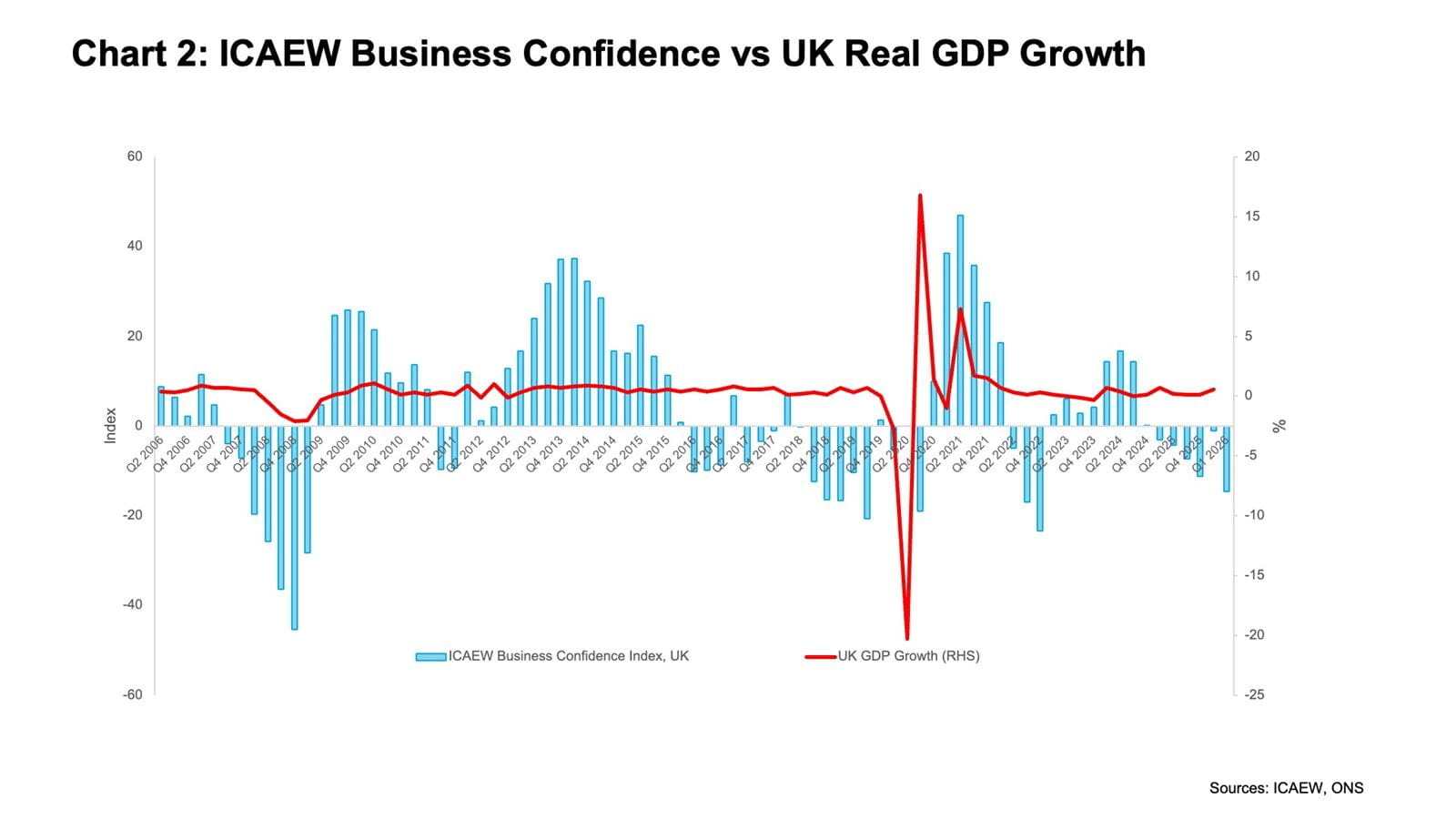
ICAEW’s Business Confidence Monitor (BCM) for Q2 2026 stood at -14.6 on the index in Q2 2026, the lowest reading since Q4 2022 and down from -1.1 in the previous quarter (see chart 2). Confidence has been in negative territory for six successive quarters – the joint-longest streak since the 2008 global financial crisis.
The fall in confidence reflected weaker expected sales activity and rising costs pressures, amid growing geopolitical turbulence. Projected growth in sales, gross profits and turnover for the year ahead all slowed in Q2 as concerns over customer demand increased.
Inflation will likely peak below 4%
Official figures revealed that UK inflation was unchanged at 2.8% in May, still well above the Bank of England’s 2% target (see Chart 1). The largest upward pressure came from motor fuels, which rose by 24.6% in May. The biggest downward pressure came from food inflation, which fell from 3% in April to 2.2% in May, the slowest rate since December 2024.
Although the MoU arrived too late to stop higher energy bills and food costs triggering a summer inflation spike, if oil prices continue to weaken, then a peak well below 4% is becoming increasingly plausible. Energy and other supply chains are likely to take months to normalise, and meaningful easing in inflation will likely be delayed until late 2026.
Businesses worry about geopolitical risks and labour costs
Geopolitical risks were the biggest growing challenge to performance, with 65% of companies citing this as an issue in the BCM report, likely reflecting the fallout from the Iran conflict.
Labour costs (58%) was the second most cited challenge amid the notable minimum wage increase during the survey period, followed by energy costs, with 55% of those surveyed seeing it as an issue in Q2, compared to 35% in Q1.
The closure of the Strait of Hormuz and rising fuel prices meant the share of businesses citing transport worries nearly doubled from 11% to 20%, the highest for more than two years.
In a further sign of the financial stress on businesses, 24% of firms cited late payments as a growing challenge, the highest proportion since Q1 2021. By sector, worries over late payments were highest among firms in construction (37%).
June inflation fall is a ‘false dawn’
Official figures suggest that UK inflation dropped from 2.8% in May to 2.6% in June, the lowest rate since March 2025. The US-Iran memorandum of understanding signed in June offered hope of a permanent end to the war. Meanwhile, the average price of diesel fell by 10.7 pence per litre between May and June 2026, and petrol prices dropped for the first time since the start of the conflict. Food price inflation stood at 1.7% in June, the lowest rate since August 2024 and down from 2.2% in May.
June’s slowdown is likely a false dawn for the UK economy, and it may have already been reversed during July. Higher energy bills, following Ofgem’s energy price cap rise, may have lifted inflation above 3%. Furthermore, the renewal of hostilities between the US and Iran have put the prospect of inflation reaching 4% later this year back on the table, despite October’s VAT cut on electricity bills.
UK jobs market is looking increasingly fragile
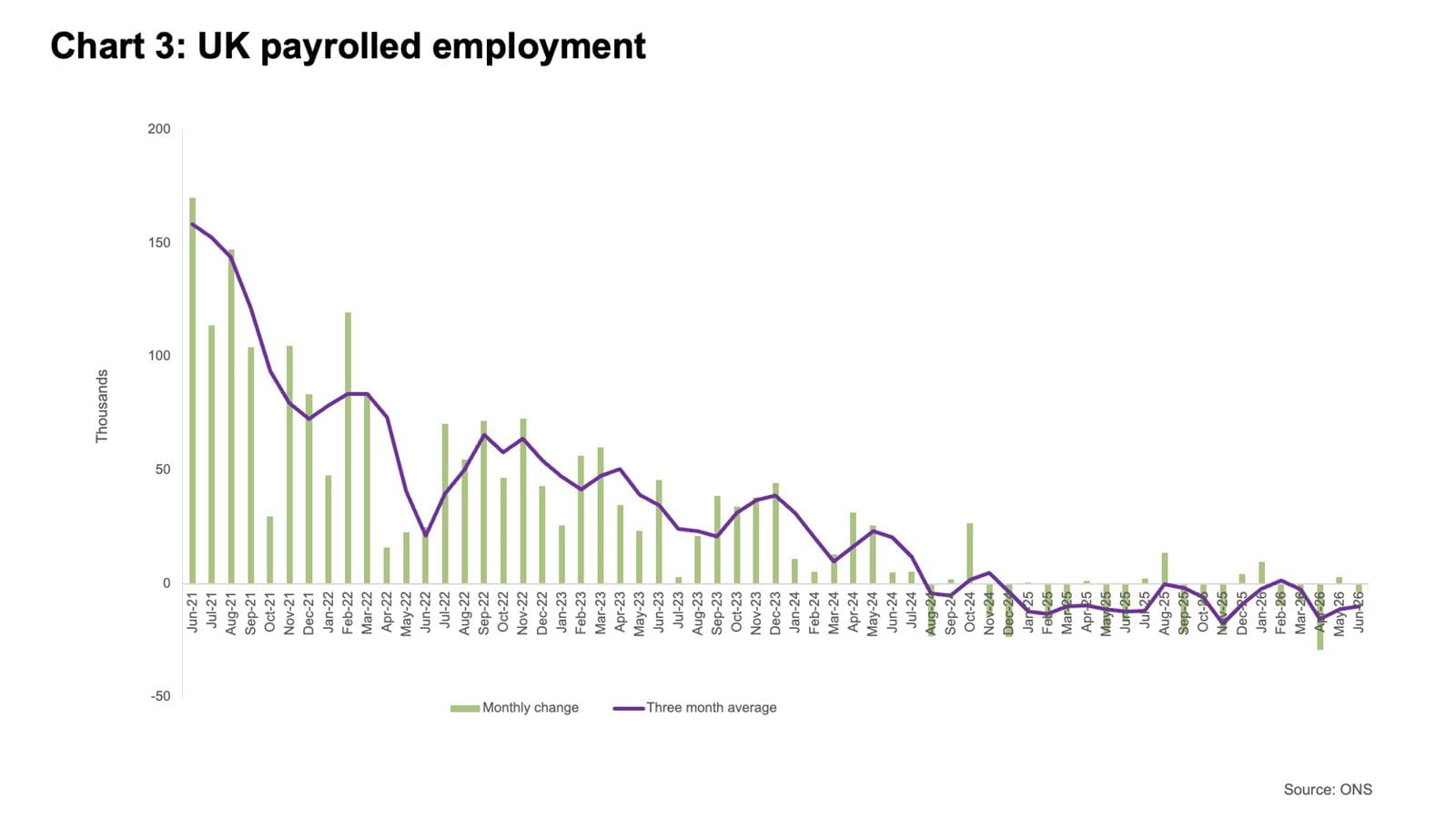
UK unemployment held steady at 4.9% in the three months to May 2026. HMRC data also revealed that the number of payrolled employees for June 2026 fell by 4,000 (see chart 3) to 30.3m.
Pay growth in the private sector slowed to 2.9%, its lowest rate since the three months to October 2020. The UK jobs market will probably face more strain over the summer. Unemployment is likely to edge higher as elevated cost pressures and weakening demand increasingly inhibits hiring, especially if uncertainty over future tax policy persists.
Implications for accountants, business owners and the economy
Overall, these figures may be as good as it gets for the new Prime Minister. The weakening forward-looking sales indicators reported in ICAEW’s latest BCM point to a difficult second half of the year for the UK economy, as the fallout from the US-Iran conflict continues to weigh on activity and increase inflation.
What to watch for next month:
- Quarterly GDP data to be released on 13 August, should confirm that UK GDP growth slowed in Q2 2026, following 0.6% growth in Q1 2026.
- Inflation figures for July, due out on 19 August, should see a sharp increase in the headline rate from the latest reading of 2.6% for June.
Read the full BCM results
The Q2 Business Confidence Monitor results highlight three major stress points for UK businesses: energy costs, labour costs and late payments.

Further support
Resources
Economy
Expert analysis on the latest national and international economic issues and trends, and interviews with prominent voices across the finance industry alongside data on the state of economy.
Visit the hubStay up to date

Subscribe to ICAEW podcasts
ICAEW podcasts help you to dissect the latest headlines and offer expert analysis on the key issues from across the world of business, finance and accountancy.
ICAEW support

Training and events
Browse upcoming and on-demand ICAEW events and webinars looking at the global economy and trade.
Events and webinars A-Z of CPD Courses