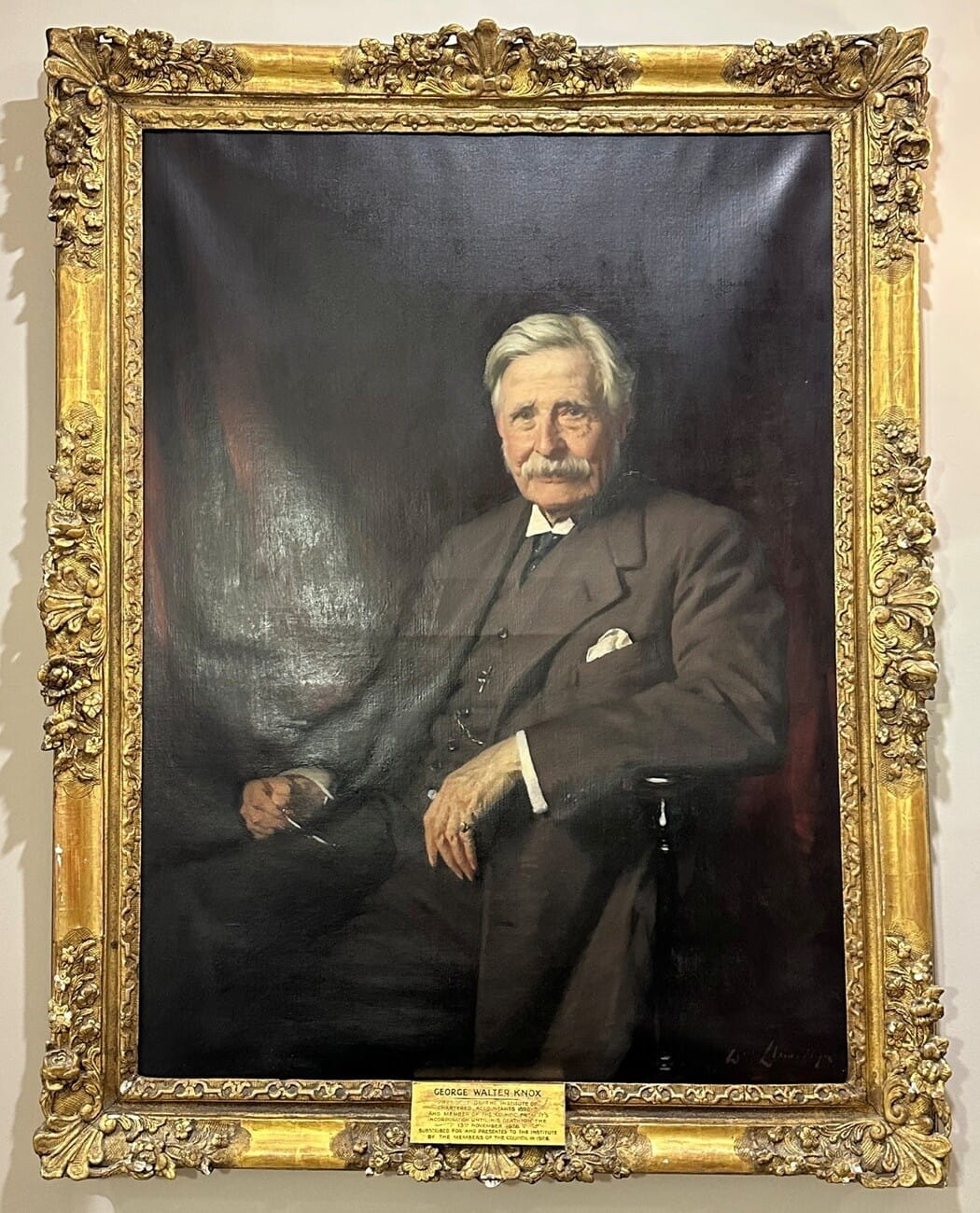
Despite this early success Knox abandoned his scientific career and began his professional career as a public accountant in Sheffield around 1870. He joined the Society of Accountants in England in 1872 and would go on to become its Vice President.
Sheffield was undergoing an industrial boom accompanied by rapid population growth when Knox began his career but the downturn in the economy in the 1870s had a disastrous effect. In 1874 there were a greater number of creditors’ meetings in Sheffield than in any other provincial town. Accountants were in high demand.
Knox was one of the 21 founder members of the Sheffield Institute of Accountants in 1877 which merged with four other professional bodies to form ICAEW. On its establishment Knox took up a position on the first ICAEW council and retained the seat for the rest of his life.
In 1884 Knox became the third President of the Sheffield Society of Chartered Accountants following its founding in 1882 and was elected as the first ICAEW President from outside London in 1896. In his presidential year ICAEW held its three day autumn meeting in Sheffield.
The high professional reputation saw Knox trusted with many high-profile engagements. He was auditor to the Midland Railway Co. for over forty years, and instituted the Salvation Army’s system of accounting, for which his firm acted as auditors. In 1912 he was appointed to help in the investigation of the accounts of David Lloyd George in the controversial ‘Marconi’ case of alleged insider dealing.
Throughout his career Knox was heavily invested in the education of students, spending 18 years on the ICAEW examination committee; was on the governing board of the University of Sheffield; and was President and Vice-President of the Chartered Accountant Students Society of London for many years.
Sir William Plender wrote an appreciation of Sir George Walter Knox which touched on the contribution he made to ICAEW and the commissioning of the painting:
"Mr. Knox was always a friend of the students. His interest in them was close and abiding, and among the Vice-Presidents of the London Students' Society he was the most often seen at the annual general meetings. He had a personal care for his articled clerks and helped them in preparing for examinations."
"He was a wise and sagacious counsellor, charitable in his views, never seeking popularity, and always modest and unassuming. The chair in which he sat on the right of the President in the Council Chamber is now empty, and his familiar face and gentle winning presence will be seen no more. The work he did for the Institute is beyond measurement, and can hardly be realised by the members generally who know but little of his services on the Council and on Committees. Those of us, however, who sat with him on the Council can appreciate his work and will deplore not only the loss of a helpful colleague but a close friend, whose affectionate and unselfish nature endeared him to everyone. There will happily be preserved for all time in the Hall of the Institute a portrait of Mr. Knox painted by Sir William Llewellyn, R.A., which the members of the Council subscribed for this year."
Knox sat for this portrait the day before he died, at the age of 84, on 13 November 1926.
Artist
William Llewellyn 1858-1941
Sir Samuel Henry William Llewellyn was a Welsh painter of the late 19th and early 20th centuries. He studied at the National Art Training School in London, and at the ateliers of Fernand Cormon, Jules Joseph Lefebvre and Gabriel Ferrier in Paris. He painted primarily portraits and landscapes in the grand academic tradition, and exhibited assiduously at the Royal Academy in London. Llewellyn was awarded the Albert Medal by the Royal Society of Arts in 1933.