Origins: a brainchild of the Library
When ICAEW launched its first website in June 1996, the internet was still unfamiliar territory for many organisations.
The UK Government had created open.gov.uk in 1994, BBC News Online launched in 1997, and Guardian Unlimited went live in January 1999.
ICAEW’s move online in 1996 thus placed it among the earlier adopters of the web, particularly among professional bodies.
The idea for the website originated in the Library and Information Service. Susan Moore, then Head of Library and Information Service, had been reading about the internet and discussing its potential with Barry Spaul of Exeter University. Susan and another member of the Library team, Neil Williams, visited Exeter to see how academic staff were using the web. Susan later recalled telling colleagues that “this will change everything for us!”.
This will change everything for us!
Early days: barebones, but functional
The first website was built with limited resources: Neil describes it as “pretty basic”, having been “done on a shoestring”. Nonetheless, it launched successfully.
Its main purpose was to provide information to members and other audiences, and did not have the interactive or community features that later became common.
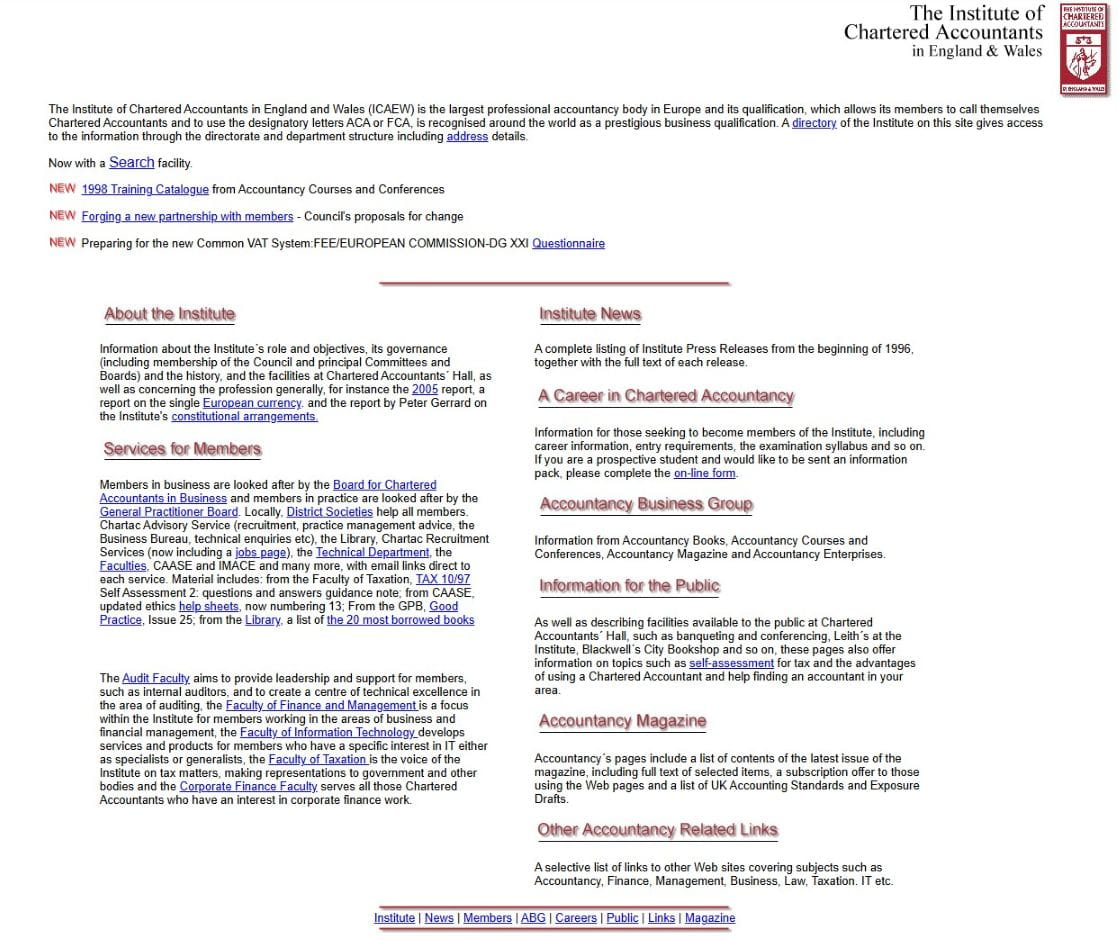
The site was launched at ICAEW’s annual conference in 1996, where Neil and Simon demonstrated it to visiting members. They also ran internal demonstrations around the same time, helping departments understand what the web could be used for.
Organisational adoption
What had started as a focused project led by two seconded staff soon became a wider organisational endeavour.
Having recognised the website's value as a new channel for reaching members, students and the wider public, the Communications department took on responsibility for its continued development in the years following its initial launch.
As the site became increasingly important to ICAEW’s communications, services and public image, several new dedicated teams were created to work on particular aspects of it. These included the Web Development team, the Library's web team, DPX (or Digital Product Experience), and the Content team. Each possessing their own skills and perspectives, they collaborated to shape the user experience, structure and editorial quality of the growing site.
For the Library, the website was an extension of existing enquiry work. It meant that the team could answer a member’s question once, then publish the answer online so that others could benefit. One early task was to turn a Word document of useful websites into the LIS Links Pages, which became the starting point for the Library’s web presence.
As more material went online, Library enquiries did not disappear, however. Rather, they became more complex as simpler factual information became easier to find.
Evolution: from directory to digital gateway
Over time, the site evolved from a largely text-based information directory to a more visual, service-led website.
In its initial form (as seen in the screenshot above), the website followed the conventions of the early web: plain white space, dense blocks of text, blue underlined links, simple section headings and the ICAEW logo positioned prominently in the top-right corner.
Gradually, its design became more sophisticated, incorporating images, navigation panes, branded colour schemes, and so on.
During its first decade, the site also saw a range of functional innovations, including the introduction of a members-only area, online payments, and online voting.
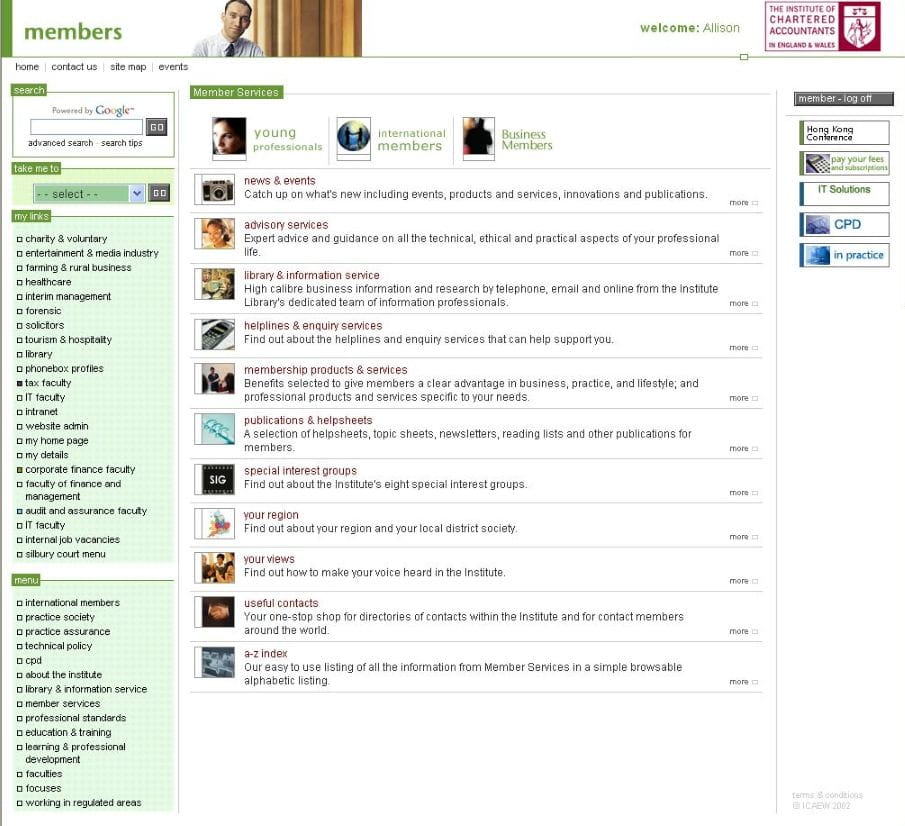
By the mid-2000s, the site had become more recognisably a corporate portal, and it hosted a range of online membership self-service facilities. Search, login, news, features and audience routes were more prominent, with right-hand navigation helping users move between sections.
The homepage was no longer simply a barebones directory of links and updates; it used colour blocking and clearly signposted distinct routes for different audiences.
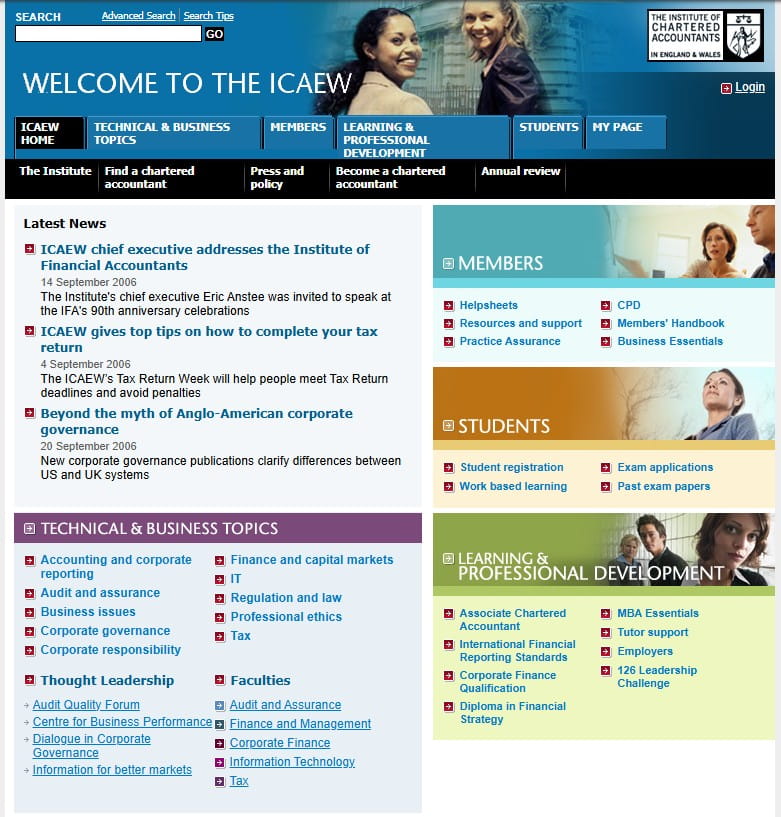
Meanwhile, the site had absorbed 23 previously separate websites which had been created for faculties, district societies, and other initiatives during the ‘wild west’ early days of the web.
Particular sections of the site thus developed their own character, as customised pages were produced for various member and student groups — though they remained united by common navigation, search tools and page structures.
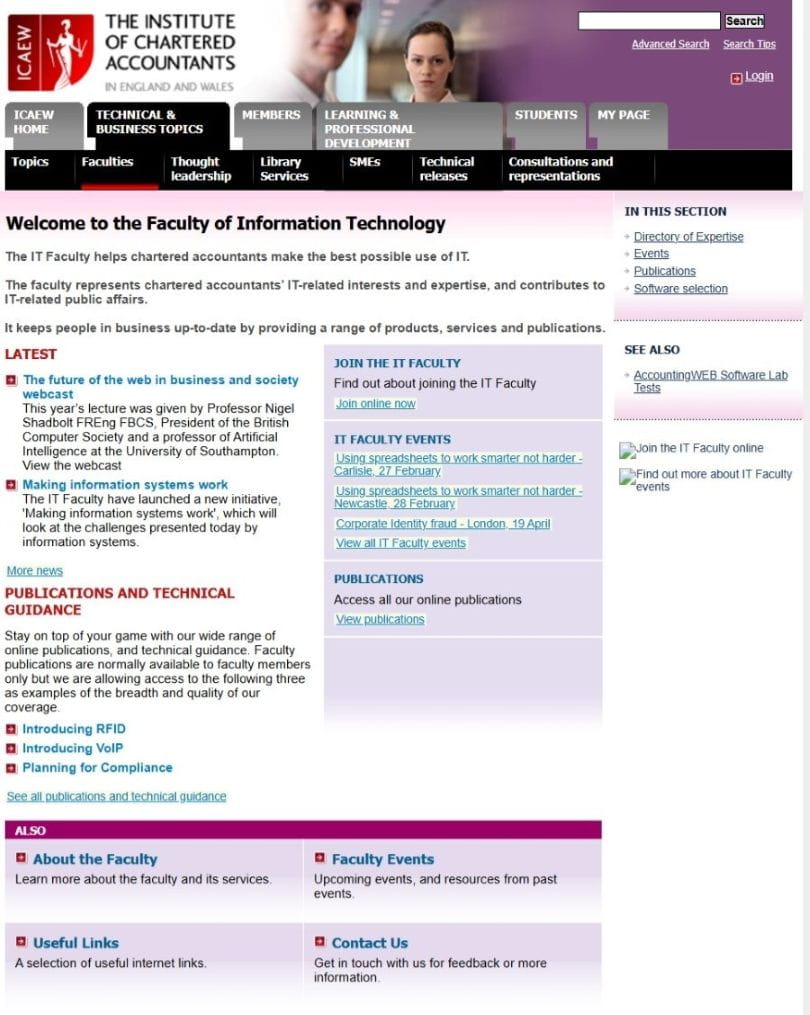
Having switched domain from icaew.co.uk to icaew.com in 2007, the site's design began to move towards a cleaner style, with more direct calls to action. From this time onwards, it increasingly came to serve as ICAEW's primary publishing channel, as the organisation moved to a digital-first model.
In 2008, the site gained a parallel mobile app, with the first version of the latter going live within three months of the launch of Apple's App Store.
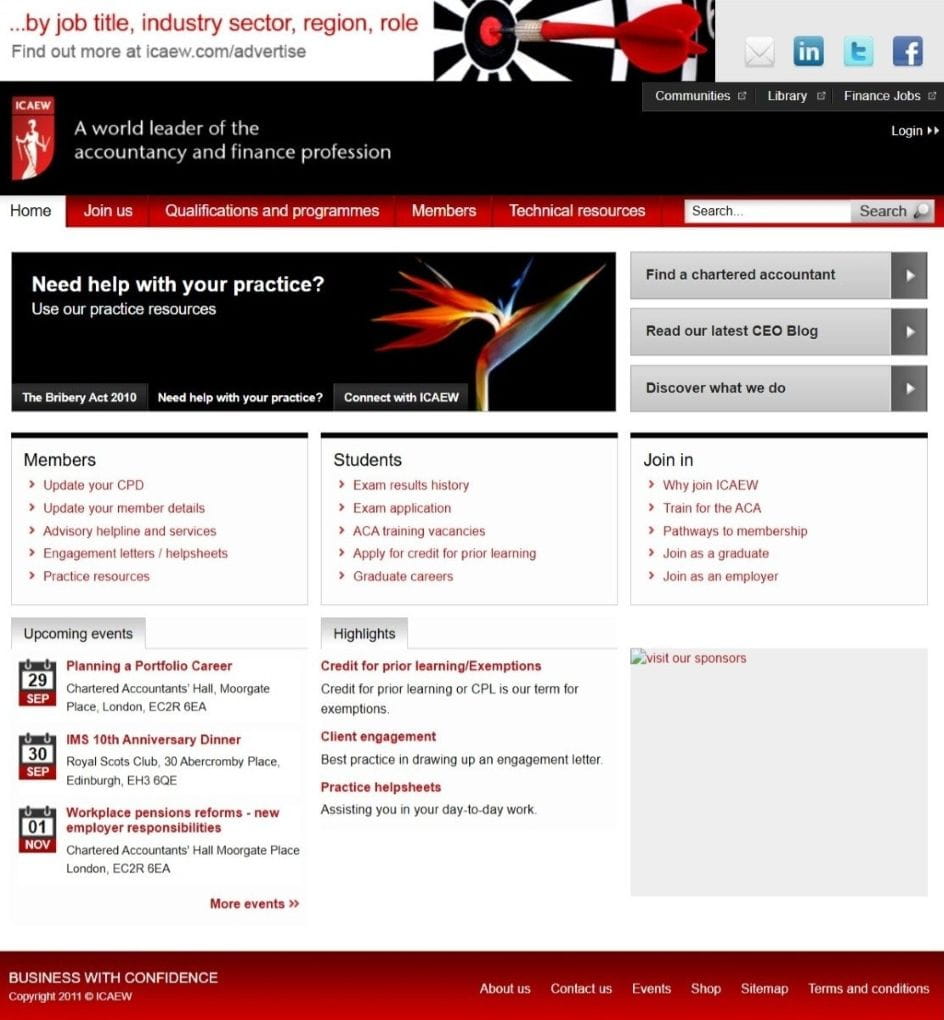
On the 2011 version of homepage shown below, a simpler style is evident. For example, links for members, students and prospective members are presented in three clear, prominent columns.
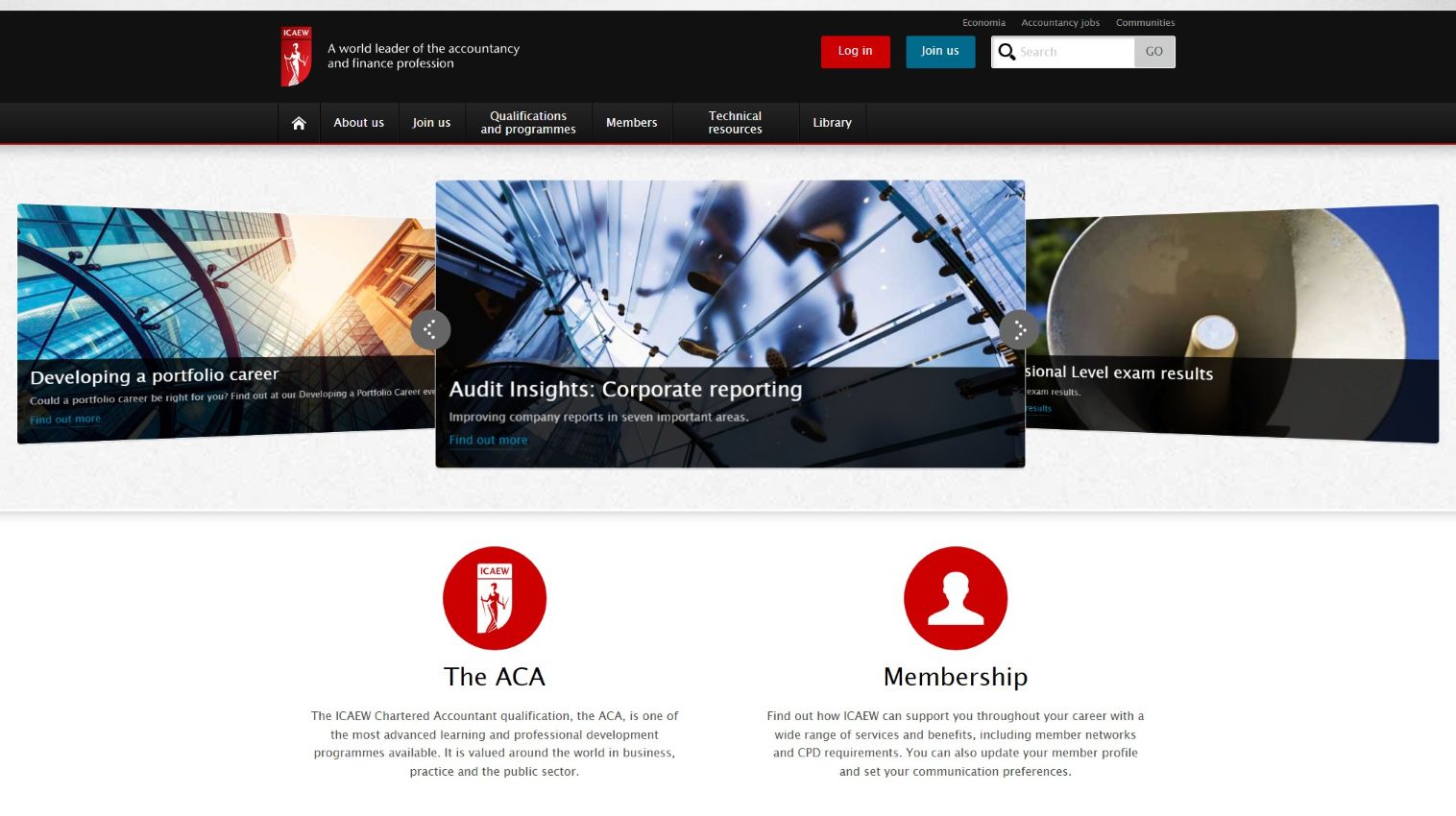
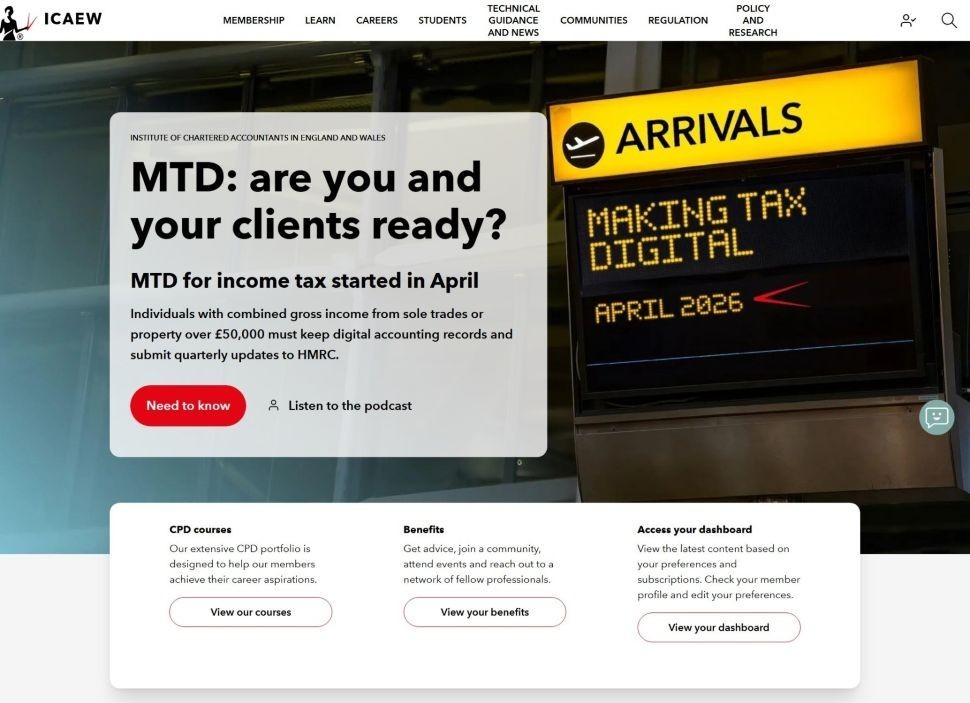
This tendency towards simplicity and directness had been taken further by 2016, with the homepage now featuring large promotional imagery, a stronger top navigation bar and clearer routes into two key sections: ACA and membership.
Beneath these design changes lay a great deal of technical work, as ICAEW moved to modernise the content management system (CMS) on which the site depended.
Vital underpinnings: taxonomy and metadata
As ICAEW’s web content grew and became more varied and complex, strong metadata and effective discovery became increasingly important.
In 2012, therefore, ICAEW undertook a Corporate Taxonomy and Metadata Project to unify its content classification system. The project – a three-way collaboration between the Library, IT and Digital teams – aimed, among other things, to improve information retrieval and to help create a better-structured website.
It resulted in the creation of a wide-ranging corporate taxonomy, covering entities such as organisations and locations; subject areas such as taxation, law, corporate finance and financial reporting; and filters such as content type, media format, publication, language and audience.
The taxonomy quickly became crucial to the functioning of the website, and has remained so ever since. Today, it is maintained and refined by the Library team on an ongoing basis.
Most importantly, it allows content to be classified, retrieved and delivered according to a consistent institutional model. It is the foundation for ICAEW’s system of automated web content classification, which helps content to reach the right pages on the website faster and more reliably.
ICAEW's experience of taxonomy creation was used as a case study in a book on the subject, generating much interest from other organisations seeking to implement their own solutions.
Innovation continues: the Digital Archive and AI
Thirty years after the launch of its first website, ICAEW continues to innovate in the realm of digital access and preservation.
Notably, the Library and Information Service is behind the ICAEW Digital Archive, a long-term project to preserve past ICAEW digital publications, digitised material from the Library’s print collection, and regular snapshots of the ICAEW website. It has two main strands: preservation of publications and audio-visual files, and six-monthly website captures.
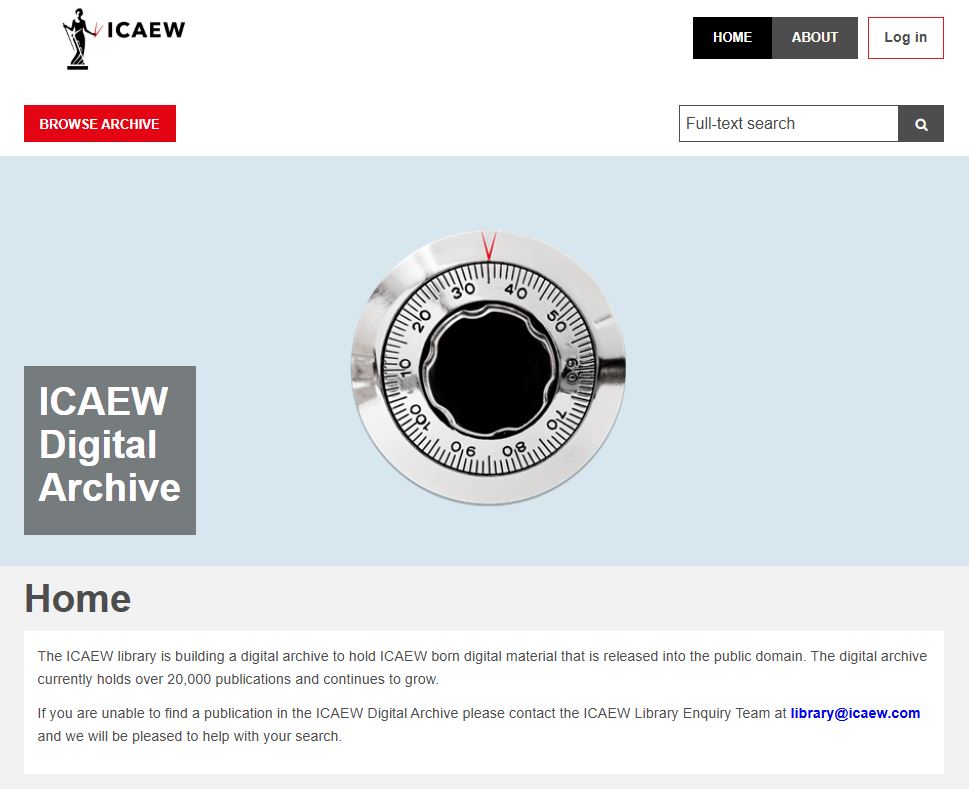
The Digital Archive helps ensure that material published on icaew.com is preserved for posterity, rather than being lost when pages are updated, replaced or removed. It also allows content that is no longer current to be taken down from the live site without disappearing altogether. This is increasingly important in the age of AI, as large language models may draw on old web content and present it as current, potentially producing misleading or incorrect responses.
In a move that once again places ICAEW at the cutting edge of digital innovation, the Digital Archive is using AI-assisted workflows to improve and augment its metadata, and thus enhance the discoverability of archived assets. More information can be found in a blog post on the Digital Preservation Coalition website.
Our commitment to improvement
What will the next 30 years hold for the ICAEW website? It's a tough question to answer. The pace of change in the last few years has been unlike anything we have seen since the early days of the internet and is already radically altering the information landscape. Users are now interacting with websites via AI tools in a way that we would never have imagined possible in 1996. However, the need for quality technical content hasn't changed.
ICAEW is committed to the continuous improvement of the website and always looking for ways to innovate. You can be sure that ICAEW will be ready to meet the needs of members and students whatever the future looks like.
Can't find what you're looking for?
The ICAEW Library can give you the right information from trustworthy, professional sources that aren't freely available online. Contact us for expert help with your enquiries and research.
ICAEW accepts no responsibility for the content on any site to which a hypertext link from this site exists. The links are provided ‘as is’ with no warranty, express or implied, for the information provided within them. Please see the full copyright and disclaimer notice.