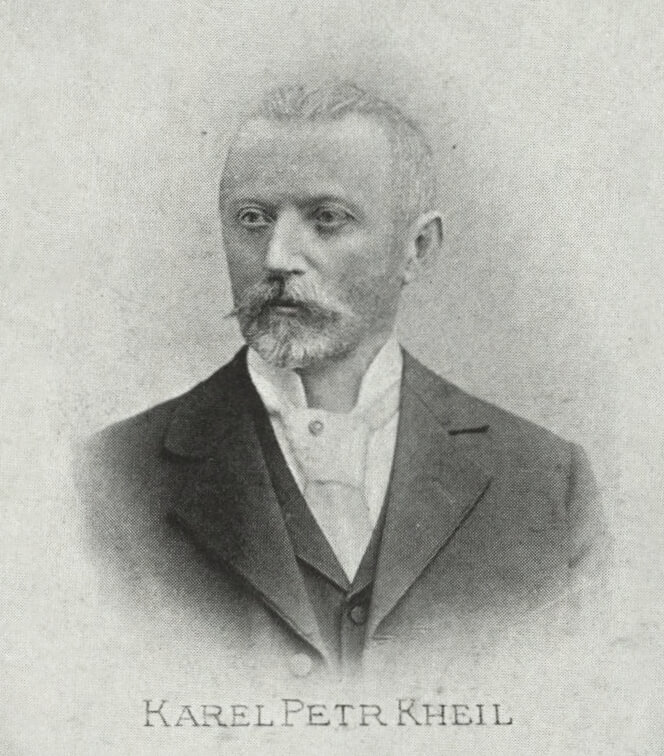
The Kheil collection was begun by Karl Peter Kheil Senior (1817-1881), a merchant and the Director of a private school of commerce in Prague. The author of numerous books on commerce we know little of the collection he formed but in 1860 it comprised over 1800 books on economics, commerce and book-keeping.
On his death in 1881 the library was shared by his two sons, Napoleon Manuel Kheil (1849-1923) and Karl Peter Kheil Junior, who inherited the major part. Like their father, both sons ran private schools of commerce, and both formed substantial libraries. The books they inherited must have been important parts of their collections. Napoleon Kheil's collection concentrated on commerce and after his death in 1923, one part went to the National Library, the other to the Academy of Commerce, both in Prague.
Karl Peter Kheil Junior built his library to number 10,000 volumes on commercial subjects with a special collection of historical books on book-keeping that amounted to over 1000 items in his inventory of 1903. By the time of his death in 1908 it had grown to over 1700 titles. The collection included works in all European languages and was intended to form the basis of a universal bibliography of book-keeping which was never finished and whose manuscript appears to have been lost.
The collection also provided the material from which Kheil wrote his many books and articles on the practice of book-keeping, and its history. One of his most notable works being the translation into Czech of the book-keeping section of Pacioli 's Summa. This was made from one of the two copies of the first edition of 1494 that he owned. A copy of the second edition of 1523 also being in the collection together with Casanova's rare Specchio Luciddissimo, 1550. The collection also included copies of Gottlieb 1531, one of the rarest of early German works; and was notably strong in Dutch and German books of the 17th century. There were about twenty-six books from before 1600 and over sixty from the 17th century. The most desirable item, however, was the copy of Peele's 'Maner and Fourme' 1553, the most perfect of the two known copies and the earliest surviving book on book-keeping by an Englishman.
On Kheil's death, his daughter, Mrs. Lotty Trakae-Kheil, who was his heir, asked the Dutch antiquarian bookseller Martinus Nijhoff to sell the library. He prepared a catalogue, and in July 1912 sent a copy to the Librarian of the Institute, Cosmo Gordon. Gordon was authorised by the Library Committee to travel to The Hague and inspect the collection and to offer not more than £350 for it. On his arrival in Holland he discovered that the collection was still located in Prague and that the sellers did not wish to dispose of the collection of historical books separately from the large library of books on commerce. The price required was £4000; this was far more than Gordon thought the library was worth, even had the Institute wished to acquire, or had the space to accommodate, 10,000 books on commerce. He asked Nijhoff to contact him if Mrs Kheil changed her mind. In April of the following year Nijhoff advised him that he had not been able to sell the library to anybody else as Mrs. Kheil would not lower the price. Gordon wrote to Dr. Vanek, Mrs. Kheil's secretary, and informed him that:
The Council [of the Institute of Chartered Accountants] still wish to buy the book-keeping portion and I think you will admit that the library of the Institute would be a fitting home for Dr. Kheil's splendid collection. The Council have decided to offer £500 for the book-keeping collection alone and if I can personally inspect the books and report favourably it is possible that they might make a rather larger offer.
Vanek replied that he had persuaded Mrs. Kheil to lower the price for the book-keeping portion of the library, including the historical books, from £2500 to £1600 and in November of 1913 Gordon set off for Prague to see the collection, doubtless hoping to secure a further reduction in the price since he had been authorised to offer a maximum of £750. At the meeting of the Library Committee on 7th January 1914 he reported that he had succeeded and that he had purchased the collection for £690. With this purchase the Institute was able to complement what was already a good basic collection with a collection very strong in European material. As the Kheils had been familiar with the works on book-keeping of many of their contemporaries, and had made extensive purchases of books in West and East European languages this had given the library a unique collection.
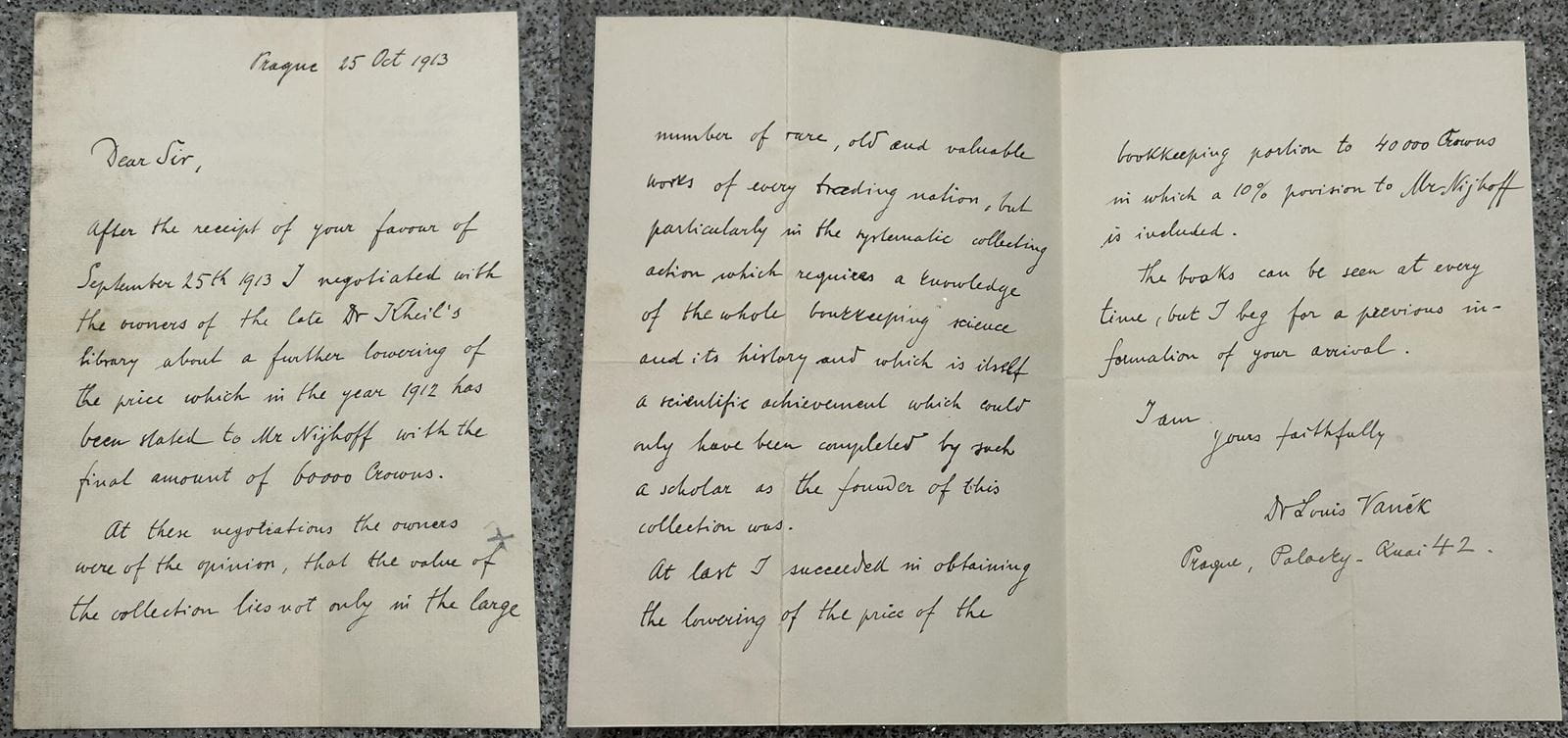
At last I succeeded in obtaining the lowering of the price of the bookkeeping portion to 40,000 crowns in which a 10% provision to Mr Nijhoff is included.
As soon as the collection had arrived at the Institute, Gordon was instructed to prepare a supplement to the 1913 catalogue to include the collection. Unfortunately the intervention of the First World War, during which Gordon served in the Army, prevented the realisation of this project until 1937 when a two volume catalogue appeared; volume 1 being devoted to the historical collection as a whole. Gordon checked all of the Kheil collection in the British Museum [today, the British Library] catalogue and found that out of the total of 1634 books in the Kheil collection only 187 were in Europe's largest library. Gordon also paid tribute in the preface to his catalogue of the impetus given to building the collection by Pixley, the long serving Chairman of the Library Committee. Pixley died shortly after retiring in May 1933 and was unable to see the main acquisition made in December 1933 of the Ympyn's Nieue Instructie, Antwerp 1543, one of the only three copies and the basis, in translation, of the second book on book-keeping published in English.
Since the acquisition of the Kheil collection the library has continued to purchase historical books although the opportunity rarely arises to acquire material of great rarity that we do not already possess. A small collection was fortuitously acquired in 1957 when the Institute amalgamated with another body of accountants, the Society of Incorporated Accountants which had been founded in 1885. The Society possessed a small library including a collection of about 150 books published before 1885, Many of these had been presented to the Society by their members, (who have also been an important source of material for the Institute collection) and the collection included a copy of the rare 1596 edition of 'Patheway to Knowledge' and an incomplete second copy of Mellis.
This article is an extract from a lecture given by Michael Bywater at the 37th Congress of the Japan Accounting Association on 13 September 1978.