Acknowledging earlier traditions of economic record-keeping
One work in the collection, James Warden Urquhart's An introduction to British Indian book-keeping by single and double entry (1853), is notable for drawing attention to India's longstanding practices of commercial and financial documentation, which the author presents as being in continuity with the modern practice of accounting.
In his preface, Urquhart pitches the treatise as an “elementary work on Book-keeping, adapted to the commerce and currency of India”. In his view, such a work was “much required”, given that the “few good works on Book-keeping published in England, are practically unsuited to this country”.
However, this should not be taken to imply that he regarded systematic accounting as something new to India. On the contrary, he states:
The invention of Double Entry cannot be claimed by the Italians; for, in the opinion of the writer, the Hindus made use of a Journal, Khusra [sic], in their system of Book-keeping more than 20 centuries ago.
Furthermore, he cites the "Code of Manu" (the Manusmriti), with its rules on "pecuniary transactions and engagements", as additional evidence of an ancient "knowledge of Accounts" in India.
Although more recent scholarly works suggest that some of Urquhart’s historical conclusions ought to be read cautiously (the claim that a double-entry system of book-keeping existed in India pre-Pacioli has been the subject of considerable debate), he was clearly right to recognise India’s deep-rooted traditions of economic record-keeping – as evidenced by the Arthaśāstra, among many other sources.
Adapting modern double-entry book-keeping to Indian commercial customs
Our collection includes a number of accounting 'manuals' published in India during the nineteenth century. A significant feature of many of these works is an attempt to place modern double-entry book-keeping in a distinctively Indian context, and to adapt it where necessary to reflect the customs and practical requirements of Indian commerce.
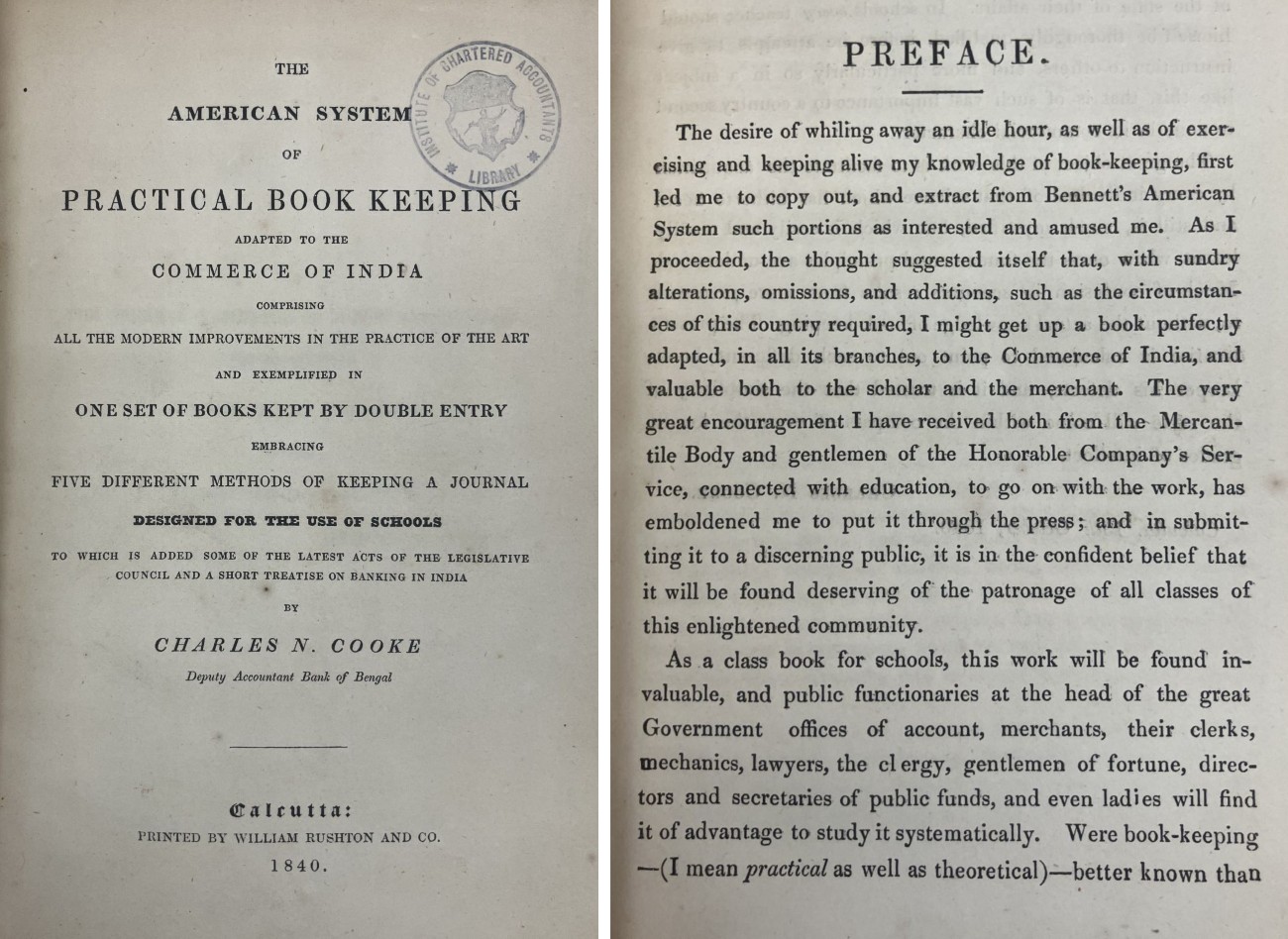
One such work is Charles N. Cooke's reworked version of Bennett’s American System, published in Calcutta in 1840. In the book's preface, Cooke (then Deputy Accountant at the Bank of Bengal) writes of how it was born of a desire to produce a work “perfectly adapted, in all its branches, to the Commerce of India”. Achieving this goal, he tells us, meant making “sundry alterations, omissions, and additions, such as the circumstances of this country required”.
Several specific examples of how the double-entry system was adapted to reflect Indian commercial practice can be found in Urquhart’s aforementioned introduction to British Indian book-keeping. Perhaps most notably, the model mercantile accounts presented in the book are based on the “voucher system” which, according to the author, was at that time “prevalent in almost every house of business in India, as well as in all Governmental Offices of Accounts”.
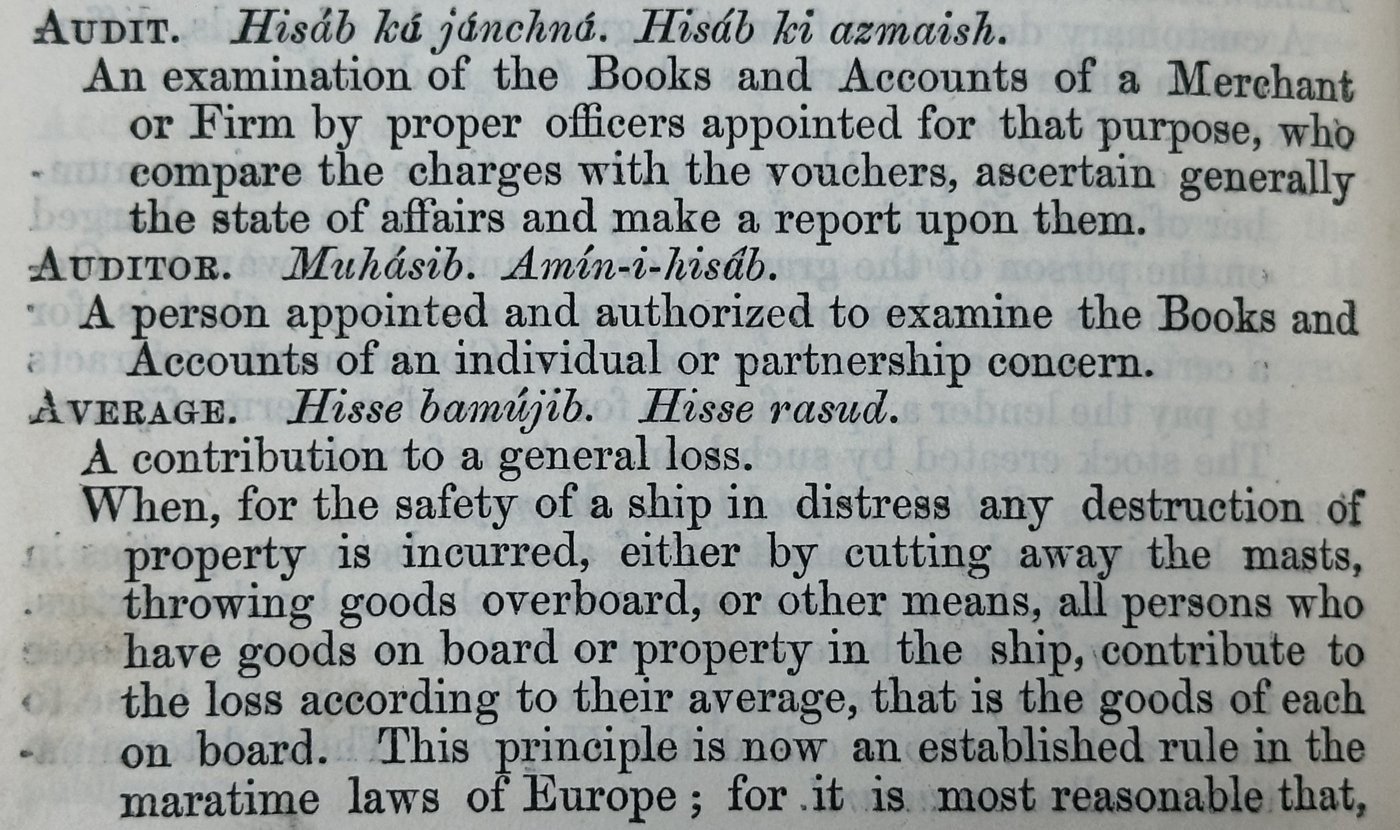
Urquhart’s work also includes a dictionary of English commercial terms, presented alongside their respective Hindustani translations. An extract from this dictionary can be seen in the image below.
Formalisation and early professional organisations
Some later works in the collection provide evidence of how modern accounting methods came to be standardised and institutionalised in India through formal instruction and examination, and how accountants around the country began to organise themselves into professional bodies.
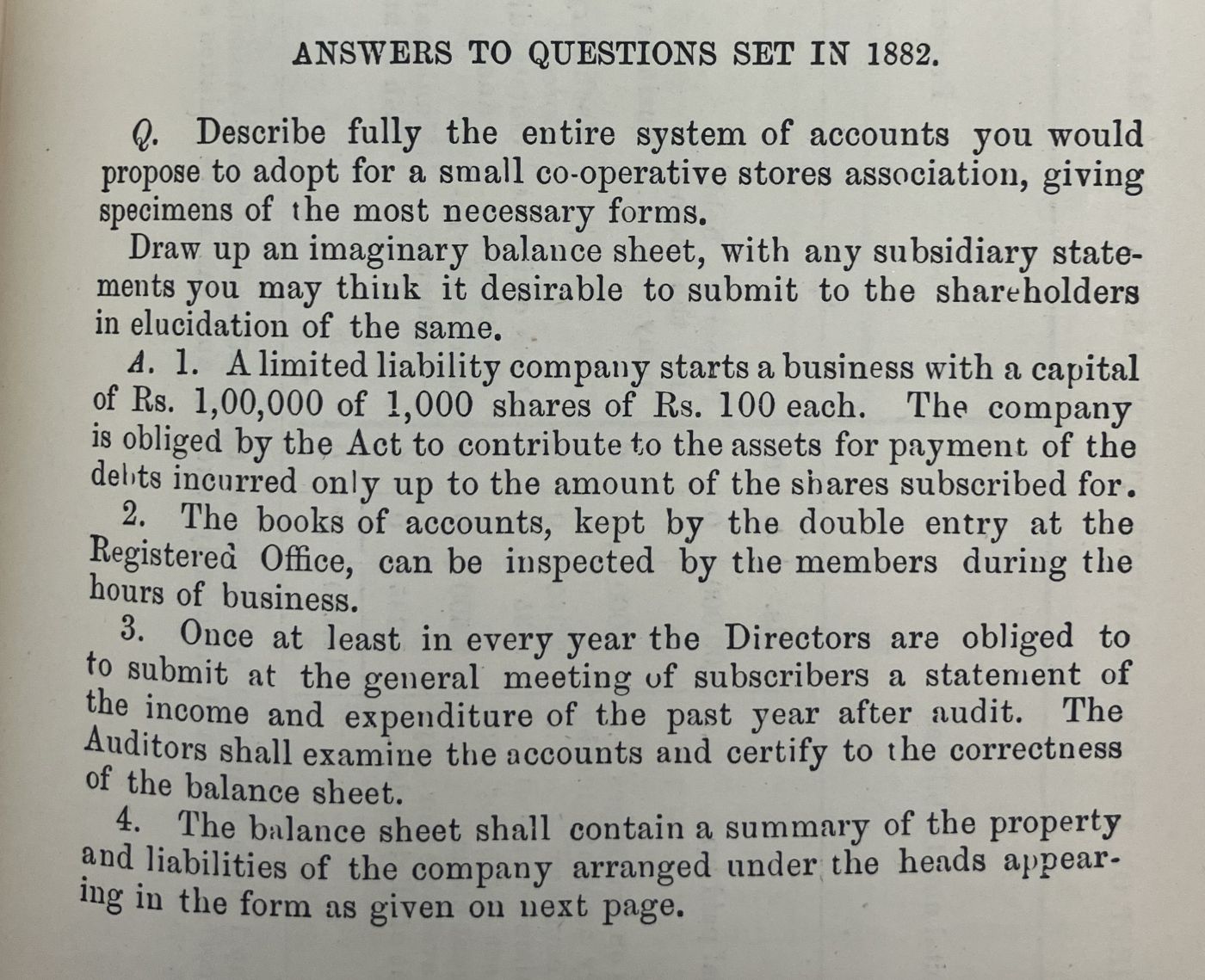
C. J. Michôd’s Book-keeping: a manual for the use of schools in India (1890), for example, includes a range of practical exercises intended to test students’ knowledge and understanding. Meanwhile, S. George’s A guide to book-keeping by single and double entry (published in Calcutta in 1893) includes answers to examination questions which had been put to candidates for promotion in the Public Works Accounts Department in Bengal.
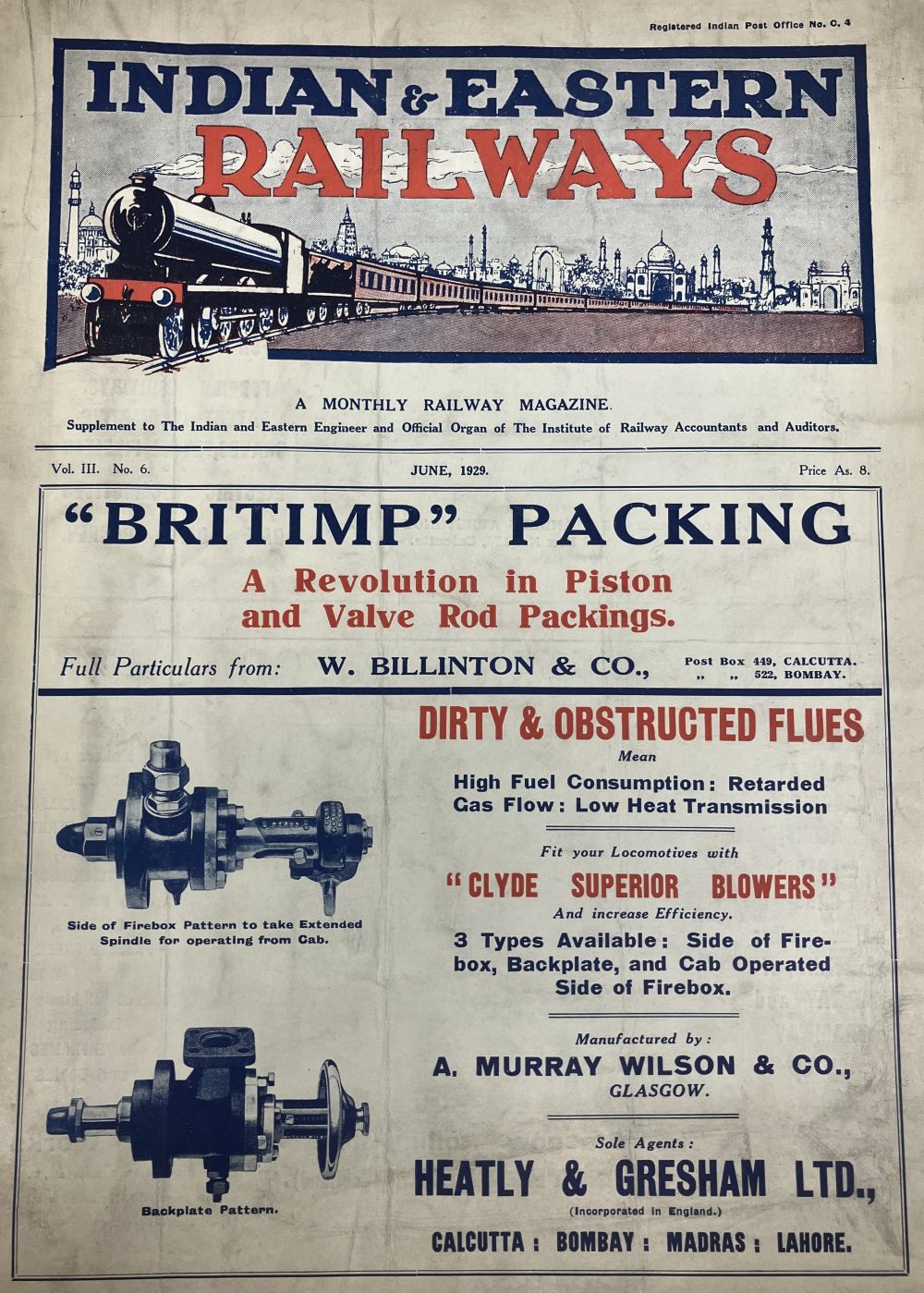
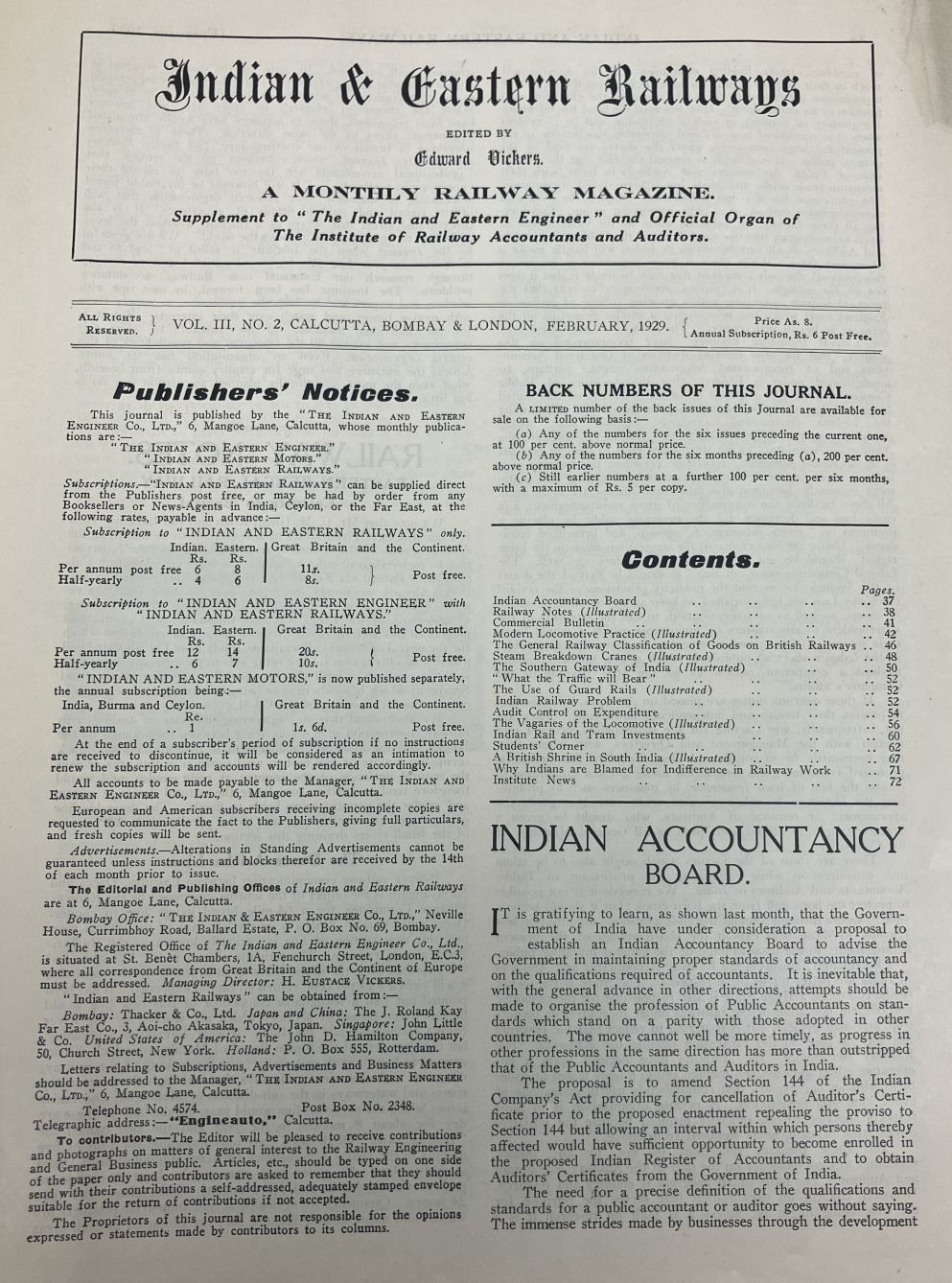
In 1927 one early Indian professional body was established in the form of the Institute of Railway Accountants and Auditors. Soon after, it began producing Indian and Eastern Railways, a monthly magazine covering various matters likely to be of interest to the Institute’s members. As well as discussing technical issues, it commented on burgeoning efforts to organise and further the accountancy profession in India.
In February 1929, for instance, the journal welcomed a proposal for the creation of an Indian Accountancy Board, to advise the government on standards and qualifications. The Board was eventually established in 1932.
I have followed with interest the progress of the Institute and would like to lay some stress on its value to the Accounting Profession, particularly in its relation to the Railways of India.
Dickinson’s involvement illustrates the international reach of ICAEW Chartered Accountants at that time. Simultaneously, however, the journal – much like the other works discussed above – places such international connections within a wider story of steady professionalisation rooted in the particularities of India itself.
Taken together, the works discussed here serve as evidence not of simple one-way transmission, but rather of a “matrix of interconnections” (Peers and Gooptu, 2012) and a complex process of adaptation, exchange and development.
Further resources
For details of other rare books in our collection relating to the history of accountancy in India, please see the rare books catalogue:
Enquiries about the rare books collection, including requests from researchers wishing to consult particular works, should be addressed to the Library by phone on +44 (0)20 7920 8620 or by email at library@icaew.com. Requests for access must be submitted in advance.
Interested readers may also wish to consult related works in our wider collection, including:
- The Kautiliya Arthasastra, edited by R. P. Kangle (Bombay University Press, 1965-1972).
- The beginnings of accounting practice and accounting thought, by R. Mattessich (Garland, 2000). This book contains chapters examining the treatment of accounting, budgeting and taxation in Kautilya’s Arthaśāstra, and the significance of medieval Indian mathematics for accounting.
- Accountancy and empire: the British legacy of professional organization, edited by C. Poullaos and S. Sian (Routledge, 2010). This book contains a chapter on the influence of empire and cultural imperialism on the establishment of the Institute of Chartered Accountants of India after independence.
To find out how you can borrow books from the Library please see our guide to borrowing books.
You can obtain copies of articles or extracts of books and reports through our document supply service.
Can't find what you're looking for?
The ICAEW Library can give you the right information from trustworthy, professional sources that aren't freely available online. Contact us for expert help with your enquiries and research.
ICAEW accepts no responsibility for the content on any site to which a hypertext link from this site exists. The links are provided ‘as is’ with no warranty, express or implied, for the information provided within them. Please see the full copyright and disclaimer notice.