The results demonstrate a positive commitment to continuous improvement, while highlighting opportunities to strengthen independence and documented follow-up.
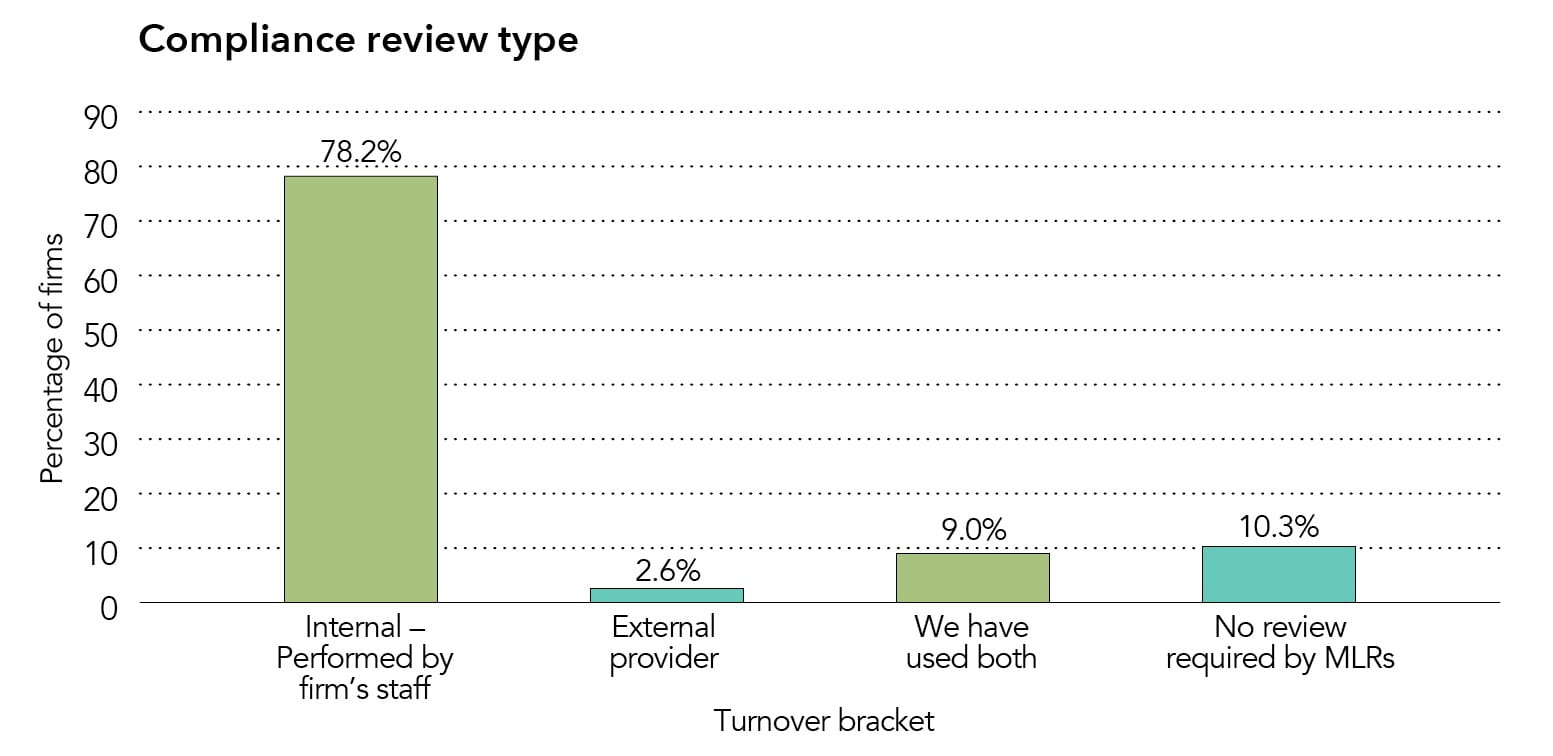
How do firms approach AML compliance reviews?
Independence can be built into in-house reviews: firms used peer review, structured checklists, sample-based testing and senior oversight to strengthen objectivity and critical challenge.
Internal reviews can be just as effective: 50% of firms conducting internal-only reviews identified areas for improvement, the same proportion as firms using external-only reviews. This provides assurance that internal reviews can be effective when carried out with appropriate independence and scepticism.
What makes an effective AML compliance review?
- Build independence into internal reviews – use peer review, objective checklists, sample testing and senior oversight to provide effective challenge
- Focus on effectiveness, not tick-box compliance – in-house reviews should critically assess whether AML procedures are working in practice.
- Review the firm-wide risk assessment – check that it remains current, captures relevant money laundering and terrorist financing risks, and is supported by effective controls.
- Check the whole AML framework – reviews should cover policies and procedures, key AML roles, internal reporting arrangements, staff training and record keeping.
What do the regulations say?
Regulation 21 (c) of the MLRs requires all relevant firms to:
Establish an independent audit function with the responsibility:
- to examine and evaluate the adequacy and effectiveness of the policies, controls and procedures adopted by the relevant person to comply with the requirements of these Regulations;
- to make recommendations in relation to those policies, controls and procedures; and
- to monitor the relevant person’s compliance with those recommendations.
We refer to this process as an AML compliance review.
Our expert

Sandy originally trained with Ernst & Young, where she qualified as a chartered accountant. She then had operational roles in industry, including a few years at the BBC. This was followed by a stint as a sole practitioner which helped her to appreciate the many challenges faced by smaller firms. After 14 years as a quality assurance reviewer she now works in the AML supervisory team at ICAEW. Although her role does encompass monitoring firms' compliance with the Money Laundering Regulations, a large chunk of it is dedicated to providing guidance to our member firms.