Q2: Business confidence in Scotland drops sharply into deep negative territory.
The latest national Business Confidence Monitor (BCM) shows that the Iran War significantly dented confidence as it dropped to a near four-year low and suffered its sixth successive negative quarterly score. Companies reported rising costs pressures, weaker expected sales and profits growth for the coming year, while late payment concerns hit a five-year high.
The survey results are based on 1,000 telephone interviews among ICAEW Chartered Accountants covering a range of UK sectors, regions and company sizes, ensuring a representative picture of the UK economy. The latest quarterly findings are based on the period 13 April to 19 June 2026.
- Business confidence in Scotland dropped back into negative territory, falling to -21.1 from +2.1 in Q1 2026, below the historical norm (+5.7) and below the UK average (-14.6).
- Amid widespread concern about geopolitical risks, annual domestic sales and exports growth were both subdued and lagged behind the UK average.
- Energy costs were the most widely cited rising challenge, and annual input price inflation rose in Q2 2026, with profits growth slowing sharply.
- Annual wage inflation eased and companies predict the rate of pay rises will slow notably over the next 12 months alongside lower employment growth.
- Companies plan to pare back the rapid capital investment growth recorded over the last year but still expect to outperform the UK, while also intending to strengthen R&D spending.
Business confidence in Scotland
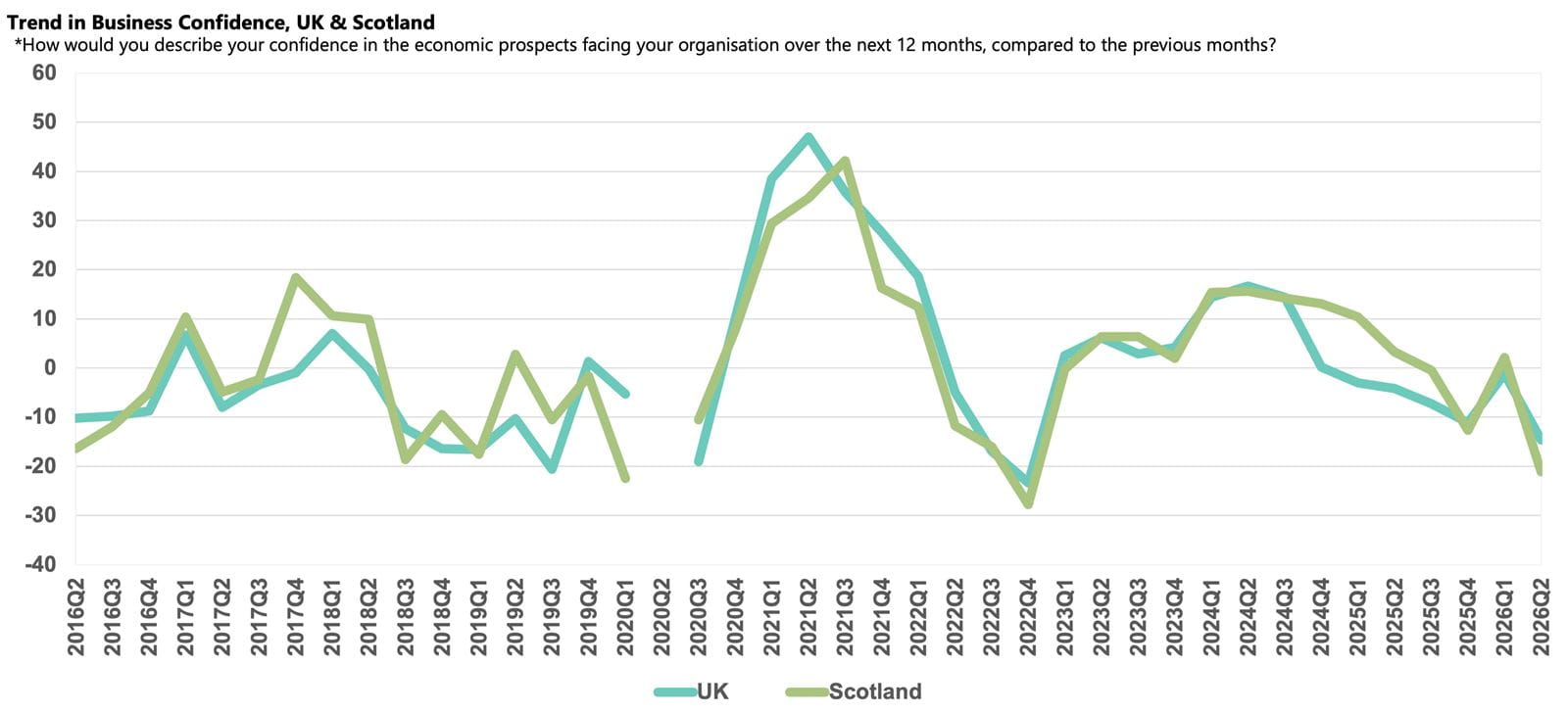
Sentiment among Scottish businesses dropped sharply into negative territory in Q2 2026, with the Business Confidence Index falling from +2.1 in Q1 2026 to -21.1. Confidence among Scottish businesses was significantly below the historical norm (+5.7) and below the UK average (-14.6).
The Iran War, which broke out at the end of February 2026, and the subsequent closure of the Strait of Hormuz, pushed up energy and oil prices and weighed heavily on sentiment among Scottish businesses this quarter, with the drop in confidence more pronounced than the UK-wide decline. The Middle East conflict placed additional pressure on Scottish exporters with the ONS BICS survey in May finding that 12.1% of all Scottish businesses reported some impact of US tariffs, with the figure rising to 35% for goods exporters.
Scotland’s economic growth was already subdued compared to the wider UK in the first quarter of 2026, with GDP growth expanding by just 0.1% compared to UK growth of 0.6% over the same period. Meanwhile, the Scottish Parliament election in May produced a more fragmented Holyrood, with the SNP falling short of a majority, making cross-party negotiation and policy uncertainty more likely.
Domestic sales and exports growth
Annual domestic sales growth in Scotland stood at just 1.6% in Q2 2026, the weakest expansion of any part of the UK, slowing from the previous quarter and below both the historical norm (3.0%) and the 3.6% rate recorded nationally. The slowdown likely reflects weaker growth reported by Energy, Water & Mining and Manufacturing & Engineering this quarter. Scottish companies expect a notable uplift over the next 12 months, projecting 4.6% growth, broadly comparable with the 4.7% rise forecast nationally.
Annual exports growth in Scotland was steady in Q2 2026 at 2.7% but remained below both the historical norm (2.9%) and the 3.1% rate recorded nationally. Export growth was likely held back by softer US demand for Scottish whisky and salmon as a result of US tariffs. Businesses are optimistic that exports growth will gain momentum, predicting a rise of 4.6% over the coming 12 months, compared with 4.0% forecast nationally.
Business challenges
The widespread disruption caused by the conflict in the Middle East is evident in the growing challenges reported by Scottish businesses in Q2 2026. Energy costs were the most widely reported rising challenge in Q2 2026, cited by 65% of companies and the highest share of any UK region. Citations were up from the previous quarter and above the national average (55%). Geopolitical risks were added to the survey this quarter and the concern was reported as a rising challenge by 61% of companies, slightly below the national average (65%).
There are numerous other challenges that remain prominent concerns for businesses and are also likely to have contributed to the sharp decline in confidence during the quarter, including regulatory requirements (50%), labour costs (50%) and competition in the marketplace (48%). The latter was more widespread than found in any other part of the UK, while there was also an uptick in reports of customer demand (43%) as a growing challenge, which is higher than the Scottish norm (34%).
Input and selling prices, and profits growth
Like most other parts of the UK, Scottish businesses reported an up-tick in annual input price inflation in Q2 2026, rising to 4.2% and slightly above the UK average (4.1%). While businesses expect a slight moderation over the next 12 months to 4.0%, the projected rise is significantly higher than the recorded historical average (2.7%) and above the UK projection (3.8%).
There was further evidence from BCM that companies in Scotland are absorbing some of their input cost rises rather than passing them on to customers. Despite the uptick in input inflation in the quarter, annual selling price growth in Scotland moderated to 2.8% in Q2 2026. While price inflation remains higher than the historical norm (1.6%), companies plan to ease price rise growth slightly over the year ahead to 2.7%, compared to 2.4% nationally.
Rising cost pressures and slowing sales growth has impacted profits growth for Scottish businesses in Scotland in Q2 2026. Growth slowed to 1.0%, lagging behind the 2.8% rate recorded nationally. Businesses expect profits growth to accelerate notably over the next 12 months, to 4.9%, compared with the 4.7% rise forecast nationally, lifting growth above Scotland’s historical norm (3.4%).
Labour market
Businesses reported annual employment growth of 1.4% in Q2 2026, matching the UK rate, and above the Scottish historical norm (1.2%). But there is evidence from BCM that labour market conditions remain challenging for companies, and they plan to ease jobs growth over the coming year to 0.9%, compared with the 1.5% rise forecast nationally.
Annual wage growth in Scotland eased to 3.0% in Q2 2026, broadly in line with the 3.1% national rate, but remained elevated compared to the historical average (2.2%). Businesses predict annual wage growth will slow notably over the next 12 months to 2.3%, compared with the 2.7% rise forecast nationally. However, concern about the availability of management skills was reported by 27% of businesses in the region, the highest incidence in the UK.
Capital investment and R&D
Annual capital investment in Scotland expanded by 3.9% in Q2 2026, accelerating sharply from the previous quarter and outpacing both the region's historical norm (2.1%) and the 2.7% rate recorded nationally. The fast pace of growth was likely linked to investments in the Energy, Water & Mining sector. While companies anticipate a notable slowdown, planned growth of 2.6% is higher than projected nationally (1.8%).
Annual R&D budget growth in Scotland slowed to 1.3% in Q2 2026 and dropped below both the region's historical norm (2.0%) and the 2.0% rate recorded nationally. Businesses expect R&D growth to edge higher over the next 12 months to 1.8%, matching the UK projection.