How could a profession that had undergone so much turbulence and upheaval for six years regroup and decide what it should look like in a country that, while victorious, was itself crawling out of the rubble?
First, as befits the profession, there were costs to be counted.
Pride and sacrifice
On one side of the ledger, the profession had much to be proud of. According to records, accountants who were also ICAEW members and who served in the conflict garnered over 500 honours -including two Victoria Crosses, 17 Distinguished Service Orders, 17 Distinguished Service Crosses, 34 Distinguished Flying Crosses and 54 Military Crosses.
On the other side, inevitably, were the sacrifices. In an address of May 1946, ICAEW President Harold G Howitt confirmed that the body had lost 187 members and 211 articled clerks. “Nor is this the full story,” he said, highlighting a drop in membership that hinted at the additional civilian casualties of wartime, including those serving as air raid wardens and in other roles on the home front.
In parallel, Howitt noted, the ICAEW had “lost the proper influx of new blood through the war period.” This was compounded by many articled clerks who were serving in the forces choosing not to return to the profession, as the war had given them a different perspective or opened other horizons. Many went straight into business, often abroad, while some changed tack dramatically, such as Flight Lieutenant Bill Skelton D.S.O, D.F.C., who joined the clergy. Other men stayed in the military, like Lt Colonel Maynard Pockson O.B.E., D.S.O., who served in Malaya in the 1950s.
In light of this, Howitt stressed: “We are now deeply involved – I should think as much as any other calling – in post-war problems.”
Resettlement plan
Significant steps to address those problems had already been undertaken. In October 1945, ICAEW published an important pamphlet titled “The Resettlement of Members of the Institute and Articled Clerks Affected by National Service”. As Howitt noted in his address, by the end of the war, around 2,795 members were on National Service, some of whom had been away for the full six years. Many had endured terrible hardships – a point acknowledged in June 1945, when Howitt and other ICAEW representatives welcomed a group of returning prisoners of war – 20 members and 23 articled clerks – to Chartered Accountants’ Hall for a tea party in their honour.

As it made clear on its front page, the pamphlet sought to reassure returning professionals that they had “no fear of becoming ‘forgotten men.’” As such, it recognised – without explicitly saying so – that those re-entering civilian life would be somewhat rusty. It stated: “prominence has been given … to enable members who are, or have been, engaged in National Service to bring their professional knowledge up to date; attention is also drawn to facilities enabling articled clerks similarly placed (including those whose articles have expired) to complete their training”.
To members and articled clerks serving in His Majesty's Forces, especially the men overseas and, above all, to those who are prisoners of war, I should like to send a special message of greeting and good cheer. They need have no fear of becoming 'forgotten men'...
Outlined in the pamphlet, a cornerstone of the resettlement plan was ICAEW’s ambition to hold a series of special refresher courses for returnees in various high-priority subjects. The publication also set out measures covering remuneration, the sourcing of work through the Institute’s Employment Register and the provision of textbooks.
In January 1946, the pamphlet was revised and reissued – split into one edition for members and another for articled clerks. With the refresher courses programme finalised, the updated documents confirmed that the first course would take place at Emmanuel College, Cambridge, in the late summer that year. Subsequent Cambridge courses were held at Jesus, Downing and Pembroke, while Oxford hosted further refreshers at Queen’s, Keble, Christ Church and St Edmund Hall.
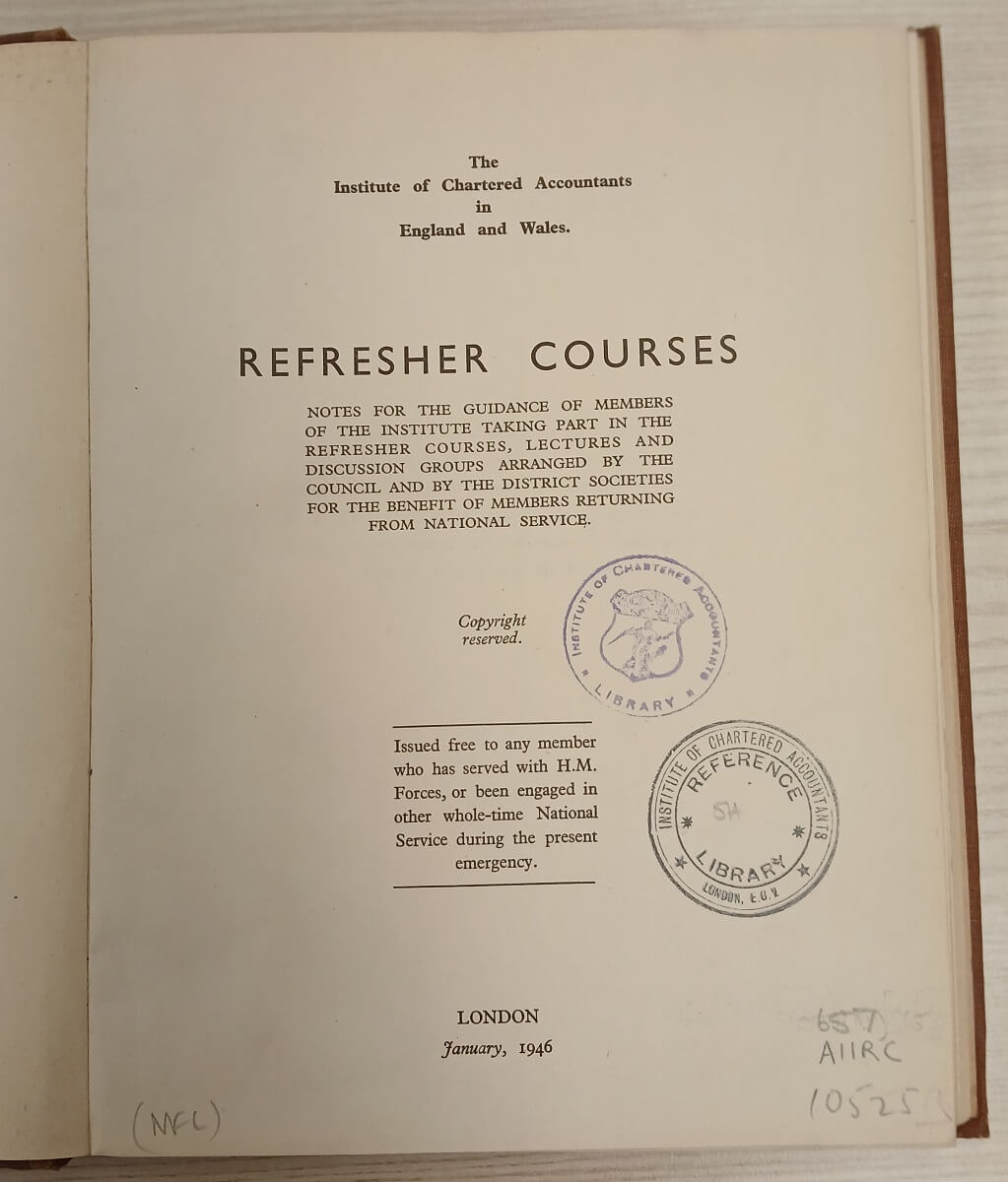
One of the heaviest costs of the war has been the interruption in the careers of young men, This is particularly true of those in professions. It is, therefore, the earnest desire of the Council of the Institute that members should receive all possible assistance in bringing their professional knowledge up to date on their return from National Service
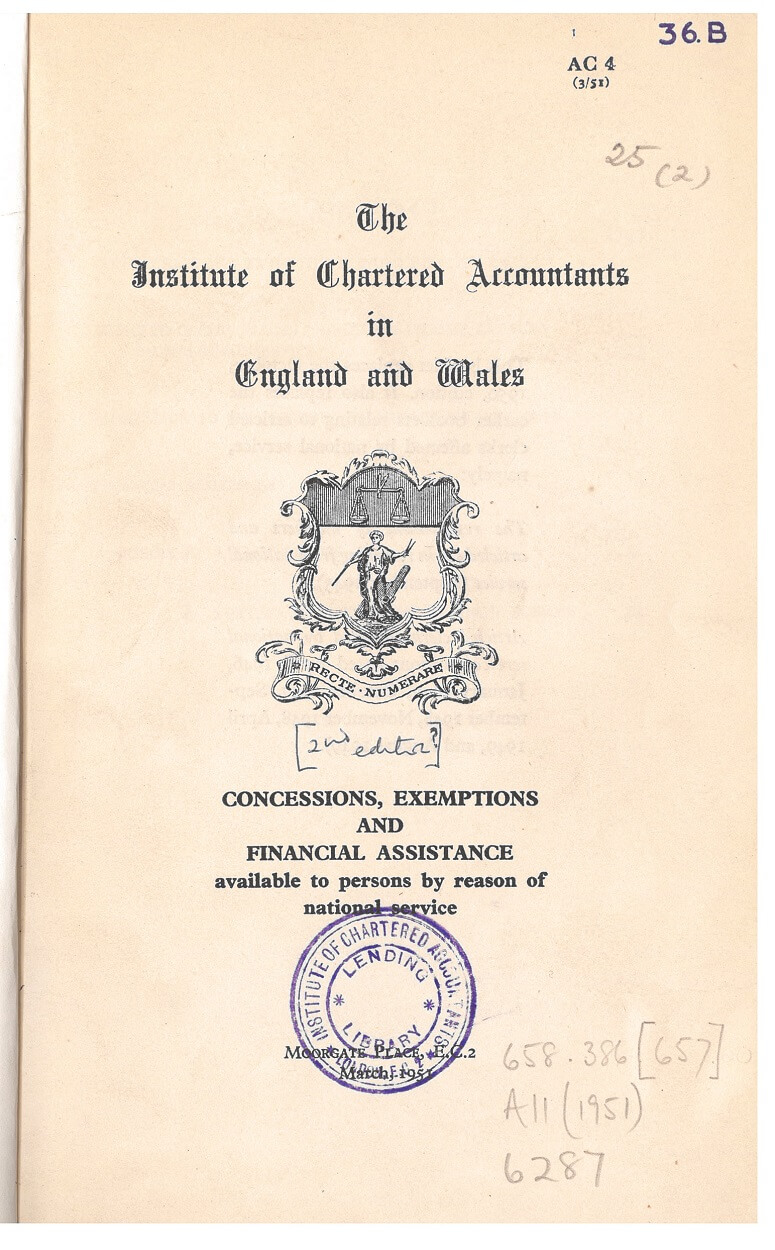
ICAEW would update the "The Resettlement of Members of the Institute and articled clerks affected by national service" a further 6 times until it was replaced by "Concessions, exemptions and financial assistance available to persons by reason of National Service" in March 1951.
The need for these special arrangements disappeared with the ending of UK National Service with the final call-up in 1960.
The very last man to be officially discharged from National Service was Chartered Accountant Richard Vaughan, who served in the Royal Army Pay Corps until May 1963.
Bold experiment
The involvement of venerable higher education bodies in the staging of the refreshers chimed with another crucial step in the modernisation of ICAEW’s course delivery: the University Scheme. Inaugurated in 1945, with the involvement of several universities (not including Oxford or Cambridge), the scheme offered options for trainees to pursue their membership of the profession by presenting the ICAEW’s syllabus in state-of-the-art campus facilities. The aim of the scheme was to attract much-needed new blood.
A notable effect of the scheme was to evolve the journey of the articled clerk. Over a study period of around six years, a clerk was able to obtain not just ICAEW membership, but a full university degree. At the same time, they could secure an exemption from the Intermediate exam, as long as their course included – in addition to accountancy – economics and law. For the practical component, a clerk could choose to work with an employer for either the first or last three years of the course. (At that point, a ‘sandwich’-style course structure, alternating shorter spells of practical and academic study, was not favoured among those who developed the scheme.)
Howitt hailed the initiative in his May 1946 address, saying that he was glad to see it was underway and describing it as “an experiment.” He added: “I earnestly hope it may succeed, as yet another step in the direction of enhancing the already high professional status of our calling, and as a further means of attracting a good type of entrant to the Institute.”
Seeds of modernisation sown in the wake of the Second World War continued to flourish. In the 1956-57 academic year, the University Scheme hit a milestone – finally surpassing its desired annual intake of 200 students. Around that time, the Institute and participating universities formed a Joint Standing Committee to oversee the scheme.
In the present, strategic partnerships with higher education bodies form a significant tranche of ICAEW education, both at home and abroad.
Meanwhile, the refreshers evolved into regular, annual summer courses that continued to attract members throughout the 1950s and 60s. In 1964, one such course covered the topic of electronic data processing – thereby pointing even further into the future.
You may also be interested in

Medals and decorations
Members and Articled Clerks were awarded with hundreds of awards for bravery and service during Word War 2, including 2 Victoria Crosses.
Medals awarded to members Medals awarded to articled clerks
Roll of Honour
Lists of ICAEW Members and Articled Clerks who died in World War 2.
ICAEW members Articled Clerks
Examinations in wartime
Many Members and Articled clerks became prisoners of war. Articled Clerks were able to take exams while in captivity.
Read their stories WW2 hub