
On 16 September 1939, trade magazine The Accountant caught the air of impending disruption that the Second World War would bring to everyday life and the profession. “None of us can foresee the extent of the sacrifices which will inevitably be demanded of us all,” its editorial declared, stressing: “The experience of the last war shows that no activity was more important or more necessary for the national economy than accounting.”
In the journal’s view, accountants’ skills would be vital for three core tasks: providing the government with amplified revenue; enabling suppliers to meet requirements in the most economical fashion; and helping businesses “carry on in the new circumstances which may be thrust upon them”.
As accountants strove to answer the challenge, the war caused significant upheaval in the profession and wrenched careers on to unpredictable paths. Yet it also fostered a climate of innovative thinking that produced laudable achievements for notable accountants.
Unlike during the First World War, the UK government recognised the need for skilled accounting staff. The Select Committee on National Expenditure ordered the best use of qualified accountants to avoid the same shortage the government faced in the First World War, when it had to withdraw accountants from the Forces to assist with preventing and correcting financial irregularities.
Rumbling controversy
For months, the profession had sensed the direction of travel towards conflict. In January 1939, The Accountant directed readers to letters that the English and Scottish accountancy bodies had sent to members, encouraging those prepared to offer their services in a time of war to register their names. The call for voluntary National Service had begun.
Two months later, the RAF used the journal to announce the launch of a limited number of short-service commissions, enabling select professionals to serve as Accountant Officers. (Later in the war, it opened further Accountant Officer commissions.)
Also deep in planning mode, the government unveiled its Schedule of Reserved Occupations in January 1939, setting age restrictions on military service for men in different professions. The aim was to avoid repeating the mistakes of the First World War, whereby sweeping call-ups had spawned severe manpower shortages in critical industries – particularly war production.
However, accountancy’s reserved age of 30 sparked huge controversy, which rumbled through The Accountant’s letters pages for more than two years into the hostilities.
Amid concerns over potential staff shortages in business and practice, many readers called for the age to be lowered to 25, to bring more accountants within the scope of reservation. In April 1940, the journal welcomed a government decision – spurred by representations from the accountancy bodies – to lower the reserved age to 25. But just 12 months later, the Ministry of Labour and National Service announced that the age would be restored to 30.
Constrained resources
Perhaps inevitably, the staff shortages that the government had hoped to contain proved unavoidable. Despite dedicating 2,000 staff to support its many responsibilities, the Board of Trade found itself needing to recruit another 4,500 staff. The accountancy profession proved a particularly fruitful sector because of the great value accountants were able to bring to run government agencies and wartime industries and offer support with the reorganisation of industries.
In a letter of July 1941, accountancy firm owner ‘Horatio’ told The Accountant that in September 1939, 50% of his male staff – all Territorials and Navy reservists – had had to join the Forces. “Now the government requires to take the remainder either for the Forces or for munitions,” he wrote, describing the situation as “intolerable”.
Women in the profession were also increasingly moved into war roles. In October 1942, The Accountant reported that the Ministry had instructed District Man-Power Boards to cancel existing deferrals and refuse new deferment applications for single women born in 1920-21 and the first half of 1922.
Only on the rare grounds that they had special qualifications that were not in demand for the war effort – or that their withdrawal from employment would lead to the closure of a business of national importance – would female professionals be considered for deferment. At that time, women’s value to the profession was the subject of a lobbying campaign by Chas JG Palmour, Chairman of the Accountants’ Committee for England and Wales.
Not that everything worked smoothly, one recurring source of frustration reported in The Accountant was ‘square-peggery’: professionals ending up in war roles that did not make good use of their talents. One letter that neatly captured the problem came from a firm that related the experience of a highly capable former employee who had been assigned to “elementary” clerical work. The ex-staffer wrote to the firm that “his section officer has no idea of what a chartered accountant is or does”, and that another ACA in the same unit “is a sort of odd-job man – cutting string to required lengths and writing out ration cards”.
Strokes of genius
In happier circumstances, the war tested accountants’ intellects and spurred innovative thinking. Indeed, we can find ample evidence of this in the stories of key figures from the predecessor firms of PwC – as told in the Big Four firm’s commemorative research project For the Fifty, published in 2023.
In 1942, Henry Benson – future Joint Senior Partner at Cooper Brothers – was recruited to the Special Operations Executive (SOE), the covert sabotage unit that had made accountancy mastermind John Franklyn Venner its Director of Finance. Having made a strong impression in SOE procurement, Benson was transferred to the Ministry of Supply, where he developed a manual for standardising the control of budgets, cash, pay and inventory across 40 ordnance factories, dramatically turning around “awful” administration.
Before the war, Ted Parker was a humble Manager at Price Waterhouse (PW). Seconded to the Board of Trade in 1940, he led a team of accountants that devised industrial controls for textiles, followed by a national scheme for clothes rationing, launched in 1941. Three years after the war, Fuel and Power Minister Hugh Gaitskell personally invited Parker to help revise the system for petrol rationing, which would remain in place until 1950.
Gaitskell told Parker: “I know of no one else with this knowledge and that is why I am so keen that you should take on the job.”
As early as 1938, PW junior Stanley Duncan had joined the Territorial Army, landing a role as a driver. Coming to believe that his skills could be better utilised, Duncan negotiated a path into industry, landing at aviation company AV Roe, a subsidiary of PW client Hawker Siddeley. Among various initiatives he led in wartime was the development of a new batch costing system for the business. Years later, Duncan became PW Senior Partner.
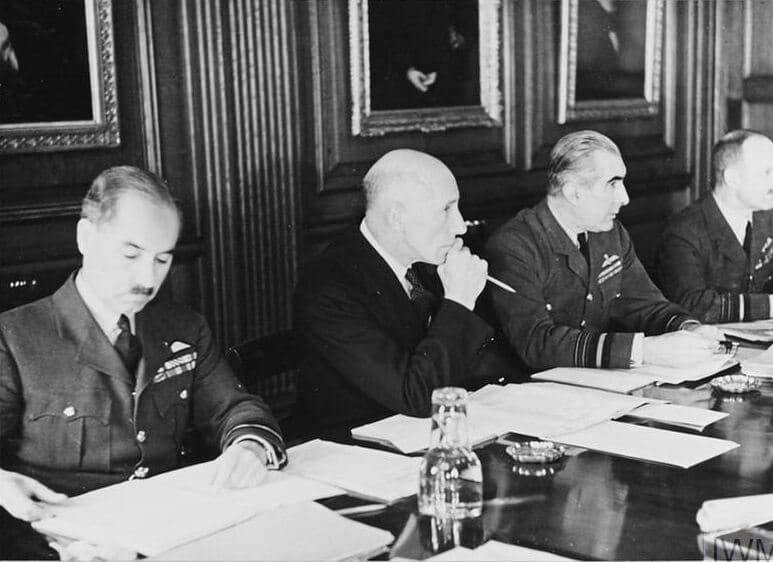
The Air Council in session in the Council Chamber at Adastral House, London. Sir Harold G Howitt D.S.O., M.C., F.C.A.,(Centre) of Peat, Marwick, Mitchell and Co. was ICAEW president in 1945/46. Image: IWM (CH 966) © Imperial War Museum.
Legacy
The varied roles carried out by accountants during and between the world wars were vital in managing both the war effort and the reorganisation of industry that came out of this. This proved a significant turning point for the accountancy profession’s involvement advising business and government, which we can still see today.
The numbers tell their own story. Before the First World War the number of qualified accountants working in business was insignificant, but by 1951 this rose to half of all professionally qualified accountants. The number of companies with a qualified accountant on the board doubled between 1931 and 1951.
All of this led the editor of Financial News to look out at the post-war world and confidently proclaim: “This is the age of the accountant”.
You may also be interested in

Medals and decorations
Members and Articled Clerks were awarded with hundreds of awards for bravery and service during Word War 2, including 2 Victoria Crosses.
Medals awarded to members Medals awarded to articled clerks
Roll of Honour
Lists of ICAEW Members and Articled Clerks who died in World War 2.
ICAEW members Articled Clerks
Examinations in wartime
Many Members and Articled clerks became prisoners of war. Articled Clerks were able to take exams while in captivity.
Read their stories WW2 hub