The Renters’ Rights Act 2025 was given royal assent on 27 October, providing a range of new protections for tenants of private sector landlords in England. Its passing prompted us to ask just how many private sector tenancies will be affected by these changes once they are introduced into law.
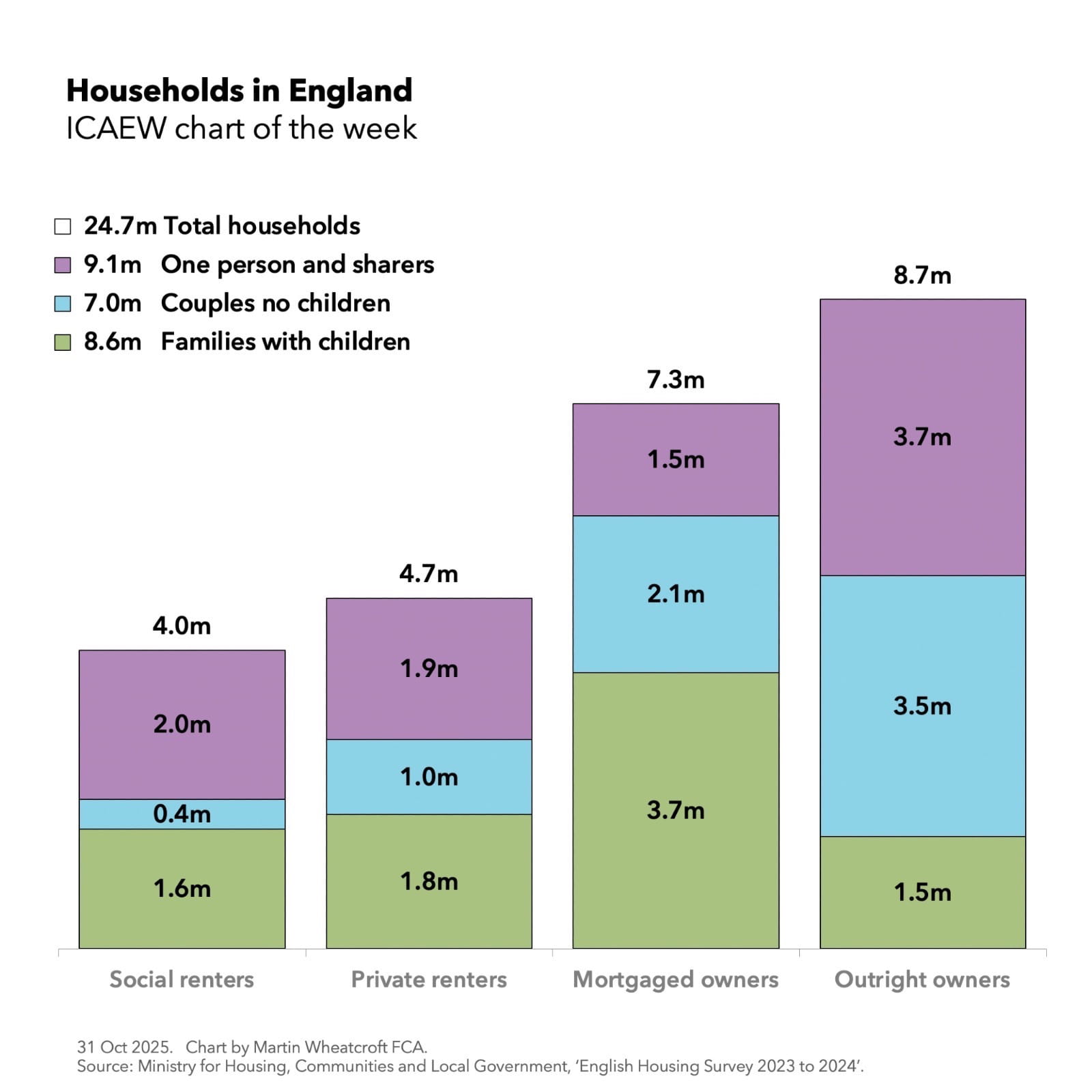
Our chart this week illustrates that there were 24.7m households in England in 2023/24 according to the Ministry of Housing, Communities and Local Government. Of these, 4.0m, or 16% of households, were in social housing (2.5m housing association and 1.5m local authority properties), 4.7m, or 19%, were tenants of private sector landlords, 7.3m, or 30%, were in properties owned with a mortgage, and 8.7m or 35% were in properties owned outright.
Our chart also shows a breakdown of the 8.6m families with children (1.6m social renters, 1.8m private renters, 3.7m mortgaged owners and 1.5m outright owners), 7.0m couples with no children (0.4m, 1.0m, 2.1m and 3.5m respectively), and 9.1m one person or shared households (2.0m, 1.9m, 1.5m and 3.7m respectively).
The 8.6m family households comprised 5.7m couples with children, 2.5m lone parents with children, and 0.4m two or more family households, while the 9.1m one person or shared households comprised 8.5m one person households (4.5m female and 4.0m male) and 0.6m shared households containing two or more lone persons.
The 4.0m social renter households, 4.7m private renters, 7.3m mortgaged owners and 8.7m outright owners comprise 8.6m, 10.7m, 19.6m and 16.0m people respectively – the latter reflecting the older demographic where we see more outright ownership, fewer children and a higher proportion living alone.
For both tenants and their landlords, the Renters’ Rights Act 2025 will result in significant changes to their contractual arrangements and legal rights. The measures include new restrictions on no fault evictions, the end of fixed-term tenancies, limitations on rent increases, a new ombudsman, a requirement on landlords to register their properties, more rights to have pets, higher property standards, deadlines for rectifying hazards, an end to discrimination against those on benefits or who have children, an end to post-advertisement bidding wars, strengthened local authority enforcement, and the ability for rent repayment orders to be recovered from superior landlords.
For more information on the changes see the government website.
Backing business-led growth
Drawing on members expertise and our research, ICAEW is offering policymakers advice on how to tackle the three key barriers to growth.

Latest charts
Further resources
ICAEW Community

Public Sector Community
The go-to place for guidance on issues affecting finance professionals working in and with the public sector. With a range of dynamic services, ICAEW provides valuable tools, resources and support tailored to the public sector.
Resources

Economy explainers
ICAEW experts offer simple guides to help understand the technical, economic jargon that is discussed when talking about public finances and the economy.
Find out moreICAEW support

Training and events
Browse upcoming and on-demand ICAEW events and webinars offering support on technical areas, such as assurance, reporting and tax, as well as personal development.
Events and webinars A-Z of courses