The Chancellor presented the latest fiscal forecast prepared by the Office for Budget Responsibility (OBR) to Parliament on Tuesday 3 March 2026 together with an extensive defence of the government’s economic record since taking office almost two years ago.
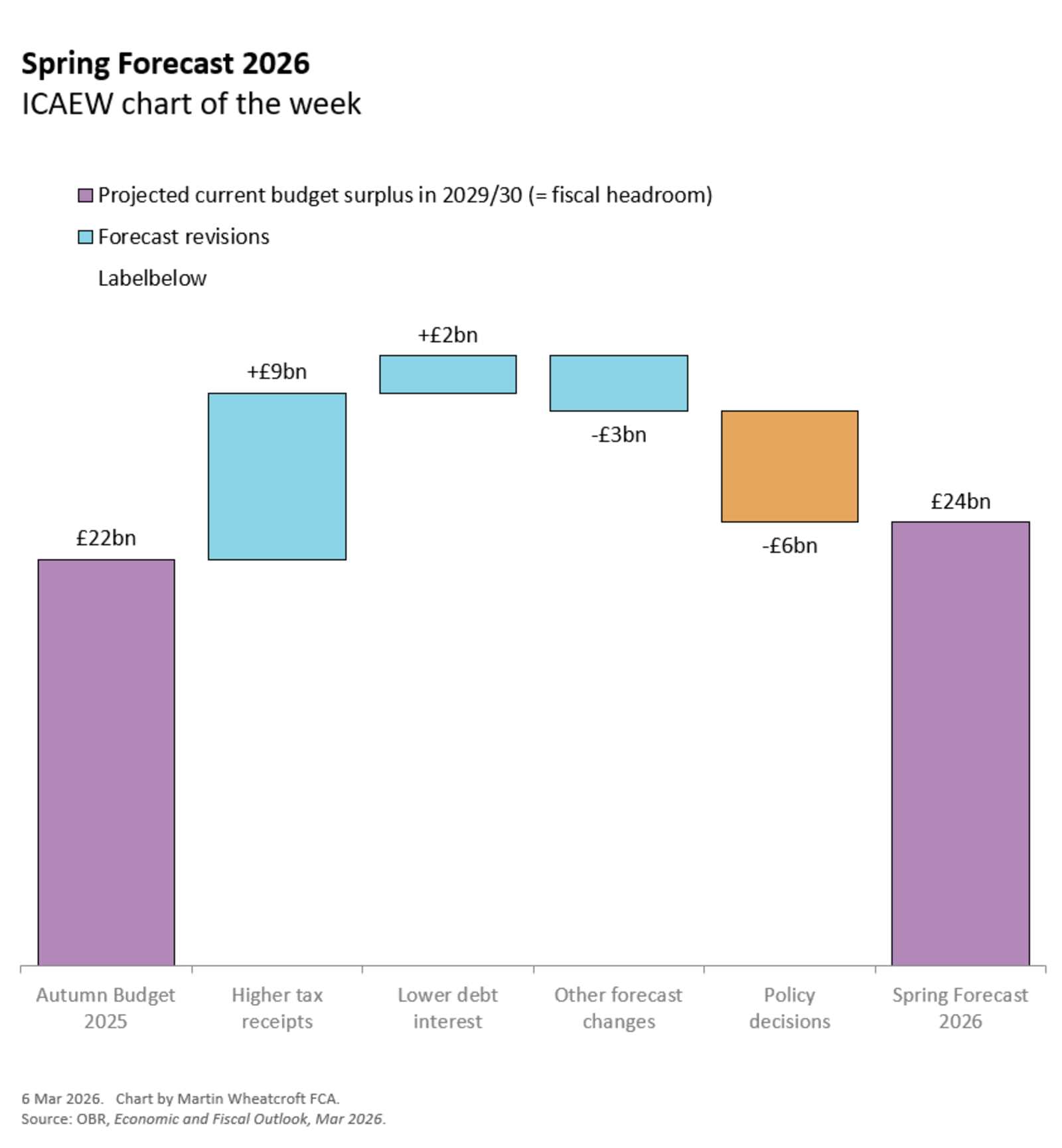
The good news for the Chancellor was that she was able to report that the fiscal headroom against her primary fiscal rule has increased from £22bn in the Autumn Budget 2025 to £24bn in the Spring Forecast.
Our chart this week illustrates the components of this change, with forecast revisions by the OBR adding £8bn to the projected budget surplus in 2029/30 – the fourth year of the forecast period – before deducting £6bn for the net cost of policy announcements made by the government since November last year.
The forecast revisions start with £9bn in higher tax receipts, of which £6bn relate to higher equity prices boosting projected capital gains tax and carried interest income tax receipts and £3bn to other tax receipts, primarily from stronger economic growth predicted by the OBR between 2027 and 2030.
A further £2bn of uplift comes from lower debt interest charges in 2029/30 as a consequence of a reduction in the OBR’s predictions for inflation and interest rates.
This was then offset by £3bn from other changes to the forecast for current expenditure, including £1bn in higher welfare spending and £2bn for other reasons.
The £6bn (£5.7bn before rounding) net cost of policy decisions comprised £4.4bn in extra SEND funding as announced by the government eight days before the Spring Forecast and £0.5bn in other spending increases announced since last November – a total of £4.9bn in additional spending in 2029/30. This was partially offset by additional council tax increases of £0.5bn before taking account of tax cuts in 2029/30 of £0.7bn for US-parented groups, £0.1bn relating to inheritance tax on farmers, £0.2bn in other tax cuts and a £0.3bn indirect impact on receipts from policy decisions.
Not shown in the chart is net investment, where the OBR reduced the projection for 2029/30 by £3bn from £90bn to £87bn. This means the projected fiscal deficit for 2029/30 has reduced from £68bn (a previously projected current budget surplus of £22bn less £90bn net investment) to £63bn (a current budget surplus of £24bn less £87bn).
Reacting to the Spring Forecast, ICAEW’s Chief Executive, Alan Vallance, said: “While businesses will be relieved that they will not have to respond to any major policy announcements from the Chancellor, their attention will be turned to the situation in the Middle East. In an increasingly volatile world, having just one fiscal event a year is the right move to dampen speculation and increase certainty.
“Our members tell us that they want stability, but since these forecasts were finalised, the world has again changed. People and businesses will be concerned about the impacts of more geopolitical uncertainty, and it is inevitable that costs, particularly energy costs, will rise.
“This unfolding crisis underscores the need to foster a more stable and supportive environment for business, including developing a long-term fiscal strategy that puts the public finances on a more sustainable path and an urgently needed commitment to comprehensive tax reform.”
Public Sector analysis of Spring Forecast
ICAEW's Public Sector Community provides further commentary on the Forecast as Chancellor holds the line in first ever ‘non-fiscal’ fiscal event.

Latest charts
Further resources
ICAEW Community

Public Sector Community
The go-to place for guidance on issues affecting finance professionals working in and with the public sector. With a range of dynamic services, ICAEW provides valuable tools, resources and support tailored to the public sector.
Resources

Economy explainers
ICAEW experts offer simple guides to help understand the technical, economic jargon that is discussed when talking about public finances and the economy.
Find out moreICAEW support

Training and events
Browse upcoming and on-demand ICAEW events and webinars offering support on technical areas, such as assurance, reporting and tax, as well as personal development.
Events and webinars A-Z of courses