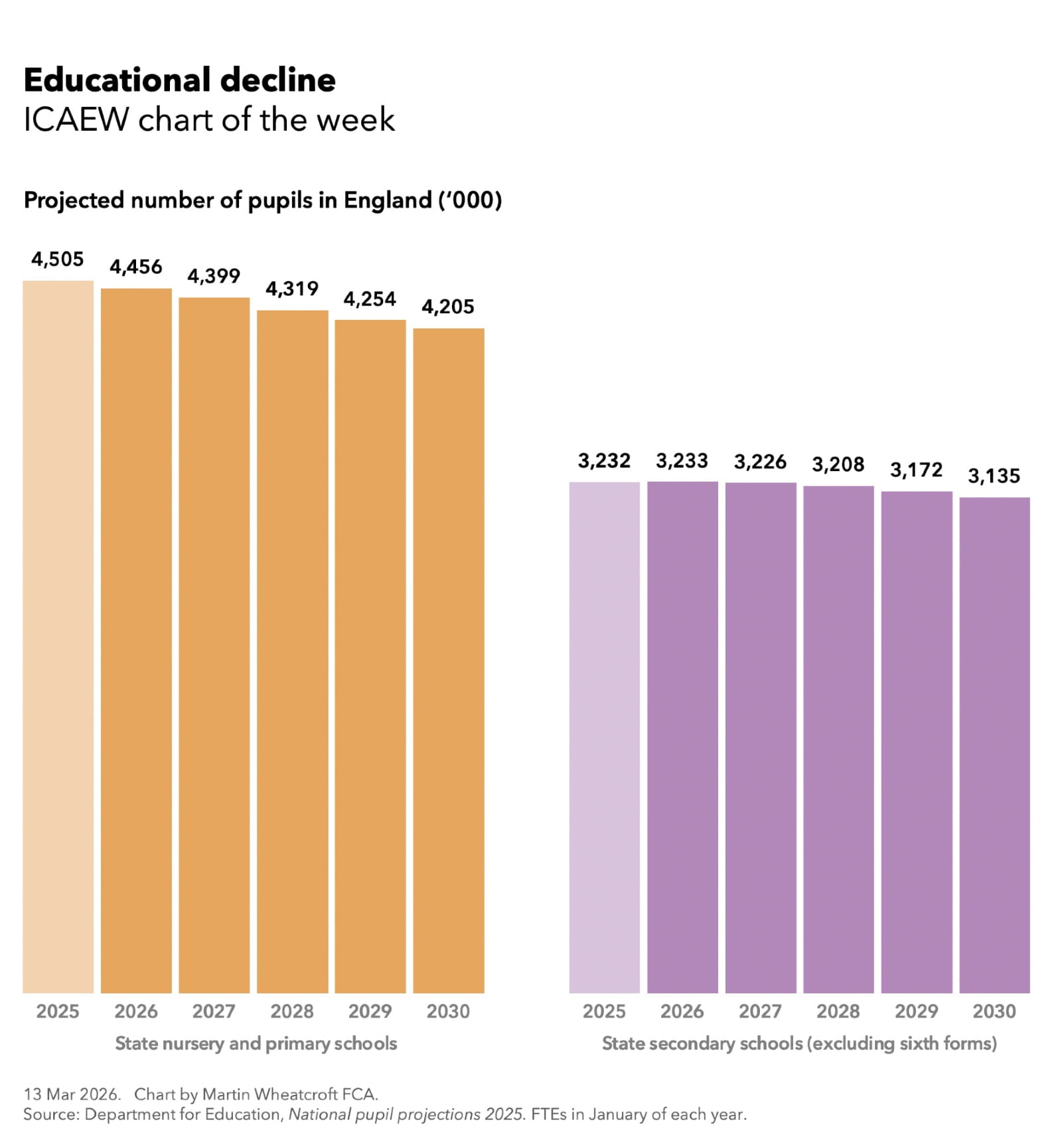
According to Department for Education statistics, there were 8,384,000 school pupils under the age of 16 in England in January 2025 (ages recorded as of 31 August 2024). Of these, 4,505,000 were in maintained nursery and state primary schools, 3,232,000 were in state secondary schools, 146,000 were in state special schools, 482,000 were in independent schools and 16,000 were in alternative provision.
Our chart this week shows how the largest two categories of schools are projected to change over the next five years, starting with a projected 7% fall in pupil numbers in state nursery and primary schools from 4,505,000 in the last academic year to 4,205,000 in 2030. This follows a decline of 3% since 2019 when state nursery and primary numbers peaked at 4,652,000.
Meanwhile the number of state secondary school pupils under the age of 16 at the start of the academic year is expected to decline from 3,322,000 in January 2025 to 3,135,000 in January 2030, a fall of 3% from the peak.
Driven by a falling birthrate, the 7% projected fall in state nursery and primary school pupils is likely to be a political hot potato for local authorities and government in the face of what is likely to be a large number of ‘save our local school’ campaigns. London has already seen a significant number of primary school closures over the past five years, but the further drop projected is likely to see most parts of the country affected to a greater or lesser extent.
The 3% decline from the peak in secondary school pupil numbers will also present challenges, especially as the fall in numbers is unlikely to be spread evenly across the country. Some will see smaller falls or even rises in their school rolls, while others will see a much greater drop in their intakes. Reducing the number of classes in each year is a likely response for some schools, but entire school closures and mergers are almost inevitable.
The core of the projections is the provision of school places for children who are already in the education system or have already been born, but uncertainties about the rapidly falling birth rate meant that the Department for Education limited their projections to five years instead of their traditional ten-year outlook. With these projections, the main uncertainty is in the level of migration, with government actions to restrict legal immigration likely to see the next projections revised down even further when they are released this summer.
In theory, falling school rolls should reduce pressures on the education budget while at the same time potentially increasing per pupil funding. In practice, pressures on the public finances are so large that the government is likely to be looking for every saving they can find.
Latest charts
Further resources
ICAEW Community

Public Sector Community
The go-to place for guidance on issues affecting finance professionals working in and with the public sector. With a range of dynamic services, ICAEW provides valuable tools, resources and support tailored to the public sector.
Resources

Economy explainers
ICAEW experts offer simple guides to help understand the technical, economic jargon that is discussed when talking about public finances and the economy.
Find out moreICAEW support

Training and events
Browse upcoming and on-demand ICAEW events and webinars offering support on technical areas, such as assurance, reporting and tax, as well as personal development.
Events and webinars A-Z of courses