Persuading people to do something that they don’t necessarily want to do is not easy. There’s a quote from American MIT lecturer Peter Senge that particularly rings true: “People don’t resist change. They resist being changed.”
Transformation programmes are tough and tiring experiences and often involve pressure to meet targets and a rush to deliver on time. In the heat of the moment, it’s easy to lose yourself in timelines and targets and completely forget about the people that the project is affecting.
Statistically, many academics argue that the vast majority of transformation projects fail. Research from the Harvard Business Review and Bain & Company found that just 12% of transformations result in lasting benefits. The research can be debated, but one thing is clear – the people factor is a critical element in the success or failure of these projects.
One risk that causes failure is to spend 80% of your effort in managing the resistors.
Attendees to ICAEW’s recent webinar series on transformation seem to have experienced these challenges. The vast majority of audience questions focused on communicating transformation, boosting morale and encouraging engagement. Here are some examples:
|
“Can you explain how to overcome barriers to transformation, both people/culture and financial barriers.” “How do we interact with those who are totally adamant not to change, despite all the comms and emphasis on the benefits?” |
So how do you go about bringing your people on board when undergoing a transformation project?
What do we mean by ‘people’?
The people affected by transformation projects spread across several stakeholder groups that you will need to engage with:
- the direct team impacted by the project;
- the wider team delivering the project;
- the exec sponsors;
- the board;
- customers; and
- suppliers.
Generally, organisations seem to fall into one of two categories. They might attempt to get their people involved in the change process, with some workshops about possible outcomes and design principles for change-decision criteria. People can then understand why things are changing, even if they don’t fully agree with it.
Equally, the people involved fall into three camps. Each group needs to be managed differently:
- The 10% supporters that are with you from the start.
- The 80% undecided which you need to ideally move to be supporters, or identify as resistors.
- The 10% resistors that will never be supportive.
As a transformation leader, you must ensure that you focus most of your energy on camps one and two. It is very easy to be sucked into the vortex of negativity and focus on winning over group three. But you cannot win them round. Instead, this group needs to be actively managed with top level support. This may involve some tough decisions about helping to ring-fence them or moving them into new roles (inside or outside of the organisation).
Group two can fall into either camp one or three, depending on how you communicate with them. Bring that 80% into group one, and they will feel motivated and excited about the project. Where there are tough decisions to be made, they will be more understanding and will trust you to do the right thing by them.
However, if you let them fall into group three by ignoring them throughout the process, they will not understand what is going on. They will feel like they’re being changed and will most likely resist it.
In this situation, people said they felt the project was an excuse to make redundancies. They didn’t believe what they were told and lost trust in the leadership of their organisations.
How to make it work
If you’re following the GAME PLAN approach to project management, as outlined across ICAEW articles and webinars, you should have a clear understanding of the problems you’re trying to solve with your project as part of your initial gap analysis.
In the first week of your project, take the time to identify all of the stakeholders on your project. Group them into the three camps we mentioned earlier, then plot them on a graph with their level of interest in the project on the x axis, and level of power on the y axis. Use this to create a four-quadrant grid to determine how to manage each stakeholder:
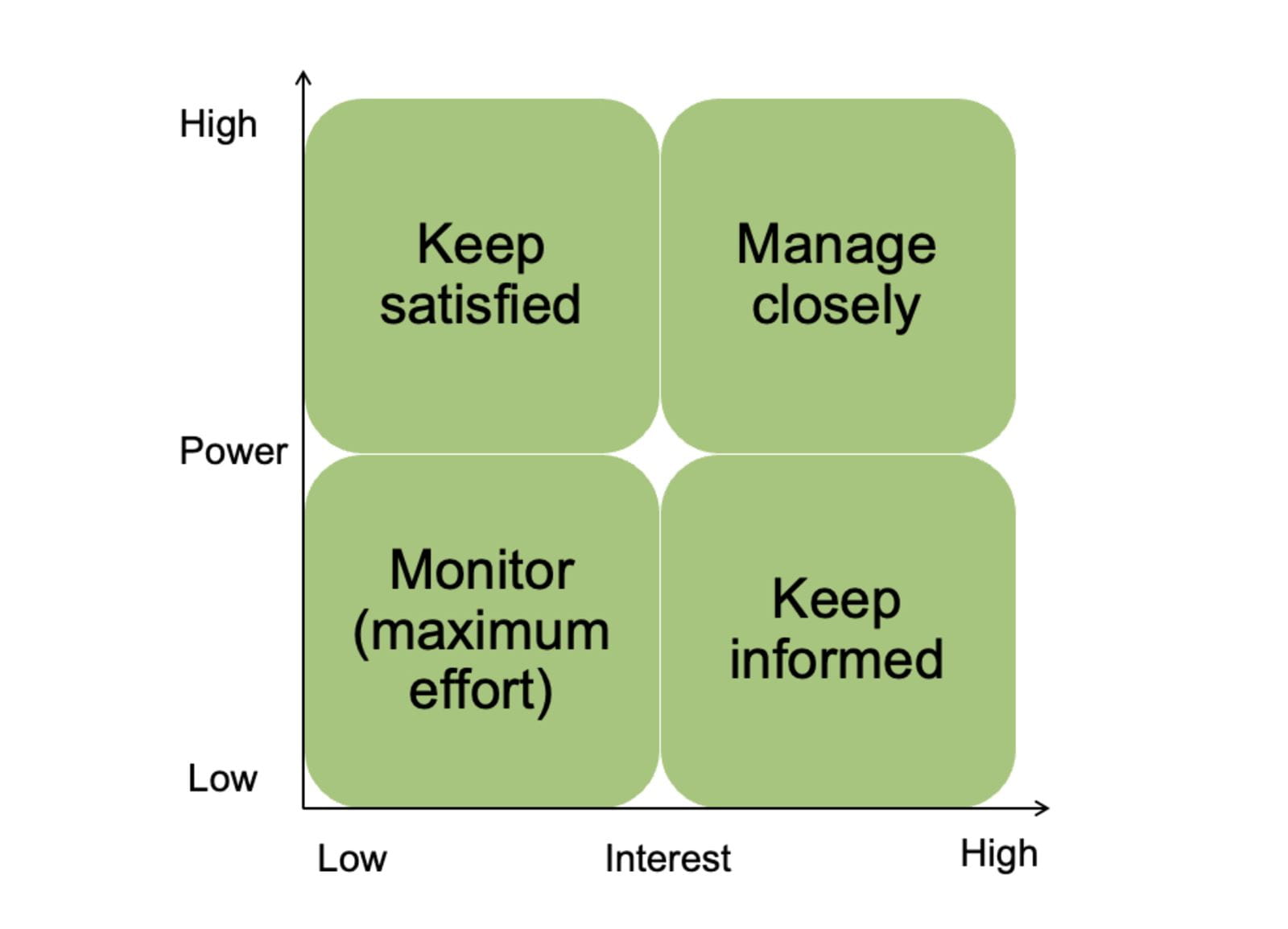
This is a widely used 2x2 and is often called the stakeholder influence or power interest grid.
Across the first month while you’re creating your action plan, create a plan for how to manage each of the people in each quadrant, and in each resistance camp. It’s critical that you get the support of your executive sponsor when it comes to your management approach.
In the first 90 days, spend time managing the people and aligning with sponsors. Identify potential barriers and make a plan for how to manage them.
Bring the wider team with you
It’s critical that you keep lines of communication open with all of your stakeholder groups. Inform them of the ‘why’ of your project, and the issues you are trying to address.
Let them tell you how these issues affect them, and how they think they could be addressed. Be upfront about the fact that the programme will involve some big changes, but that they will be part of the process and will have an opportunity to feed into it.
Ensure that you include a stakeholder communication phase at each step of the project. Once you complete your action plan, outline a timeline of events for your affected stakeholders. Give them opportunities to ask questions and answer them honestly.
- Tell people what you know and can communicate.
- Tell people that you know something and will communicate as soon as appropriate.
- Tell people what you do not know yet.
Have them be part of the learning process by allowing them to test work in progress and provide feedback on how it worked for them. Going through this cycle of communication ultimately builds trust and therefore engagement.
Celebrate successes
It’s the people that will ultimately make your transformation project a success or failure, so make sure you celebrate wins with them and acknowledge good work.
Give your people a vision for the ‘future state’ as you work towards it. Demonstrate how each project success benefits them as individuals as well as for the organisation.
Deal with high and low performance
Make stakeholder sentiment one measure of success for your project, so that bringing them with you is ingrained in the project management process. Set clear objectives so that people know what good looks like for them. Foster trust and encourage curiosity and learning.
Use clear KPIs to help you identify low performance early. Engage in regular, constructive feedback, and provide additional support and mentoring where necessary.
Ensure exec sponsorship is aligned with your approach and supports you in critical performance management when necessary. This is needed both for dealing with poor performance and in recognising exceptional performance.
This also applies to SMEs
There is sometimes an assumption that this approach cannot work for smaller organisations. But getting your people on board with change is relevant whether you have a team of two, or 2,000, or 200,000 people. No matter how big or small a project might be, some people in the organisation will be affected by it, and their perspectives need to be considered. This is drastically underappreciated and not taught enough.
If you can understand how this might affect the purchase ledger clerk, the deputy CFO and the financial controller on the team being affected by the project you are running, you will be able to roll it out in a way that addresses their potential concerns and gets them excited about what you’re trying to do. Your transformation project has a much higher chance of succeeding as a result.
Or you can roll it out based on your perspective alone and hope for the best.
Deliver transformation
This webinar series defines what transformation is and presents a framework for leaders to design and implement a transformation programme. Access on demand recordings and register for upcoming webinars.

You may also be interested in
Resources

Communication skills
A range of articles, reports, eBooks and guides to help you successfully develop your communication and presentation skills.
Browse resourcesICAEW support

Training and events
Browse upcoming and on-demand ICAEW events and webinars covering leadership skills.
Events and webinars CPD courses and moreICAEW support

Support throughout your career
We’re here to offer you support whatever stage you are at in your career, in whichever sector you have chosen to work.
Find out more