Reginald Leonard Haine V.C. M.C
Early years
Bill Haine was born in Earlsfield, London on 10 July 1896, the son of teacher turned Police Detective, Harry and schoolteacher Louisa (nee Smith). The family lived in Wilna Road, Earlsfield, before moving to Sheerdale Road in Richmond. Haine was educated at Richmond County School in nearby East Sheen, where he was a member of the school's Officer Training Corps (O.T.C.)
Haine passed the ICAEW’s Preliminary Examination in November or December 1913 and in March 1914 he signed articles with Ernest Arthur Browne of Derbyshire Brothers & Co. of Southampton Row, for a 5 year term. Around the 4 August after having returned from a fortnights holiday, Haine received a phone call from a friend asking him 'what are you going to do about the war?'. Haine hadn't really thought about it until this point, but he met his friend, at lunchtime on the 28 August, at Armoury House on City Road and enlisted with the Honourable Artillery Company. He was encouraged by the recruiting sergeant to add a year on to his age, enabling him to be eligible to serve overseas.
WW1
Haine was sent to France on 18 Sept 1914 and was wounded on 6 June 1915, re-joining his battalion on 15 December, newly promoted to Lance Corporal. He was promoted to Lance Sergeant and Sergeant in quick succession and then to Company Sergeant Major on 15 Nov 1916. Less than a month later he received his commission as a 2nd Lt (on probation).
Haine was Mentioned in Field Marshall Sir Douglas Haig's Despatch of 9 April 1917 (Gazetted 18 May) '...names of those officers, ladies, non-commissioned officers, and men, serving, or who have served, under my command, whose distinguished and gallant services and devotion to duty I consider deserving of special mention.'
At Gavrelle, on the 28 April 1917, during the Battle of Arras, Haine led six bombing attacks against a German strong point and eventually took the position along with fifty prisoners and two machine guns. The enemy retook the position and their counter-attacks, from a battalion of the Prussian Guard, threatened to to take the whole salient. Haine and his men held out for the whole of the following night. They took the strong point for a second time the next morning - thirty hours continuous fighting in all. For this action Bill Haine was awarded the Victoria Cross.
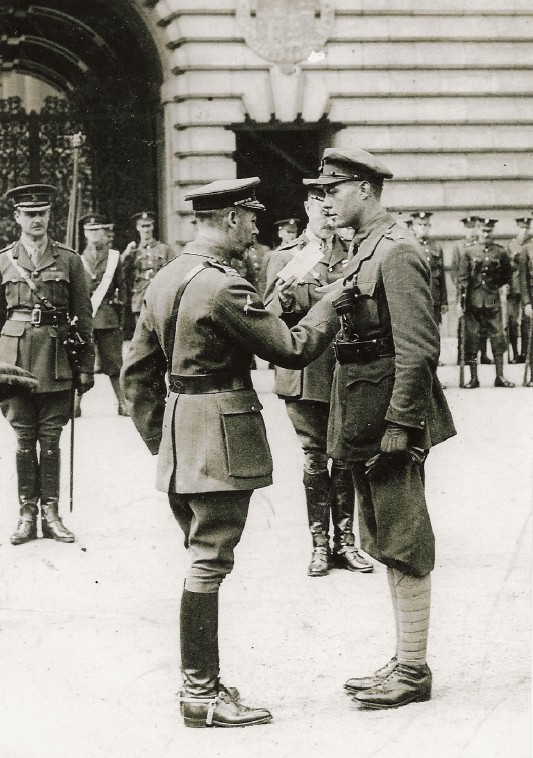
For most conspicuous bravery and determination, when our troops, occupying a pronounced salient, were repeatedly counterattacked. There was an ever-present danger that if the enemy attack succeeded, the garrison of the salient would be surrounded. 2nd Lt. Haine organised and led with the utmost gallantry six bombing attacks against a strong point which dangerously threatened our communication, capturing the position together with fifty prisoners and two machine guns. The enemy then counter-attacked with a battalion of the Guard, succeeded in regaining his position, and the situation appeared critical. 2nd Lt. Haine at once formed a block in his trench, and for the whole of the following night maintained his position against repeated determined attacks. Reorganising his men on the following morning, he again attacked and captured the strong point, pressing- the enemy back for several hundred yards, and thus relieving the situation. Throughout these operations, this Officer's superb courage, quick decision and sound judgment were beyond praise, and it was his splendid personal example which inspired his men to continue their efforts during more than thirty hours of continuous fighting.
When American troops started to arrive in France, later in 1917, Haine was involved in their training. He was promoted to Lieutenant on 7 June 1918.
In November 1918 Haine was seconded to the Indian Army and was en-route to India when he learnt about the Armistice and the end of fighting in Europe. He was attached to 35th Sikhs, an infantry Regiment of the Indian Army, part of the 2nd (Rawalpindi) Division stationed on the North West Frontier of India.
Haine hadn't been in India long when the 3rd Afghan War broke out on 3 May 1919. He was promoted to Acting Captain while holding the position of adjutant on 6 May 1919
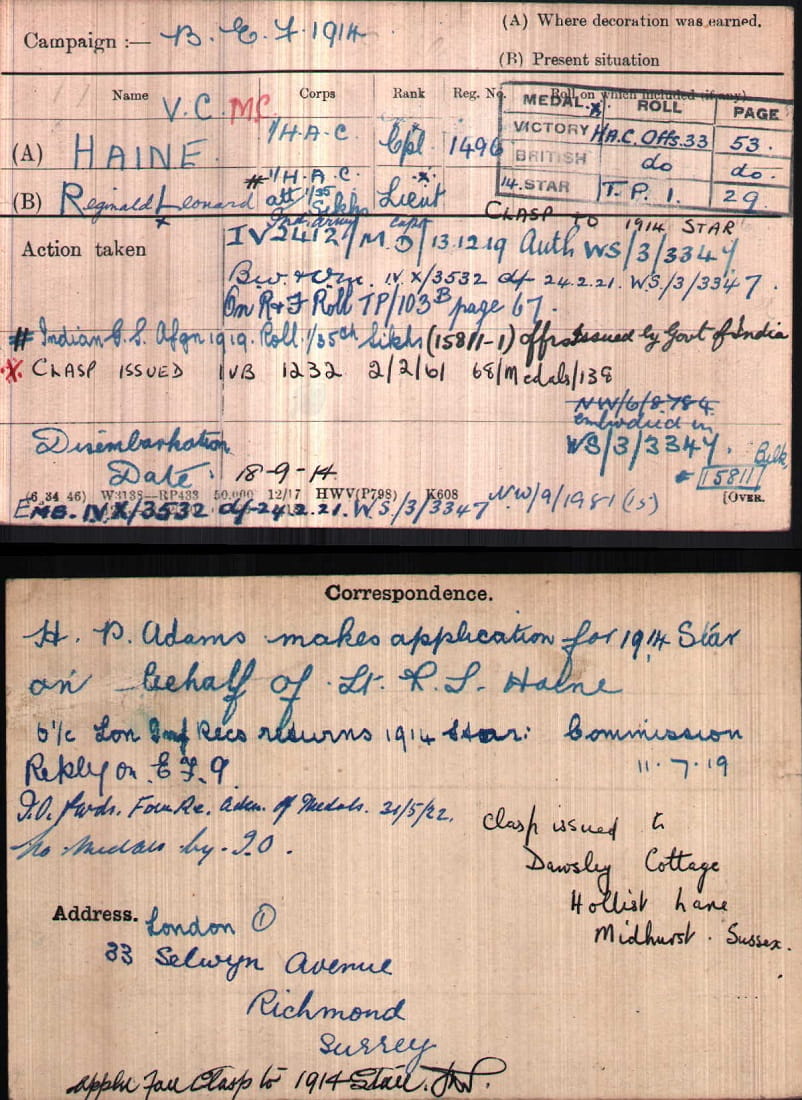
By the 17 May he was involved in heavy fighting at Dakka in Afghanistan. The British camp had been poorly sited, allowing the enemy to use the surrounded heights to attack the camp. Haine was involved in the counter-attack against the Afghan forces near the summit, which was finally secured on the 17th. Haine received the Military Cross for his actions. He also received the Indian General Service Medal with 'Afghanistan NWF 1919' clasp. Wounds received during the action lead to him being invalided back to Britain.
He relinquished his Commission 12 Jan 1920 and returned to civilian life.
For conspicuous gallantry on 17th May, 1919, at Dakka. On many occasions during the fight near the summit of the hill he did everything in his power to collect the men for an attack on the enemy entrenches on the top in face of very heavy fire. When it was decided to retire and take up a position further down the hill, he collected all the men he could gather, and, before descending, assisted in getting all the wounded away.
Between the wars
When he returned to England and started to look for new employment. Haine was told that he was of 'no commercial use' and was offered below the market rate for jobs on several occasions, which angered him, as he believed that a lot of firms had made a lot of money while soldiers were off fighting for their country.
According to our records Haine did not ever qualify as a Chartered Accountant but is reported that he joined an accountancy firm of Andrew Low. Son & Co in 1920 but this firm was not an ICAEW or SIAA one. He was later a director of Jennings Hotels Ltd.
In 1921 he again became temporary Lieutenant with the HAC Infantry (Defence Force) Battalion of the Territorial Force (renamed the Territorial Army in 1921). The 1921 census even found him at Victoria Park Camp, Bethnal Green with other members of his regiment. In 1928 he was promoted to Captain and he was transferred to the Territorial Army Reserve of Officers (T.A.R.O.) in June 1929.
WW2
In World War II, Haine was Commanding Officer (Lieutenant Colonel) of the 58th (Purley) Battalion of the Surrey Home Guards. In October 1949 The London Gazette announced that ‘Capt. R.L. Haine V.C. M.C. (27776), having exceeded the age limit of liability to recall ceases to belong to The T.A. Res. Of Offrs., 26th Oct. 1949.’ After 31 years Bill Haine was no longer in the military.
Peacetime
Although he was no longer in the military, Haine did not forget those who had served and continued to do so. He was a founder member of the VC and GC Association and joined the organisation’s committee in 1956. He was also Chairman of the Baltic Exchange branch of the Royal British Legion.
Bill Haine died in 1982, at the age of 85. He was cremated at Chichester Crematorium where his ashes were scattered and he is commemorated by a memorial plaque.
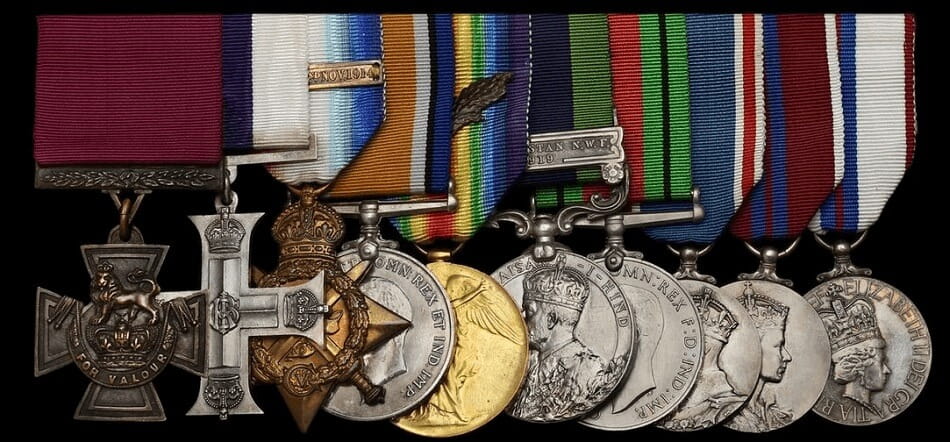
Haine's medals for sale
Bill Haine's Victoria Cross medal group was put up for auction by his family in November 2025, with a estimated sale price of £240,000-£280,000.
Albert Cecil Herring V.C.
Early years
Alfred Cecil Herring was born in Tottenham, 26 October 1988 to George Edward Herring, the Managing Clerk at the solicitors firm of Braikenridge & Edwards and Cecilia Emily (nee Lewis). The family lived in Victoria Terrace in Tottenham and then moved to Fox Lane in Palmers Green where Herring (when not abroad) remained until he married Winifred Franklin in 1922.
Herring was educated at Tottenham County School, where he captained both the cricket and football teams. While studying at Tottenham Polytechnic he passed the ICAEW's Preliminary Examination in 1907. He articled with Daniel Steurt Fripp of Evans, Fripp Deed & Co, passing the Intermediate Examination in 1911 and the Final Examination a year later. He then took up the position of clerk at Charles, Eves & Co. in 1913.

World War 1
Herring joined the Army in December 1914 as a Acting Paymaster at the Army Depot in Chatham. He was then commissioned as a 2nd Lieutenant in the Army Service Corps and was dispatched to France where he was then attached to the 6th Battalion of the Northampton Regiment on the 18 September 1917.
He had been attached to the Northants for just over 6 month when on the 23 March the 7th Battalion of the Bedfordshire Regiment had lost control of the Montagne Railway bridge, over the Canal de Saint Quentin (halfway between the villages of Jussy and Mennessis). Herring was amongst the two companies of the 6th Northants reinforcing the Bedfords. His post was cut-off and surrounded by the enemy but he immediately led the counter-attack and retook the lost ground and captured 20 Germans and six of their machine guns. The post was attacked continually through the night, but the attacks were beaten off and the position held, holding up the German advance for 11 hours before it was finally overrun.
After the battle, Herring was captured by the Germans and was held as a Prisoner of War at Graudanz Camp in West Prussia (Now Grudziądz, Poland), where he was presented with the ribbon for his Victoria Cross by the senior British officer at Graudanz, Brigadier General Sir Edward Bellingham. While a prisoner he was presented to Kaiser Wilhem who is reported to have congratulated him on a very fine fight.
He returned to England in time for Christmas 1918, but had to wait until February of 1919 to be presented with his Victoria Cross by King George V. In the meantime he had been promoted to Temporary Major and was serving as Group Accountant with the Cost Accounting Committee.
The Cost Accounting Committee was an experimental unit created within the Royal Army Service Corps during 1919, bringing together volunteers from throughout the Army and included two other V.C. holders; Captain G.B. McKean V.C., M.C., M.M., of the 1th Bn. Quebec Regiment and Captain S. Meekosha (later Ingham) V.C., of the 1/6th West Yorkshire Regiment.. The purpose of the C.A.C. was to trial cost accounting in parallel with the existing cash accounting system, that took place at a local level, and gave no provision for accounting on an accrual basis. The system was based on work by Sir Charles Harris, Assistant Financial Secretary to the War Office who had been experimenting on a cost accounting basis since 1917. Harris had appointed, as Special Assistant, Lieutenant Colonel James Grimwood, D.S.O., F.S.A.A, in 1918.
In September 1920 he was assigned to be a Temporary Accounting Officer, 3rd Class with the newly formed Corps of Military Accounting, retaining the rank of Temporary Major. Although the experiments were judged to be a success, the C.M.A. would be disbanded after only 6 years and the Royal Army Pay Corps, whose work was essentially being duplicated during the trial, would be retained with its cash accounting principles. This is despite the Lawrence Committee recommending a merger of the two Corps with future accounting continuing to utilise the cost accounting basis.
After the war
Herring resigned his commission and left the Army in 1922, returning to Evans, Fripp, Deed & Co, where he had taken his articles and where he now became a partner. Herring then joined the stockbroking firm of Laing & Cruickshank in 1925, which he became a partner of around 1946. He became an Fellow of the ICAEW in 1960 and retired from Laing & Cruikshank the following year, although he remained listed in the ICAEW List of members until 1966. He held several directorships including the Austin Motor Company Limited, George W. King Ltd and Safeguard Industrial Developments Limited.
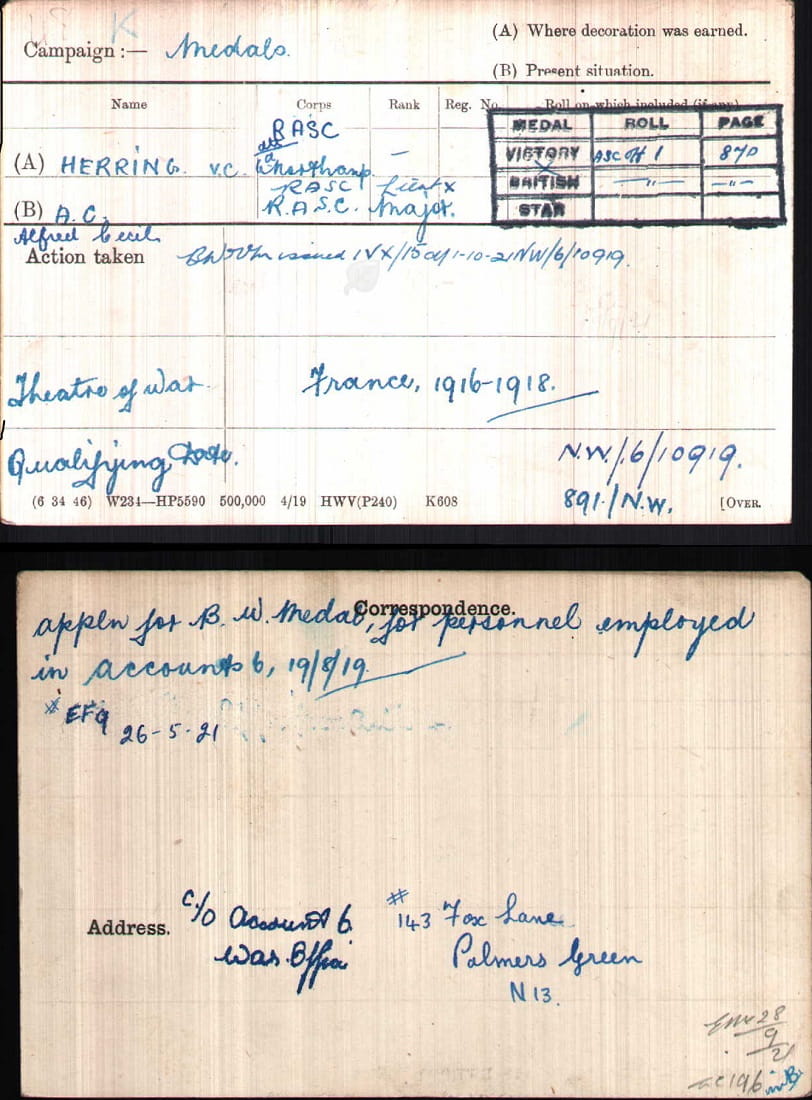
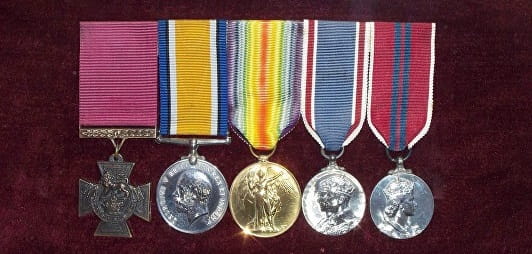
Alfred Herring died in Weybridge, Surrey on 10th August 1966 at the age of 77. He was cremated at Woking Crematorium and his ashes were scattered in the crematorium's Vase Garden. His medal group (Victoria Cross, British War Medal, Victory Medal, Coronation Medal 1937, Coronation Medal 1953) is on display at the Royal Logistics Corps Museum at Worthy Down, near Winchester. The Alfred Herring public House in Palmers Green, North London is named in his honour.
You may also be interested in

Decorations for military service
A list of all the ICAEW men who were awarded a decoration in WW1
Awards to members Awards to articled clerks
Died in the Service of their Country
List of Members and Articled Clerks who died in the service of their Country during WW1.
Read more