On this page we explain the history of the windows and how they came to be reinstated at Chartered Accountants' Hall.
Commissioning and design
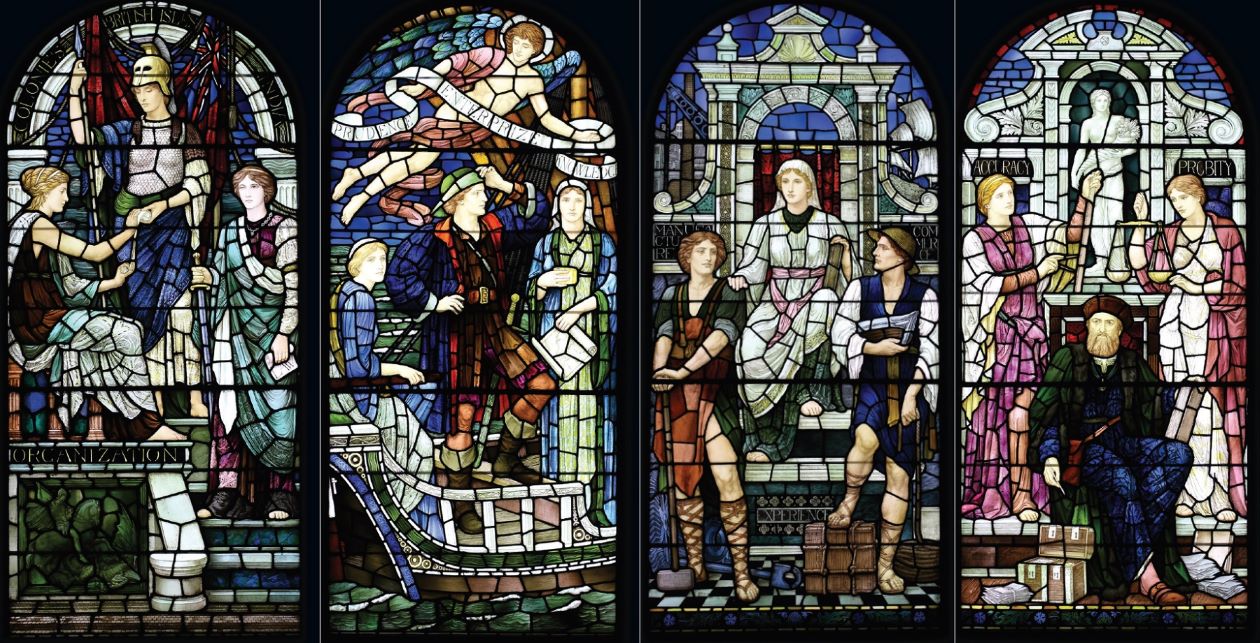
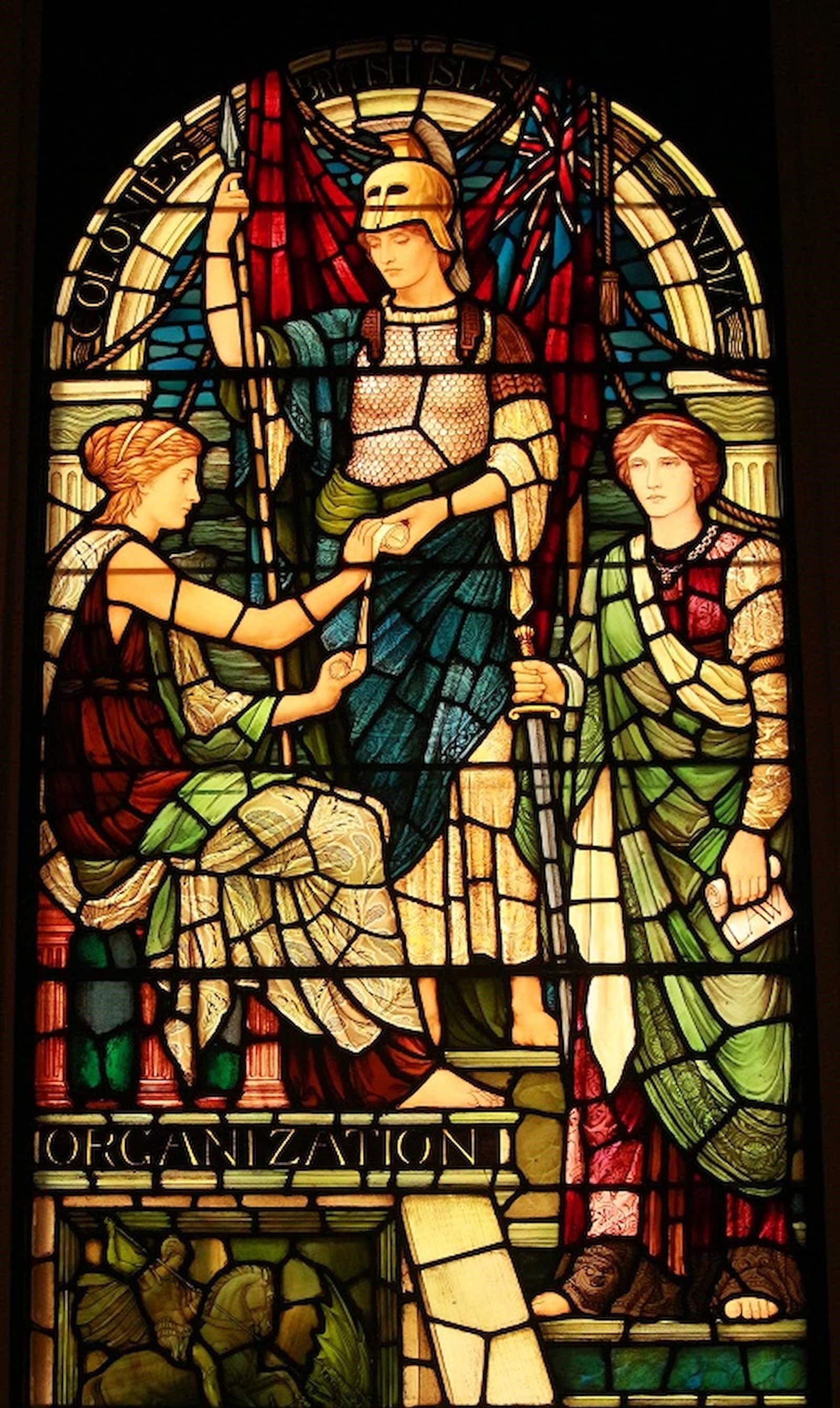
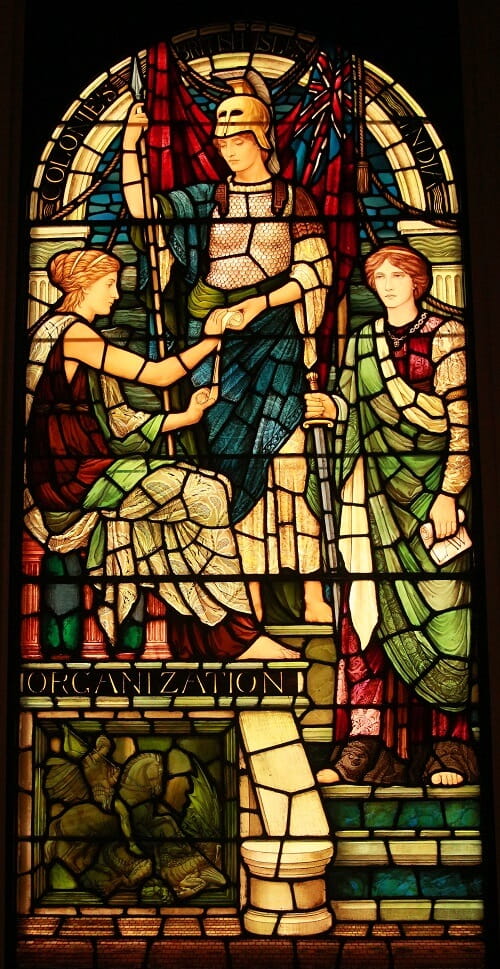
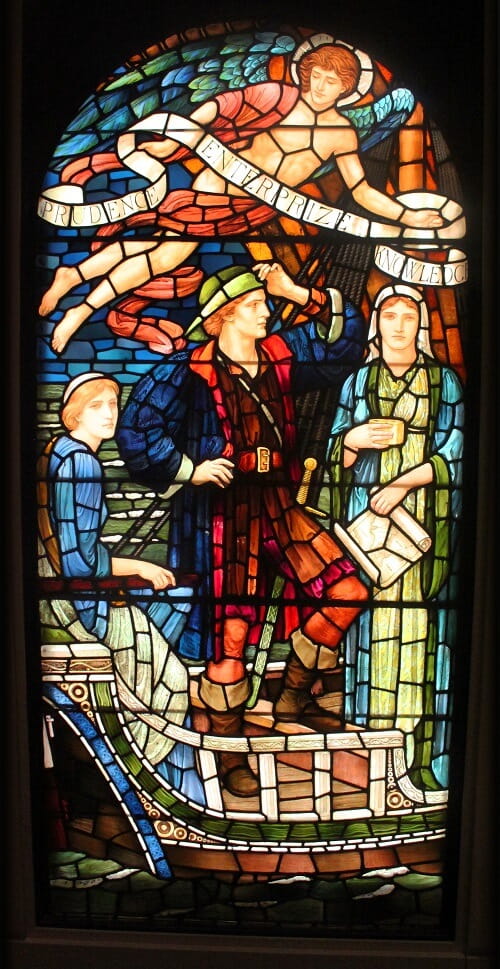
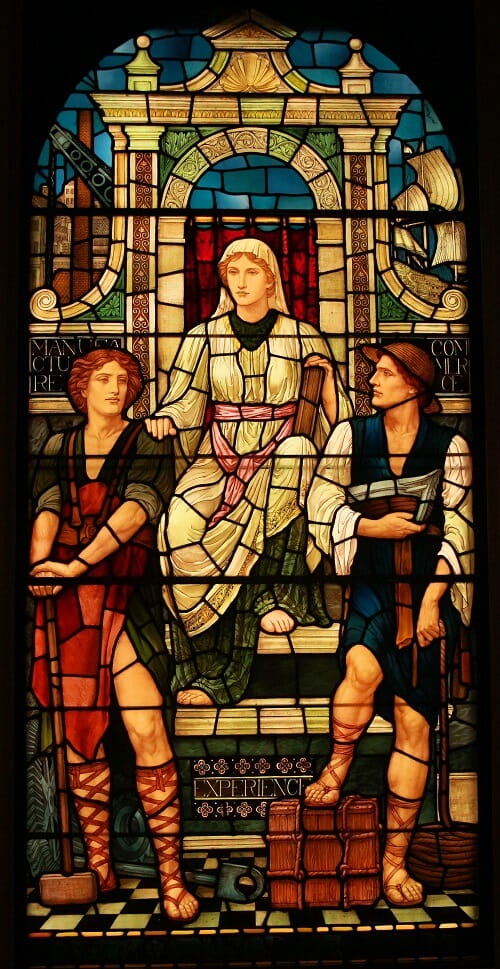
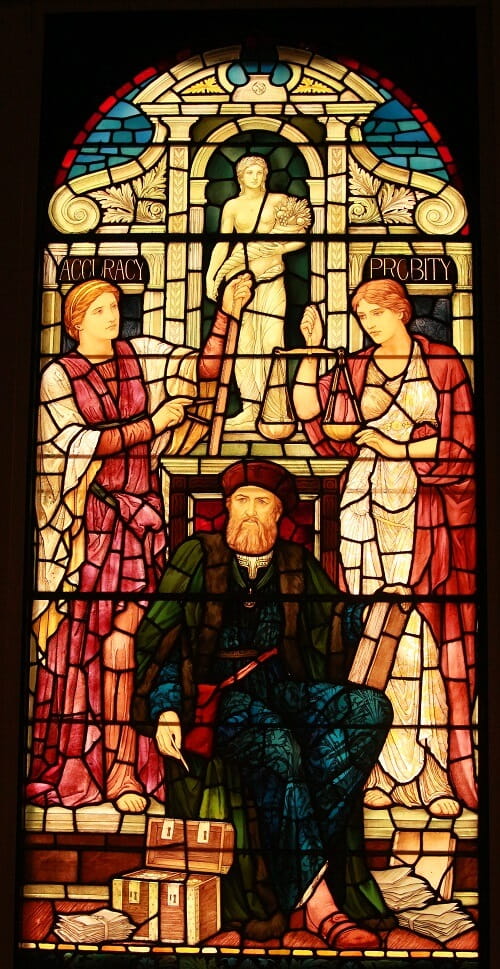
This beautiful set of four stained glass windows was designed and created by renowned stained glass artist Henry Holiday and installed in 1898 as an original commission for the main staircase at Chartered Accountants’ Hall.
Commissioned to mark the Diamond Jubilee of Queen Victoria — the monarch who had granted the Institute's original Royal Charter in May 1880 — each of Holiday's windows has a theme commemorating particular aspects of the accountancy profession, and associated virtues. For example, one window depicts allegorical figures representing Accuracy and Probity (with a sixteenth-century auditor seated beneath them), whilst another shows Prudence, Enterprise, and Knowledge.
Holiday's original paper designs, along with a further alternative design for the Enterprise window, are in the Word and Image Department of the Victoria & Albert Museum. These differ in certain respects from the finished windows. Perhaps most notably, the paper design for the window titled 'Britannia establishing Organization, supported by Law' shows a forlorn figure representing Fraud and Disorder imprisoned behind bars, beneath the throne of Organization. In the finished window, this detail is replaced by a depiction of St. George and the Dragon.
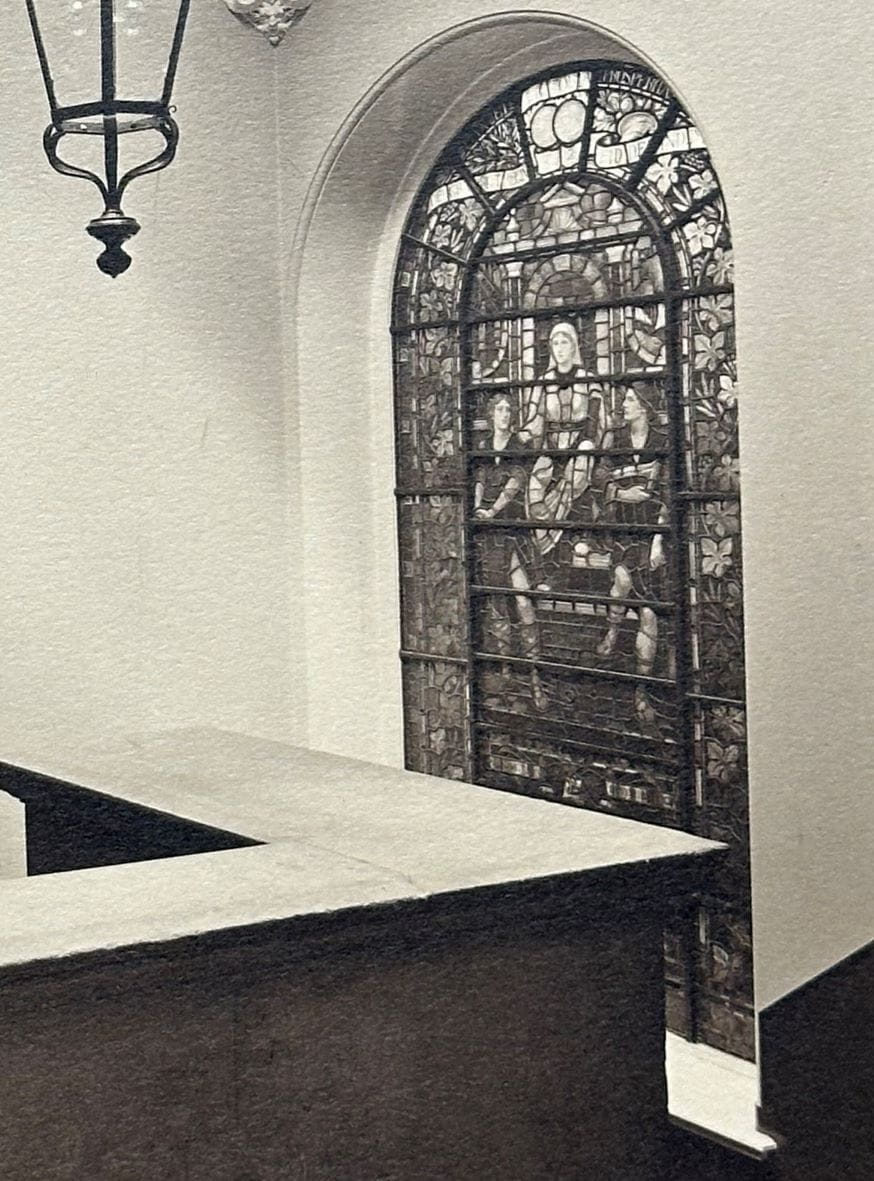
In their original form, each of the windows included an intricate lower portion incorporating a depiction of Economia within a shield, as well as an arched outer frieze which combined decorative details such as vine tendrils or acanthus foliage with textual references to central principles of the profession. Available sources suggest that the two windows on the first landing both had identical (or at least very similar) outer friezes, with the two windows on the second landing having a different surrounding design. However, it should be noted that there are no known photographs of three of the original windows in situ — and only an obscured photo of the fourth.
A partial view of one of the windows as first installed can be seen in the photograph below, taken in 1936.
Wartime damage
Unfortunately, the windows were damaged during the blitz of 1940.
The detonation of a land mine at Austin Friars on the night of 15-16 October 1940 resulted in the complete destruction of the Dutch church and devastation to many of the buildings around. Although not in the immediate vicinity, a great many of the windows on Chartered Accountants' Hall were broken or shattered by the explosion.
Documents from the time record that some of the glass in the Holiday windows was broken, with other sections bulging considerably. The windows were also apparently blown out of their recesses, allowing rain to enter the building. This necessitated their removal, with the openings being temporarily boarded up.
Post-war restoration
When the windows came to be restored, the outer friezes were not replaced, with plain glass being used instead.
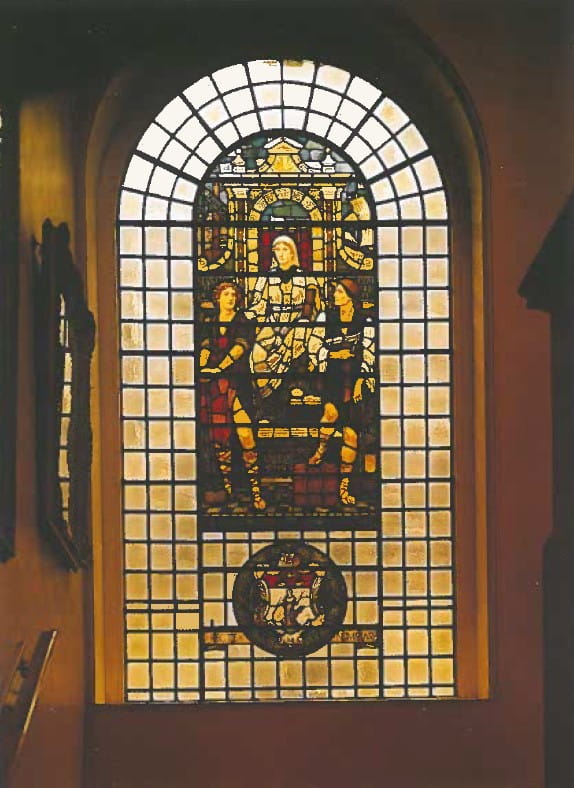
Photographs taken after this restoration — such as the one above — show stained glass roundels depicting the ICAEW coat of arms mounted beneath each of the Holiday windows. The precise origin of these roundels has been clouded by a lack of photographic and documentary evidence; some experts attribute them to Holiday, whilst others claim they are the work of another artist.
Can you help us solve the mystery?
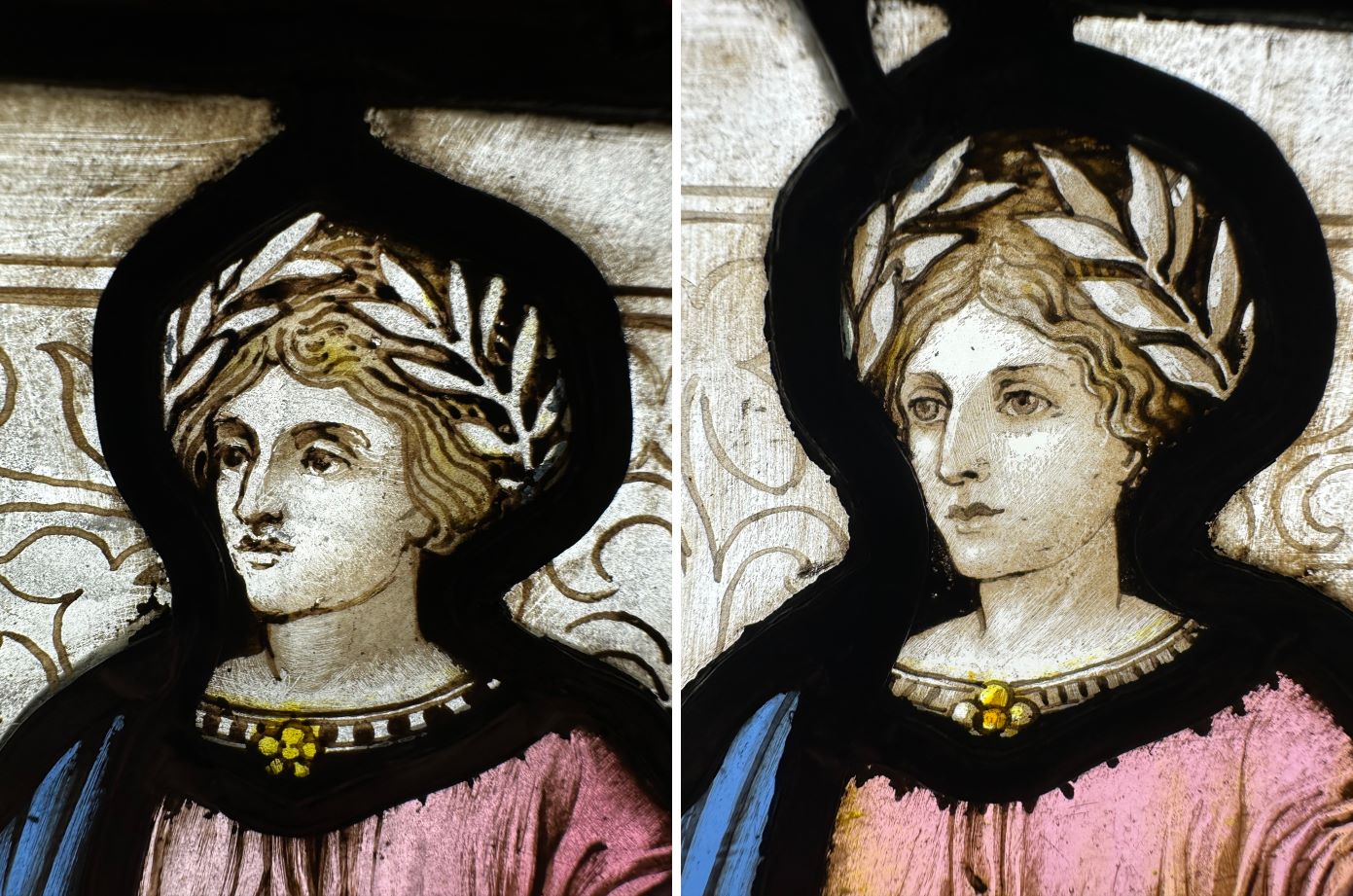
Research undertaken by the ICAEW Library team suggests that at least one of the roundels may have been salvaged from the lower portion of the windows as originally installed. The top of one roundel is just visible in the lower part of the black and white photograph from 1936, with scrolls reading 'Production' and 'Distribution' intersecting it on each side. The roundel pictured below — photographed in its present location at the entrance to the One Moorgate Place Club — features recesses that match this intersection. It also features a depiction of Economia which is quite similar in style to the depiction of St. George seen in 'Britannia establishing organization, supported by law'.
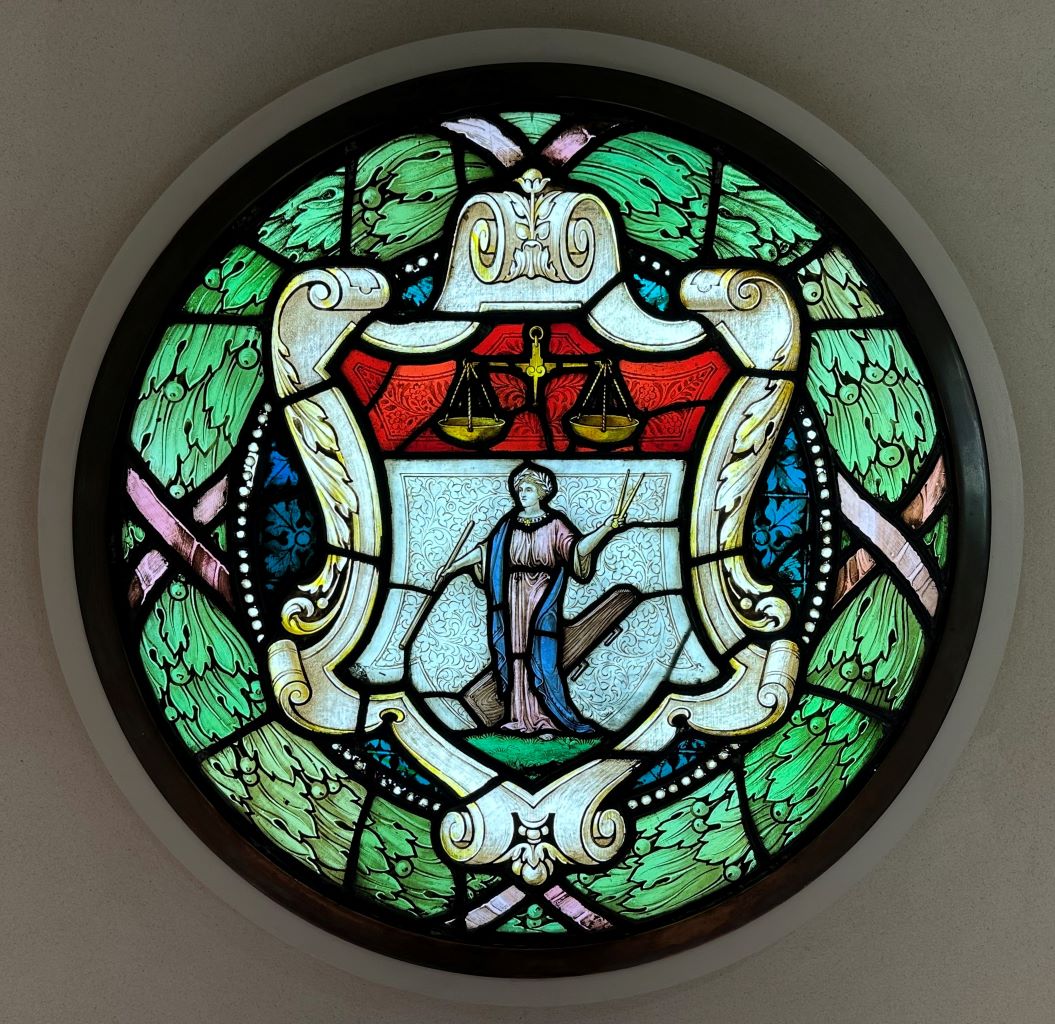
The other three roundels are different in quality and style, suggesting that they may be the work of another artist. They differ most markedly in their depiction of Economia — see the comparison below. Are these contemporary with the fourth roundel or could they be copies created when the glass was being re-set after the war? We remain open-minded as to these and other possibilities.
All four of the windows (plus the accompanying roundels) were removed in 1970 to accommodate the addition of the Whitfield Tower and the Great Hall. Thanks to the ICAEW Foundation, whose remit encompasses preservation of heritage assets, they were reacquired in 2017.
Reacquisition — bringing the windows home
It took a considerable ICAEW team effort to both reacquire and reinstate the heritage windows, which mark a significant point in the history of Chartered Accountants’ Hall.
ICAEW staff collaborated to research the original locations of the windows in the building and to uncover the mystery of where they had been for the last fifty years.
After being removed in 1970 for building work at Chartered Accountants' Hall, the windows were sold on. They spent the best part of the next five decades in a barn owned by Peter Grant, manager of rock group Led Zeppelin, who was a collector of objects of 20th century design. Following his death the windows were rediscovered by his family and put up for auction as a set.
Celebratory reception
Henry Holiday's windows were carefully reinstated in 2017 as part of the refurbishment of ICAEW's Great Hall.
The windows were unveiled at a reception in October 2017. Andrew Pianca, chair of Chartered Accountants’ Trustees, gave a speech describing the journey the windows took after they left CAH in 1970 and how they were found and reacquired.
The guests then heard from Peter Cormack, a stained glass expert and scholar of the work of Henry Holiday. He explained Holiday's 'challenge' to come up with four designs based on the subject of accountancy.
Although Holiday struggled at first, he had a breakthrough when he began to understand the pivotal role and multidisciplinary nature of the profession. This led to the four final themes chosen: law, enterprise, commerce and finance.

Further reading
Henry Holiday — four epic windows
A detailed pamphlet telling the story of Henry Holiday's career as an artist and describing the iconography and the original location of the four windows. It also explains Holiday's inspiration for the images he chose and the process used for designing and producing the windows.
Please note: the pamphlet may contain some inaccuracies as to the specifics of the windows' history. For example, although it refers to the windows being completed and installed in 1895, research by ICAEW staff has confirmed that the windows were commissioned to celebrate Queen Victoria's Diamond Jubilee (1897) and installed during 1898.
Image gallery
Can't find what you're looking for?
The ICAEW Library can give you the right information from trustworthy, professional sources that aren't freely available online. Contact us for expert help with your enquiries and research.
