A landmark English text on accounting
Published in London in 1553 by the King’s Printer, Richard Grafton, The Maner and Fourme was written to instruct English merchants and tradespeople in the systematic maintenance of accurate financial records, using the methods of double-entry bookkeeping.
Its author, James Peele, was clerk of Christ’s Hospital in London, where one of his responsibilities was the management of the institution’s financial records and accounts.
The book stands as a landmark in the history of accounting in England, given that it contributed to the diffusion of double-entry bookkeeping practices — originally developed in Renaissance Italy — into English commercial life.
It is considered to be an influential precursor to subsequent, more detailed works on the subject — including Peele’s own The Pathe Waye to Perfectnes, in th'Accomptes of Debitour, and Creditour, which was published in 1569.
A poetic appeal for good practice
One of the most charming features of The Maner and Fourme is a short didactic poem, in which Peele exhorts his readers to follow the rules set out in the book.
An image of the poem, as it appears in the Library’s copy of the book, is shown below.
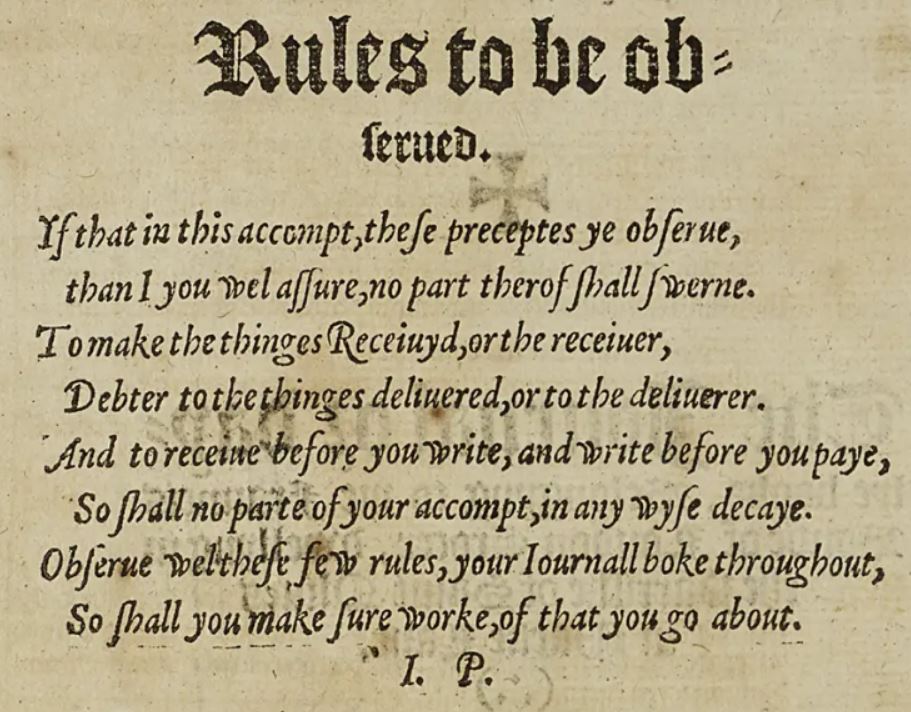
Though light in tone, the poem reflects the serious purpose of the treatise: to instil the habit of orderly double-entry bookkeeping.
Peele concludes his short verse by addressing the reader as follows:
Observe wel these few rules, your journall boke throughout, / So shall you make sure worke, of that you go about.
A unique survival
The Maner and Fourme is the earliest extant original work on bookkeeping in English. No copies of an earlier English work on the subject, Hugh Oldcastle’s A Profitable Treatyce, are known to survive.
Only one complete copy of The Maner and Fourme exists today, and it is held in the ICAEW Library collection. There is an incomplete copy of Peele's work at the British Library.
Whilst Luca Pacioli’s Summa de Arithmetica (of which the Library also holds three editions) may be more well-known, numerically speaking it is not particularly rare, with over 160 first editions known to exist around the world. The Maner and Fourme was considered to be the most desirable item in the Kheil Collection, purchased by ICAEW in 1913, and is the rarest book in our collection.
Historical Accounting Literature
The ICAEW collection of historical accounting literature currently comprises over 4,000 volumes and includes works published from the 15th century to the early 20th century. The collection includes books and journals in a variety of languages.
Contact the library
Expert help for your enquiries and research.