ICAEW’s Sole Practitioners and Small Firms in Focus research finds that technology adoption is ahead of AI adoption, with sole practitioners generally lagging small firms in both. Better integration and training are key to progress. The findings also point to concerns around data and cyber security.
ICAEW’s Sole Practitioners and Small Firms in Focus 2026 research draws on fieldwork conducted in August 2026 and explores the opportunities and challenges facing ICAEW firms with less than 11 principals.
Key takeaways:
- AI adoption: Sole practitioners and small firms are adopting AI at a slower rate than technology more generally, with better integration and training key to increasing their use of, and confidence in, AI.
- Technology use: Firms want simpler, more connected systems, with easier integration between providers and more flexible licence structures.
- Cyber security confidence uneven: Most firms recognise the growing importance of cyber security, but sole practitioners are less confident in their understanding, controls and preparedness.
AI’s impact on the profession
The impact of generative AI is regarded as the second biggest macro trend impacting the profession (after regulatory and compliance changes), ranked in their top three by 48% of sole practitioners and 55% of small firms.
Respondents anticipate that AI will reshape the profession, but there is less consensus on the nature and extent of that change. While 33% believe AI will enable firms to move up the value chain in their service offering, 45% were either neutral or unsure and 22% actively disagreed.
Just over half of respondents agree that AI will reduce the need for early-career accountants, compress mid-tier roles and require those in senior roles to have broader capabilities. Some are also concerned about the profession’s attractiveness, with 39% believing that the profession will become less attractive because of the perception that AI will replace accountancy, although 29% disagree.
More broadly, the prevailing view is that demand for accountants will continue but within a redefined profession (62%), with 47% believing the accountant’s role will shift from compliance and reporting towards judgement, systems thinking and ethical oversight.
AI adoption
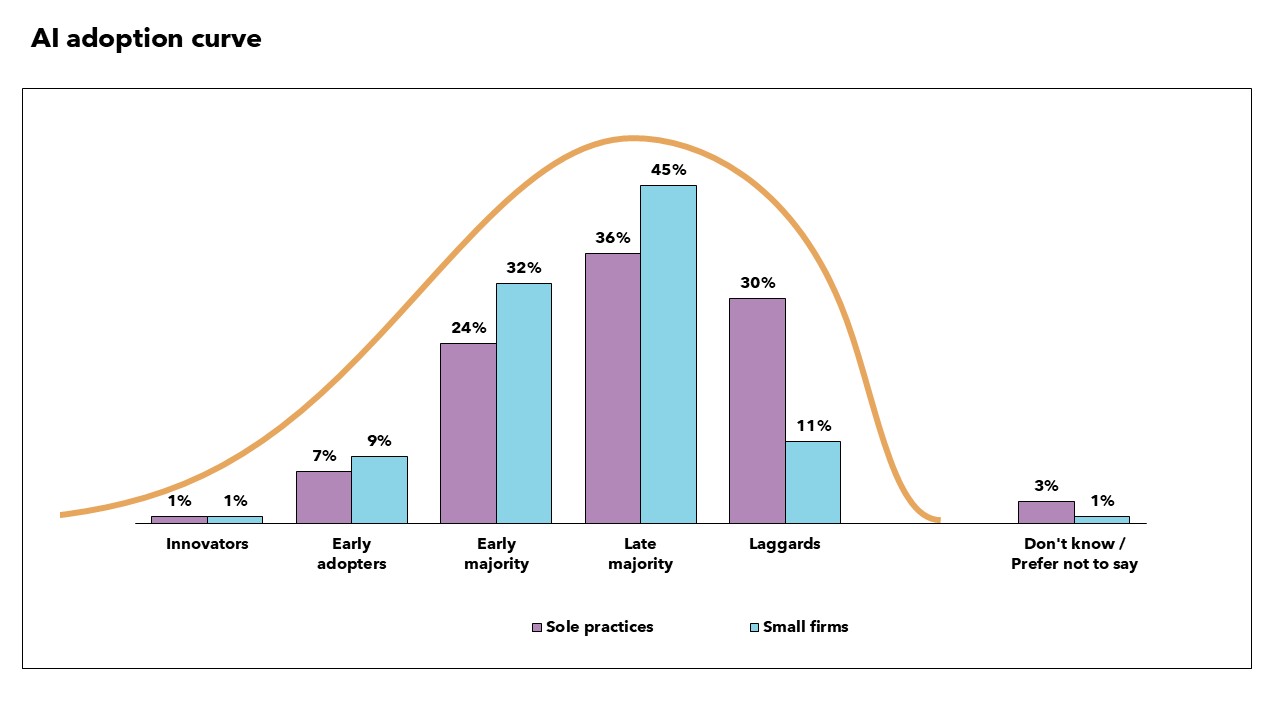
When asked where firms perceive themselves to be on the AI adoption curve, responses broadly followed a bell curve but were weighted more towards the late majority and laggards, than towards the early adopters and early majority. Sole practitioners place themselves further behind on AI adoption compared with their small firm counterparts.
-
Adoption curve definitions
- Innovators are the first individuals to embrace and adopt new technology.
- Early adopters are tech-savvy enthusiasts who follow innovators and are quick to adopt new technologies.
- The early majority are the first significant waveof mainstream consumers who adopt a technology.
- The late majority are those who adopt tehnology after the initial hype has subsided, and it has become accepted as a common part of everyday life.
- Laggards are the last group to adopt new technolgies, that continue to use their existing solutions until their are no longer viable or available.
We are happily and gradually embracing AI as it makes our lives easier. However, I suspect that there will always be demand amongst a segment of the UK business owner population for a more human-centric approach.
AI use in the firms
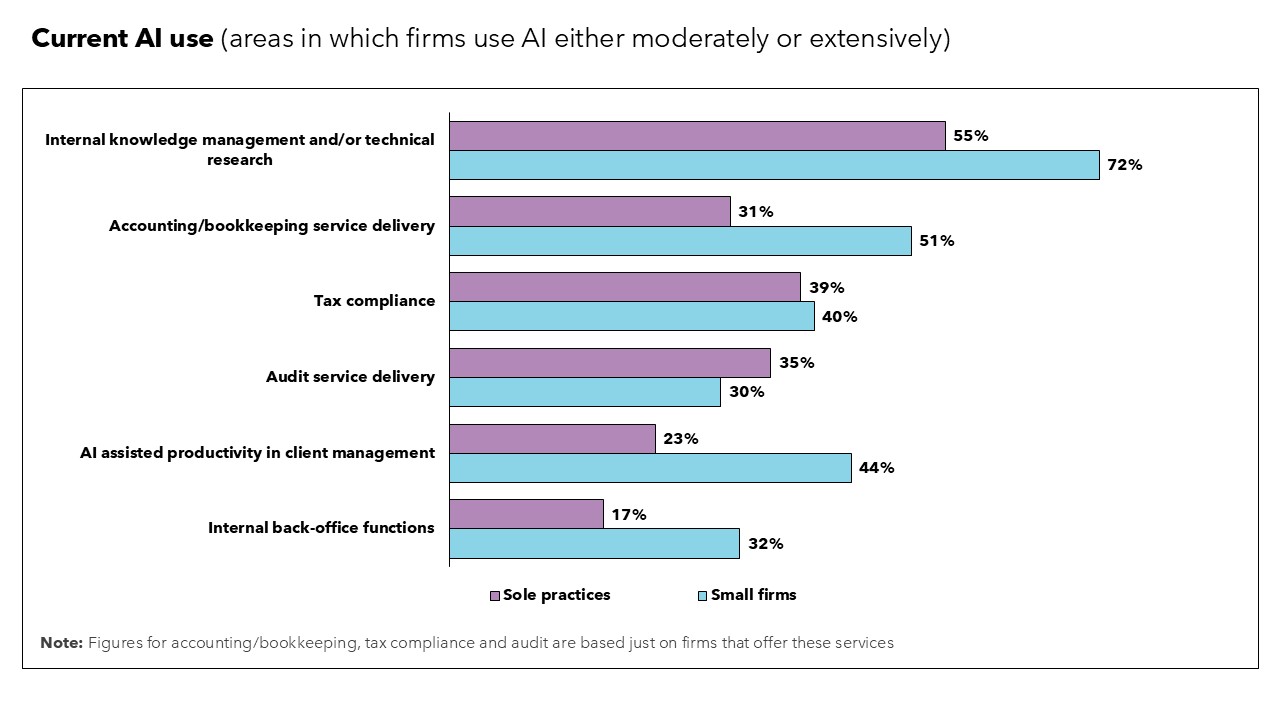
Firms report using AI across a broad range of activities, although typically at a moderate rather than extensive level, with internal knowledge management being the most common application. Across all areas, usage is highest for small firms with five or more principals.
Most small firms and a smaller, yet significant, portion of sole practitioners expect their use of AI and automation to increase.
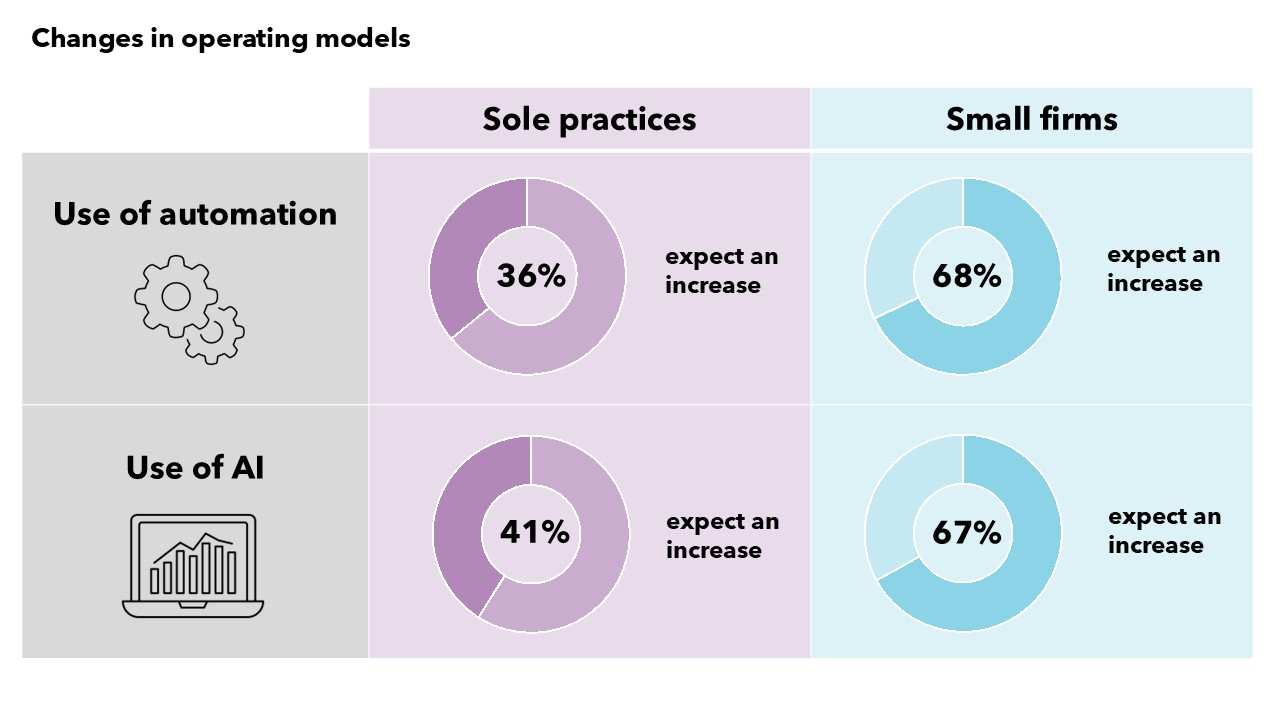
However, not all firms are looking to increase their use of AI, as one laggard stated “I maintain that my staff are better than AI, and that is not about to change any time soon”.
Better AI integration with existing tools or software, training and upskilling, and reduced data and cyber security concerns were identified as key enablers for greater AI use.
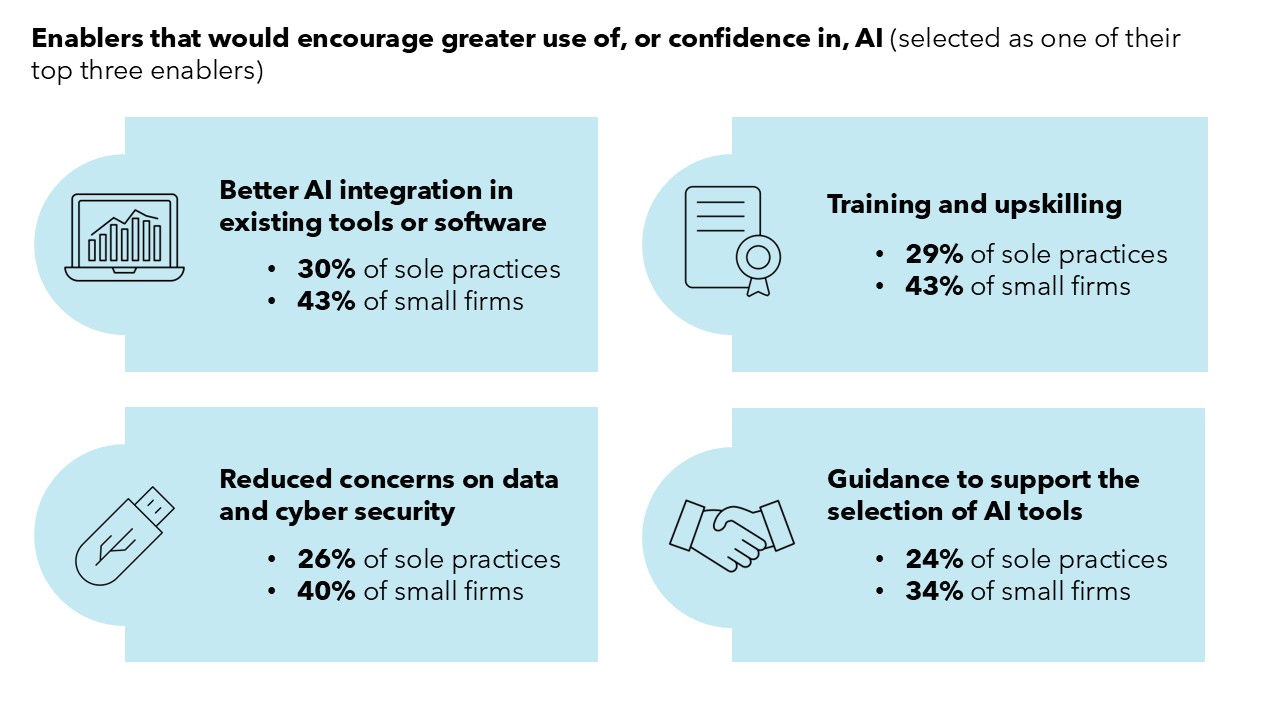
This need for training and upskilling is reflected in respondents’ wider talent challenges. Although only 14% of firms employing staff identified future-proofing skills as a top three talent challenge, 71% of this group selected AI skills as their most significant future-proofing skills gap.
AI may be one of the most significant developments facing the profession, but this research highlights the importance of keeping people at the centre of that transformation. The firms most likely to succeed will be those that can combine new technologies with the judgement, trust and relationships that clients continue to value.
Technology adoption
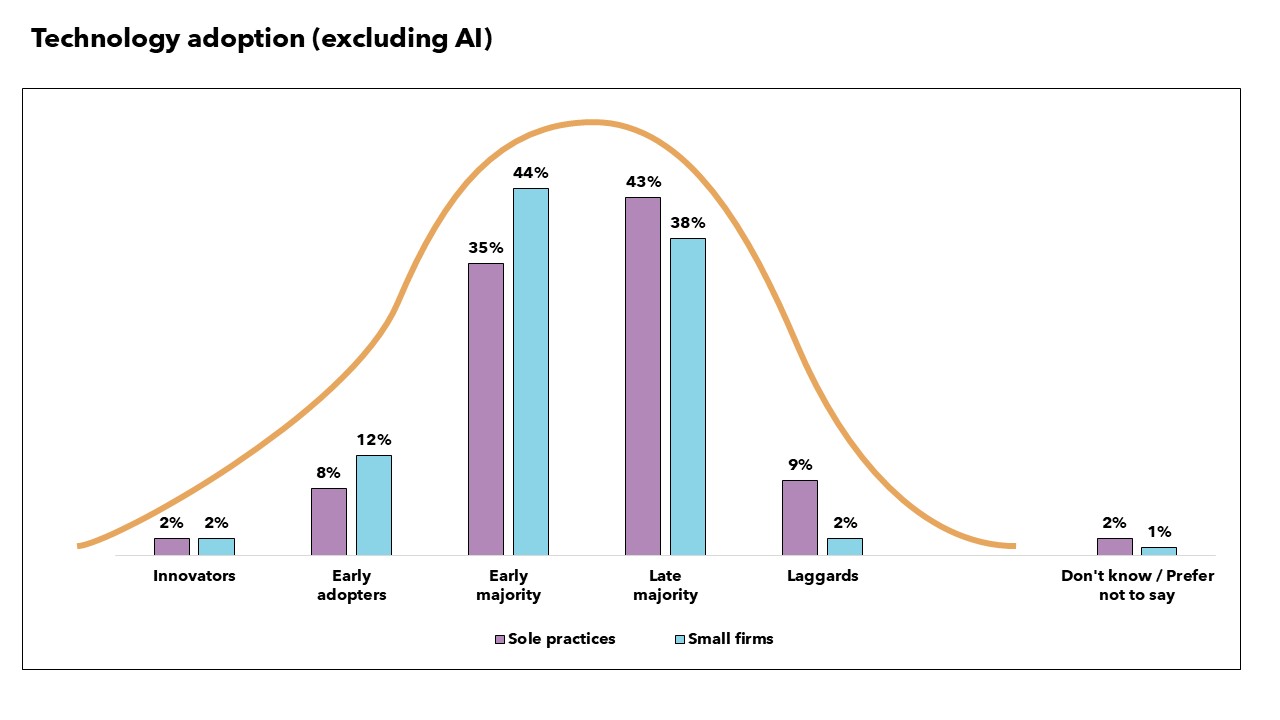
Firms generally view their technology adoption as more advanced than their AI adoption, with 43% of sole practitioners and 59% of small firms describing themselves as early majority, early adopters or innovators (compared with 32% and 43% respectively for AI adoption).
-
Adoption curve definitions
- Innovators are the first individuals to embrace and adopt new technology.
- Early adopters are tech-savvy enthusiasts who follow innovators and are quick to adopt new technologies.
- The early majority are the first significant waveof mainstream consumers who adopt a technology.
- The late majority are those who adopt tehnology after the initial hype has subsided, and it has become accepted as a common part of everyday life.
- Laggards are the last group to adopt new technolgies, that continue to use their existing solutions until their are no longer viable or available.
Specialised software
Specialised software is widely embedded across core service lines, including tax, accounts production and payroll. Only a small minority do not use it at all: 7% of sole practices and 2% of small firms.
Small firms are also more likely than sole practices to use specialised software in other areas of their operations, such as practice management, time and expense management, and client onboarding. This is particularly evident among firms with five or more principals.
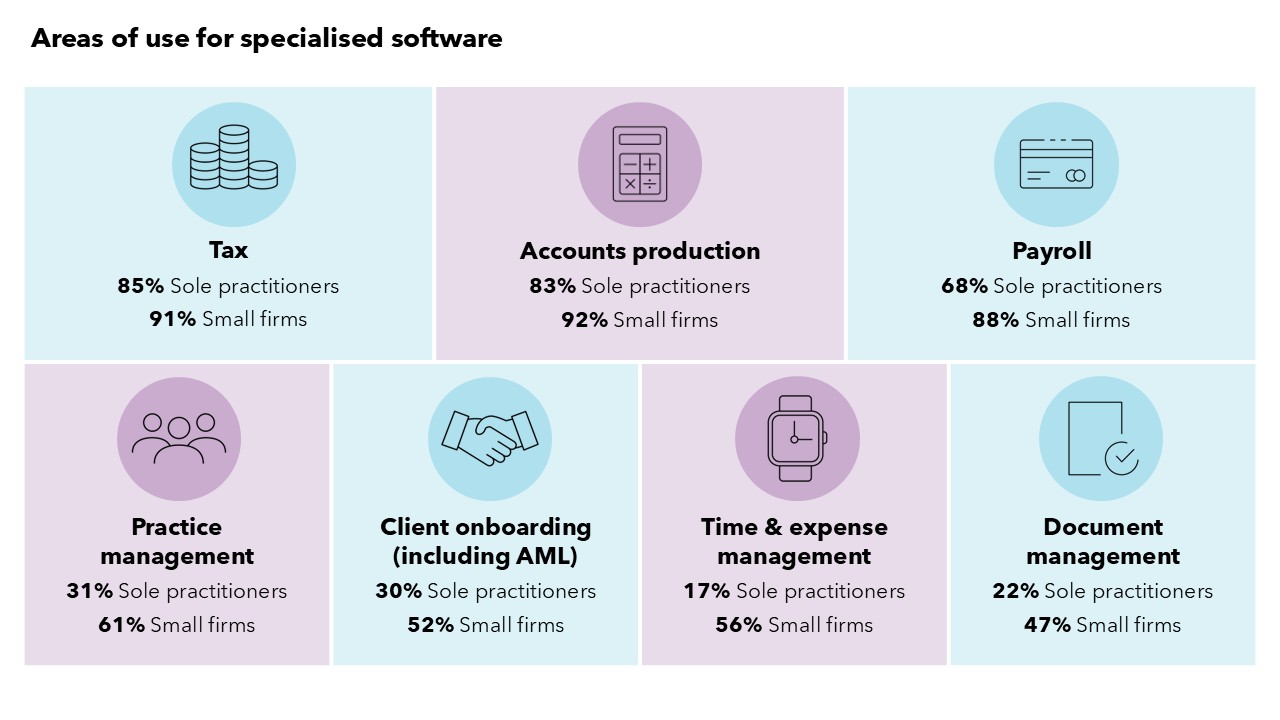
Easier integration between software providers is the single biggest factor that would increase use of, or confidence in using, specialised software. This was emphasised by 62% of small firms and 47% of sole practitioners. Clearer or more flexible licence fee structures were the next most cited enabler.
Software providers
Practitioners use a wide range of software providers, with six major providers dominating the market. Sole practices tend to use fewer providers: 21% use just one, compared with 12% of small firms. 15% of sole practices and 29% of small firms use five or more providers.
Cyber security
Cyber security emerges as an area in which firms appear insecure, with only 45% of respondents agreeing that they have a strong understanding of the risks facing their firm, and 55% believing they have appropriate measures in place to manage the risks.
A gap in cyber security preparedness emerges between sole practitioners and small firms. Small firms are more likely than sole practitioners to agree that cyber security risks are becoming increasingly significant for their firm (66% vs 47%), that they have a strong understanding of the current cyber security risks facing the firm (59% vs 37%), and that they have appropriate processes and controls in place to address cyber security risks (70% vs 46%).
A relatively high proportion of respondents, especially sole practitioners, neither agreed nor disagreed with these statements or said they did not know. This suggests that many may be uncertain about their level of cyber security preparedness and their ability to assess cyber risks confidently.
The continually evolving cyber threat landscape, combined with resource constraints, can make it challenging for firms to manage cyber security risks effectively. The findings indicate that while firms have implemented some processes and controls, they may not be addressing their most significant risks. As AI increases the speed and scale at which vulnerabilities can be identified and exploited, effective cyber governance and risk management become ever more crucial in prioritising remediation efforts and protecting firms.
Explore the findings

More information
PDF (374kb)
You can download all of the charts generated by the research and watch our webinar discussing the findings in full.
DownloadWatch our webinar