ICAEW’s Sole Practitioners and Small Firms in Focus research shows that differences in staffing, client portfolios and operating models shape the services sole practitioners and small firms offer. Despite these differences, many hold similar views on the pressures facing firms and the evolving role of the accountant.
ICAEW’s Sole Practitioners and Small Firms in Focus 2026 research draws on fieldwork conducted in August 2026 and explores the opportunities and challenges facing ICAEW firms with less than 11 principals.
Key takeaways:
- Different firm size, shared pressures: Sole practitioners and small firms differ in size and client base but face many of the same challenges.
- Growth within existing services: Advisory growth is focused on existing services, with limited appetite for diversification.
- Change is reshaping firms: Regulation, AI and talent challenges are reshaping how firms operate and support clients.
Sole practitioners
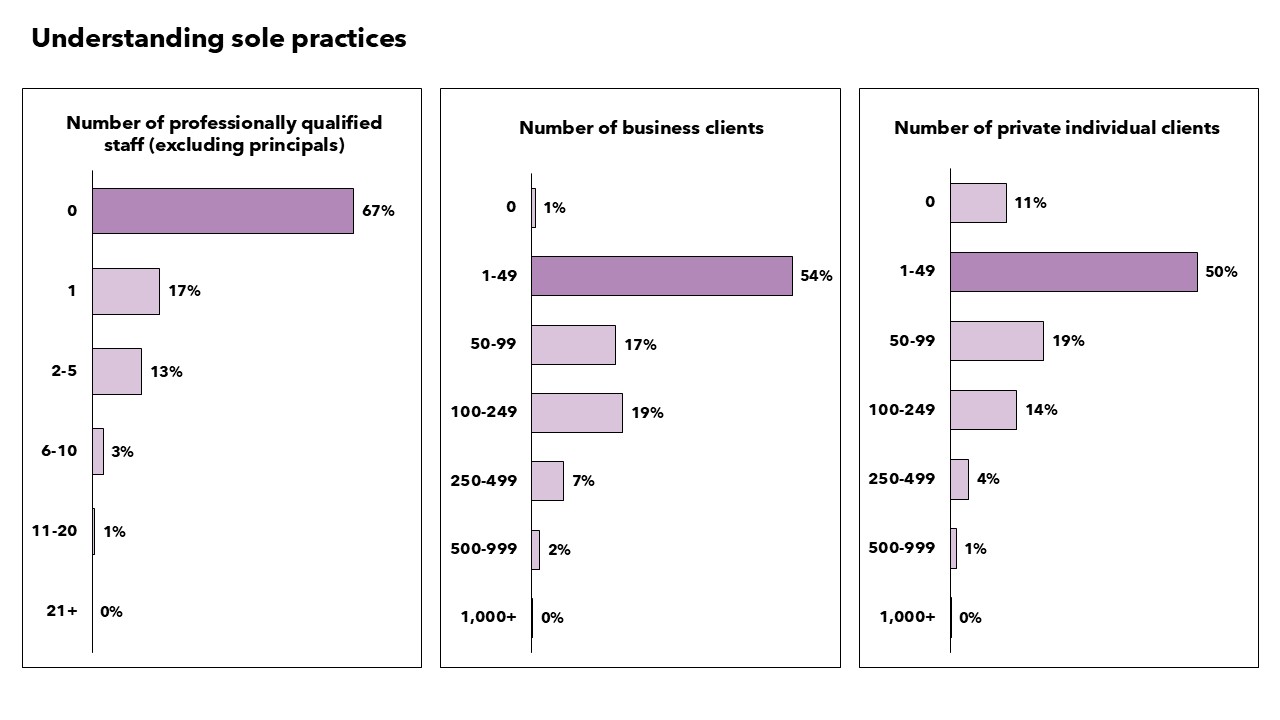
Sole practitioners make up a significant proportion of ICAEW member firms and play a pivotal role in the accountancy profession, serving a broad range of business and private individual clients.
Most sole practitioners offer accounting (92%), tax compliance (86%), bookkeeping (69%) and payroll (68%). Only 7% offer audit services.
Focusing on advisory services, tax advice is by far the most commonly provided service, offered by 78% of sole practitioners. Just over one-fifth of these practitioners plan to grow the service. Financial planning is the second most commonly provided advisory service, offered by 36%, and one-fifth of these firms plan to expand in this area.
Appetite to diversify is low, with only 11% planning to introduce a new advisory service line to their firm.
Sole practitioners identified case studies and guidance (56%), professional skills upskilling (55%) and technical expertise upskilling (51%) as the factors most helpful in enabling the growth of advisory services.
Only one-third of sole practitioners employ professionally qualified staff, and some of these firms face challenges with attracting and recruiting qualified staff (27%), succession planning for senior leadership roles (26%) and contrasting work ethos/attitudes across different generations (22%). 29% said they faced no talent challenges at all.
Stability is expected across operating models, with at least three-quarters of sole practitioners anticipating no change in the number of principals, trainees or other professional staff, or in their use of offshoring and outsourcing, over the next three years.
Small firms
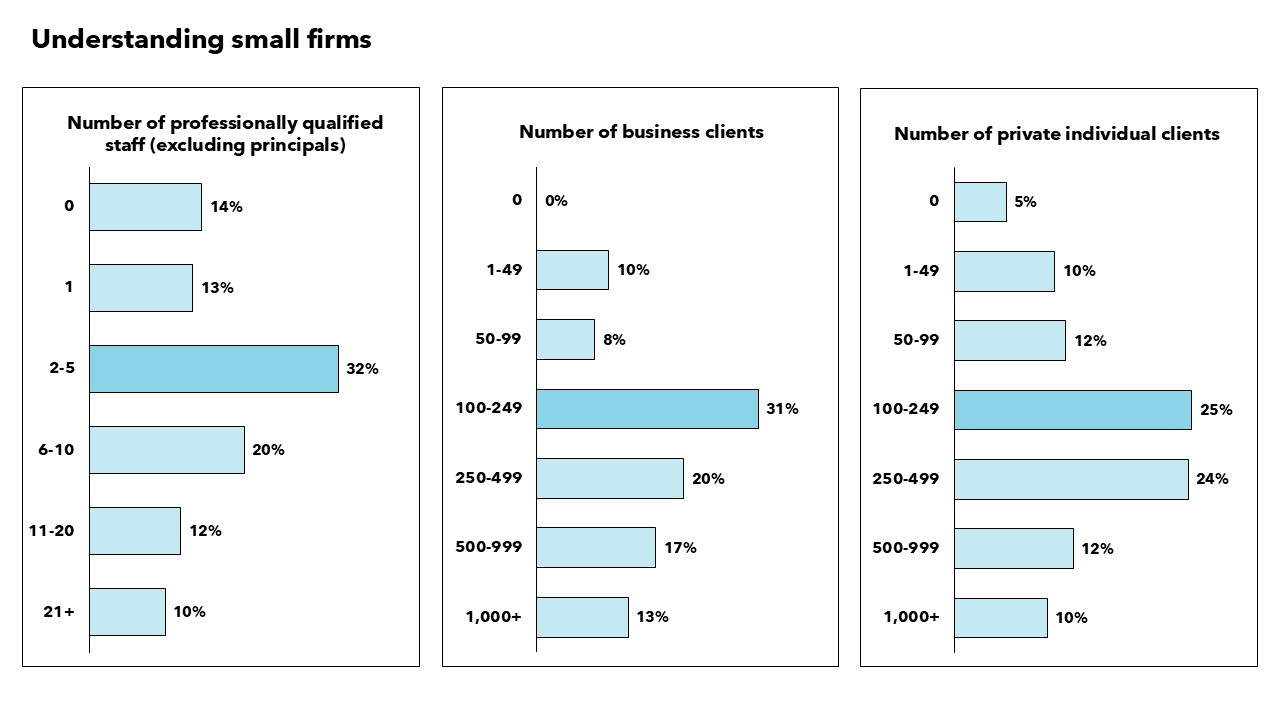
For the purposes of this research, small firms are categorised as those having between two and ten principals.
Small firms support a wide range of business and private individual clients, often drawing on broader teams to deliver their services.
Most small firms offer accounting (95%), tax compliance (94%), payroll (88%) and bookkeeping (87%). Almost half (46%) offer audit services, compared with just 7% of sole practitioners. This increases to 84% among small firms with at least 5 principals.
Tax advice is the most commonly provided advisory service, offered by 90% of small firms, with just over half planning to grow this area. Financial planning follows, offered by 61%, with just under one-third of these firms planning to expand the service. Thirdly, corporate finance services are currently offered by 28% of small firms with nearly one-third of these intending to grow the service.
Appetite among small firms to introduce entirely new advisory services is modest (although higher than for sole practitioners) with only 19% of small firms looking to launch a new service line.
The most helpful enablers of growth in advisory service lines cited by small firms are technical expertise upskilling (63%) and technical solutions (58%).
In terms of their operating models over the next three years, most small firms anticipate no change in trainee levels or in their use of offshoring and outsourcing, however, 36% expect to increase the number of professional staff between trainee level and principal.
Small firms consider their biggest talent challenges to be succession planning for senior leadership roles (42%), attracting and recruiting qualified staff (41%), contrasting work ethos/attitudes across different generations (36%) and demands for flexible or hybrid working arrangements (24%).
Macro trends impacting the profession
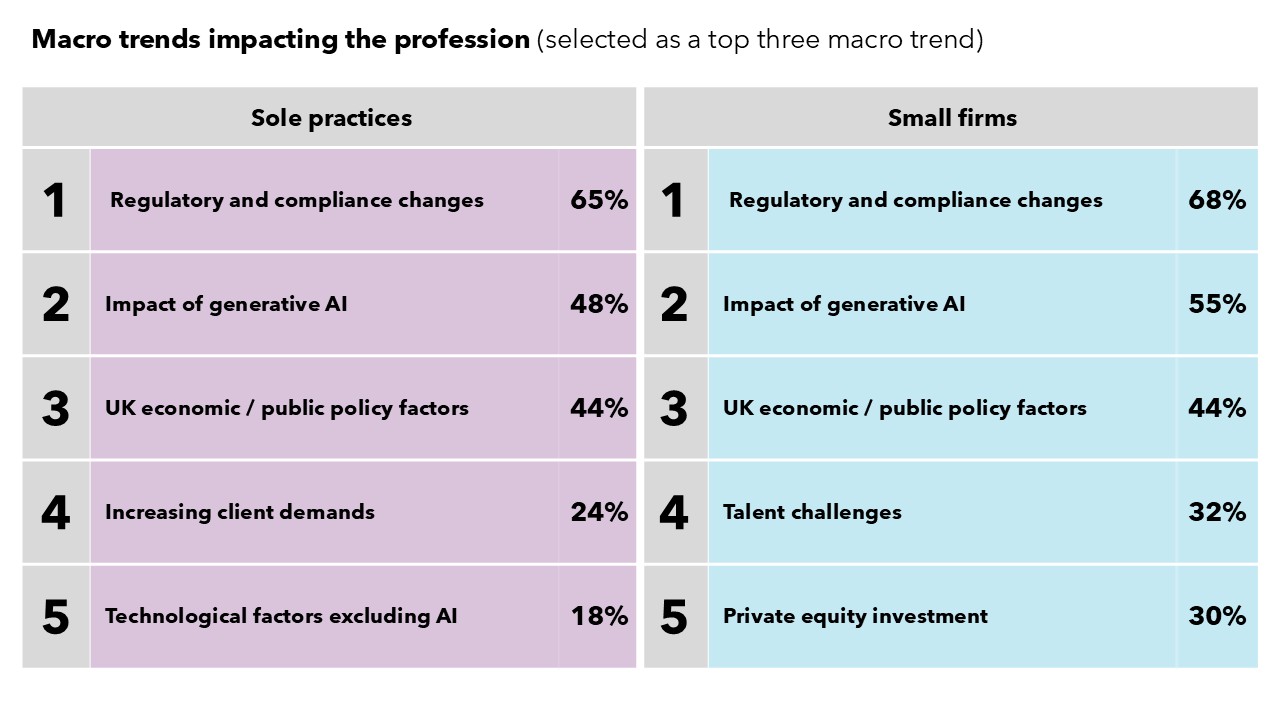
Despite their different profiles, sole practitioners and small firms share similar views on the pressures shaping the profession today.
These pressures are led by regulatory and compliance change, which was identified by two-thirds of all respondents as a top three macro trend. A further 44% identified UK economic/public policy factors and over half identified the impact of generative AI.
I am reasonably optimistic about the profession - it's always faced challenges
Sole practitioners and small firms are a diverse and vital part of the profession. While their ambitions and operating models vary, they share a strong commitment to their clients and face many of the same pressures. As the profession continues to evolve, the findings underline the value of practical support, technical expertise and guidance in helping firms adapt and thrive.
Explore the findings

More information
PDF (374kb)
You can download all of the charts generated by the research and watch our webinar discussing the findings in full.
DownloadWatch our webinar