Q2: Business confidence in Wales slumps amid concerns about labour and energy costs.
The latest national Business Confidence Monitor (BCM) shows that the Iran War significantly dented confidence as it dropped to a near four-year low and suffered its sixth successive negative quarterly score. Companies reported rising costs pressures, weaker expected sales and profits growth for the coming year, while late payment concerns hit a five-year high.
The survey results are based on 1,000 telephone interviews among ICAEW Chartered Accountants covering a range of UK sectors, regions and company sizes, ensuring a representative picture of the UK economy. The latest quarterly findings are based on the period 13 April to 19 June 2026.
- Business confidence in Wales fell sharply in Q2 2026, dropping to -14.1 from -3.7 in Q1 2026, below the historical norm (+2.5) but broadly in line with the UK average (-14.6).
- While annual domestic sales growth lagged the UK average, growth is expected to strengthen over the next 12 months. In contrast, exports growth rose in the year to Q2 2026 but is expected to moderate significantly.
- Labour costs were widely cited as a growing concern for Welsh businesses, with annual pay growth remaining significantly above the norm thought it is expected to ease.
- With energy costs another significant concern, input price inflation is expected to tick higher next year but businesses appear reluctant to pass rises on to customers.
- Companies reduced their annual capital investment and plan to scale back R&D spending over the next 12 months.
Business confidence in Wales
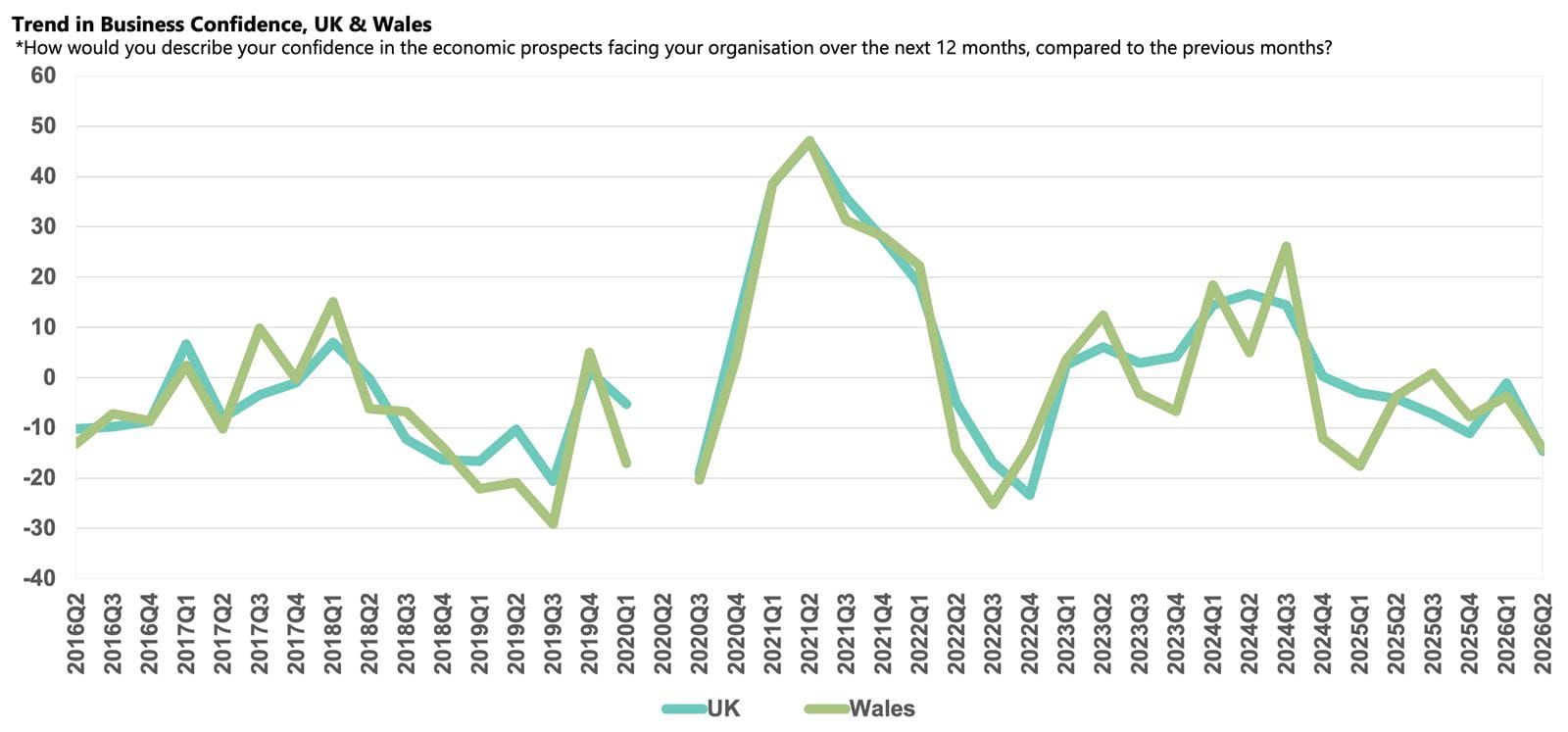
Sentiment in Wales fell deeper into negative territory in Q2 2026, with the Business Confidence Index dropping from -3.7 in Q1 2026 to -14.1. Confidence among Welsh companies was significantly below the historical norm (+2.5) and broadly in line with the UK average (-14.6).
While the election of a Plaid Cymru Government in the May elections may have inspired some hope and expectation among Welsh businesses towards the end of the survey period, volatility in the wider geopolitical climate has caused a further drop in sentiment. The Iran War and the closure of the Strait of Hormuz drove a sharp rise in energy prices and dampened sentiment across the UK, although the decline among Welsh companies was less severe than the national average. In particular, developments in US–Iran relations will be key to whether these pressures will ease in the months ahead, however Welsh businesses expect input costs to rise over the coming year and labour costs was the most widely cited growing challenge.
Domestic sales and exports growth
Businesses in Wales reported softer annual domestic sales growth in Q2 2026, at 2.2%, and below both the historical norm (3.0%) and the 3.6% rate recorded nationally. Companies expect a notable uplift over the next 12 months, with the projected increase of 5.1% set to exceed the 4.7% rise forecast nationally.
Exports growth in Wales outperformed the UK in the year to Q2 2026 with the above-average expansion perhaps attributable to stronger export performance reported by the Energy, Water & Mining sector. However, this robust performance is not expected to be sustained, and businesses anticipate exports growth to slow sharply over the next 12 months to 2.2%, below the Welsh norm (2.8%) and the 4.0% rise predicted across the UK.
Business challenges
Labour costs were the leading concern reported by businesses in Wales in Q2 2026 and is likely attributable to the uplift in employers’ National Insurance Contributions and consecutive increases in the National Minimum Wage alongside any additional costs associated with the Employment Rights Bill. This issue was cited by 62% of the companies surveyed in Wales as a growing challenge, up from the previous quarter, and above the national average (58%).
The widespread disruption caused by the closure of the Strait of Hormuz is reflected in the proportion of Welsh businesses citing energy costs as a growing concern in Q2 2026. Energy costs were the second most prominent growing challenge, with the proportion rising from the previous quarter to 56%. Transport problems were also reported by 22% of Welsh businesses, a notably higher rate than the historical average (14%). With the Iran War ongoing through much of the survey period, geopolitical risks (53%) ̶ newly added as a challenge this quarter ̶ also featured prominently among Welsh businesses.
Customer demand (53%) was a greater concern for companies in Wales than reported in any other UK region and is also likely to have contributed to the sharp decline in sentiment over the quarter.
Labour market
Against a backdrop of heightened concern about labour costs, businesses reported that they increased salaries by 3.1% in Q2 2026, with the pace of pay growth remaining well above the region’s historical norm. Businesses predict wage growth will moderate slightly over the next 12 months, to 2.9%, compared with the 2.7% rise forecast nationally. Labour costs do not appear to be preventing employment growth, with companies raising employment by 2.0% in the year to Q2 2026, outpacing both the region's historical norm (1.2%) and the 1.4% rate recorded nationally, with businesses anticipating further expansion next year.
The comparatively sharp expansion in employment in the year to Q2 2026 is reflected in concerns relating to the availability of both management (17%) and non-management (24%) skills in Wales. The proportion of businesses citing both these concerns was above each of their respective historical averages (16% and 20%) this quarter and were both more prevalent in Wales than almost any other UK region.
Input and selling prices, and profits growth
Annual input price inflation in Wales remained unchanged from the previous quarter, at 3.7% in Q2 2026, still above the historical norm (2.8%) but below the 4.1% rate recorded nationally. Following the outbreak of the war in Iran, businesses have uplifted their expectations for input price growth over the next year to reflect the subsequent supply chain bottle necks and spikes in energy prices, and now expect a 4.1% increase over the coming year, marginally exceeding the 3.8% growth anticipated nationally.
With above-average concern about customer demand, there was evidence from BCM that Welsh businesses are cautious about passing on rising input costs to their customers, with annual selling price growth moderating significantly in Q2 2026, to 2.3%. While this increase is still above the region's historical norm (1.6%), it was the joint-lowest uplift of any UK region, alongside the South East. Companies plan to soften selling price growth further over the next 12 months, with the projected increase of 2.0% lower than expected in all other regions.
Subdued domestic sales growth in the year to Q2 2026, alongside elevated cost pressures, meant that companies in Wales reported softer profits growth of 2.7% in Q2 2026, marginally lagging the 2.8% national rate. Businesses predict profits growth will accelerate sharply over the next 12 months, to reach 6.0%, surpassing the 4.7% rise forecast nationally and only behind the 6.9% increase forecast by businesses in the North East.
Capital investment and R&D
Companies in Wales cut capital investment by 0.8% in the year to Q2 2026. This reduction was the weakest outturn of any UK region with the 17% of businesses citing access to capital as a growing concern in the year to Q2 2026 also the highest rate in the UK. However, Welsh businesses anticipate a strong return to growth over the next 12 months with a projected annual increase of 5.9%, above the UK average forecast (1.8%).
Annual R&D budget growth in Wales was 4.1% in Q2 2026, accelerating sharply from 1.4% in the previous quarter and outpacing both the historical norm (1.7%) and the 2.0% rise recorded nationally. However, businesses plan to moderate R&D growth markedly over the next 12 months, with the rate of expansion expected to slow to 1.6%, below the 1.8% expected across the UK.