The UK is in a period of major energy transition, driven by the need to strengthen resilience and security of supply, improve affordability, support long-term economic growth and reduce emissions. Against this backdrop, geothermal energy is increasingly attracting attention as a reliable source of low-carbon heat, cooling and – to a lesser extent – electricity.
Geothermal energy is available across the UK, directly beneath our feet. The scale of the underlying resource is substantial. A recent industry report estimates that the UK has approximately 3,900 gigawatts of geothermal potential for heating and cooling, which is enough to meet the UK’s heating demand for more than 1,000 years.
Despite this, geothermal today supplies only 0.3% of the UK’s heat demand leaving vast untapped potential.
Unearthing geothermal energy
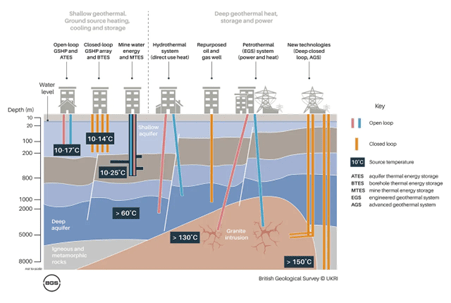
Geothermal systems use naturally occurring heat stored underground. Depending on local geology and energy demand, this can involve accessing shallow ground-source systems, warm water from abandoned mines, deep aquifers or drilling several kilometres into granite formations. Across the UK, temperatures typically increase by 25–35°C for every kilometre below the surface.
Once operational, geothermal systems provide a stable and sustainable energy source. On the surface, the geothermal fluid circulates through a closed-loop system where heat is extracted using a heat exchanger before the fluid is reinjected underground to reheat naturally and repeat the cycle.
Geothermal heating systems are seen across Europe: Paris has had geothermal heating since the 1960s, many greenhouses in the Netherlands are geothermally heated and cooled, and Munich aims to have 50% of its heat from geothermal in the near future.
In fact Germany and the Netherlands are aiming to supply around ¼ of all their heat needs from geothermal by 2050.
Despite the fact that 2,000 years ago the Romans used geothermally heated hot springs, in the UK our energy system is only just starting to include the energy beneath our feet. Live examples today include heating the biomes of the Eden Project, feeding the Southampton district heat network since 1986, heating homes and public buildings in Gateshead, and the first geothermal power in the UK was fed into the grid earlier this year at the United Downs project in Cornwall.
Enhancing energy resilience
Recent geopolitical shocks and resulting energy price fluctuations exposed the UK’s dependence on imported energy.
Geothermal energy offers a different model: a domestic energy source that is available 24/ 7 year-round and unaffected by weather conditions, with stable, predictable operating costs.
Much of the UK’s energy demand comes from heat rather than electricity, and the need for cooling is increasing. Direct geothermal heating and cooling can reduce pressure on the power grid at a time when electrification is accelerating and network capacity is becoming increasingly constrained.
Creating long-term economic value
Geothermal development has the potential to support jobs, investment and industrial transition across the UK. Opportunities exist throughout the value chain, including exploration, drilling, engineering, manufacturing, construction and operations.
The UK benefits from an existing industrial base that can support geothermal development. Skills and supply chains from oil and gas, mining and subsurface engineering are directly transferable, reducing execution risk and enabling redeployment from legacy sectors.
From a financial perspective, geothermal projects share many characteristics of long-life infrastructure assets: high upfront capital investment followed by stable operating costs and predictable revenues over decades. As businesses look to strengthen resilience against future energy market volatility, this long-term stability is becoming increasingly attractive. Projects anchored by large, creditworthy heat users such as the NHS can provide predictable revenues and improve bankability.
A further, emerging dimension is the link between geothermal and critical minerals. Geothermal systems are being developed to extract lithium from subsurface brines alongside energy production as the UK and Europe prioritise domestic sourcing of critical materials. While this is still nascent in the UK, the model is strategically relevant as it supports both energy security and mineral independence, as well as enhancing project economics.
Supporting net zero goals
The UK is unlikely to meet long-term climate targets without significantly decarbonising heat. Geothermal offers a low-carbon solution for heating and cooling.
As it provides a continuous energy output with a relatively small surface footprint, geothermal is particularly relevant for district heating, industrial facilities, hospitals, universities and communities less suited to other renewable technologies.
Baseload power production and geothermal energy storage opportunities increase the resilience of the power grid of the future, helping to offset some of the intermittency of major renewable energy sources.
Geothermal – a strategic opportunity
Geothermal energy directly supports the UK’s core energy priorities: strengthening energy security, improving affordability, building economic resilience and accelerating decarbonisation.
With the resource, skills base and demand already in place, the opportunity now is to accelerate investment, scale deployment and integrate geothermal into homes, businesses and the UK’s energy system.
*the views expressed are the author’s and not ICAEW’s
- The UK geothermal opportunity: why it matters now
- Beyond wholesale prices: The changing reality of energy costs
- Digital transformation in the energy transition
- Letter from the Chair – ICAEW Energy and Natural Resources Community advisory group
- Corporate Renewable Energy Ownership PEP White Paper Executive Summary - October 2024
