Kreston Reeves, a UK-based mid-sized accountancy firm with a history spanning over 200 years, has continually evolved to meet the changing needs of its clients, people, and communities. This commitment to progress is reflected in how it embraces sustainability today. As a B Corp certified firm, Kreston Reeves champions continuous improvement and responsible business – embedding sustainability across its operations, governance and strategy, while supporting clients in navigating ESG challenges through its dedicated ESG advisory service line.
We spoke with Dan Firmager, ESG Advisor, and Jennifer Williamson, Head of Culture and Values, to understand the motivations and changes implemented to become a B Corp certified firm, the development and impact of its ESG service line, as well as the challenges and lessons learned along the way.
Kreston Reeves has spoken about its purpose to “build a brighter future for colleagues, communities and clients.” How is sustainability embedded into your overall strategy and culture, and what has driven the firm to make it a central part of its identity?
Sustainability is at the heart of our purpose. We see it as essential to building resilience for our clients, creating a positive workplace for our people, and contributing to thriving communities. Our approach is guided by four drivers:
- Client expectations for responsible business practices.
- Employee engagement, as our people want to work for a firm that reflects their values.
- Long-term resilience, ensuring we manage risks and seize opportunities in a changing world.
- Doing the right thing, we know there is a pressing need, and we have a moral obligation to act.
Some of the ways that we embed sustainability in strategy and culture are:
- Through governance – all board papers have to consider how a proposal meets the criteria of B Corp
- Annual Impact Reports aligned with B Corp and the UN Sustainable Development Goals that indicate clear KPIs that are monitored throughout the year
- Employee community leadership group and office teams Understanding how we can adapt our service offering for clients to advocate and enable them to be a sustainable business – this was one of the drivers for our ESG Advisory Service offering
- Ensuring we benchmark ourselves against B Corp and strive for improvements
Achieving B Corp certification is a significant milestone. What motivated Kreston Reeves to pursue the certification, and what was the process like, from initial assessment through to certification?
We wanted an independent benchmark to validate our commitment to doing business responsibly. B Corp provided a rigorous framework to measure our impact on people, planet, and profit. We also wanted to be part of a movement that advocates for voluntary responsible business.
The journey began with a period of introspection during the pandemic when we took the opportunity to reflect on our purpose to ‘Guide clients, colleagues and communities to a brighter future’. This clarity of vision galvanised our ESG efforts and led to the decision to pursue B Corp certification as a formal expression of our values and long-term strategy.
The process involved completing the B Impact Assessment, identifying gaps, and implementing changes across governance, people, and supply chain. It took several months and required collaboration across all departments.
The certification was not just a tick-box exercise; it was a transformative experience. It strengthened internal processes, clarified strategic priorities, and reinforced our commitment to transparency and accountability. We scored 80.6 in our first assessment, just above the threshold, which underscored both the challenge and the achievement.
What changes did you have to make to meet the standards, and how has certification influenced your approach to governance, people, and impact across the firm?
We were delighted that our ESG efforts met the B Corp certification benchmark on our first assessment, but we recognise that we must strive for continual improvement.
On achieving certification, we formally embedded a stakeholder focused commitment in our LLP Deed which aligned our decision- making with the principles of B Corp.
Achieving the certification was a pivotal moment for our firm, prompting a series of strategic and operational changes that continue to shape how we govern, support our people, and deliver impact. We further embedded B Corp principles into the very fabric of our decision-making processes, most notably by requiring all Board papers to explicitly consider B Corp impact areas. This shift has made our leadership conversations richer and more forward-looking, with ESG training for the Board and dedicated resources approved to drive continual improvement and keep us accountable to our ambitions.
The certification has also influenced our people strategy in meaningful ways. We introduced an industry-leading maternity and adoption leave policy and introduced new provisions for those managing bereavement or family illness.
For us, this is not just about change, it’s also about continuing and building on the things we already do that are important to our stakeholders – whether that’s raising money for local charities, continuing to reduce our carbon footprint, enhancing our maternity leave or developing skills as an accredited training provider.
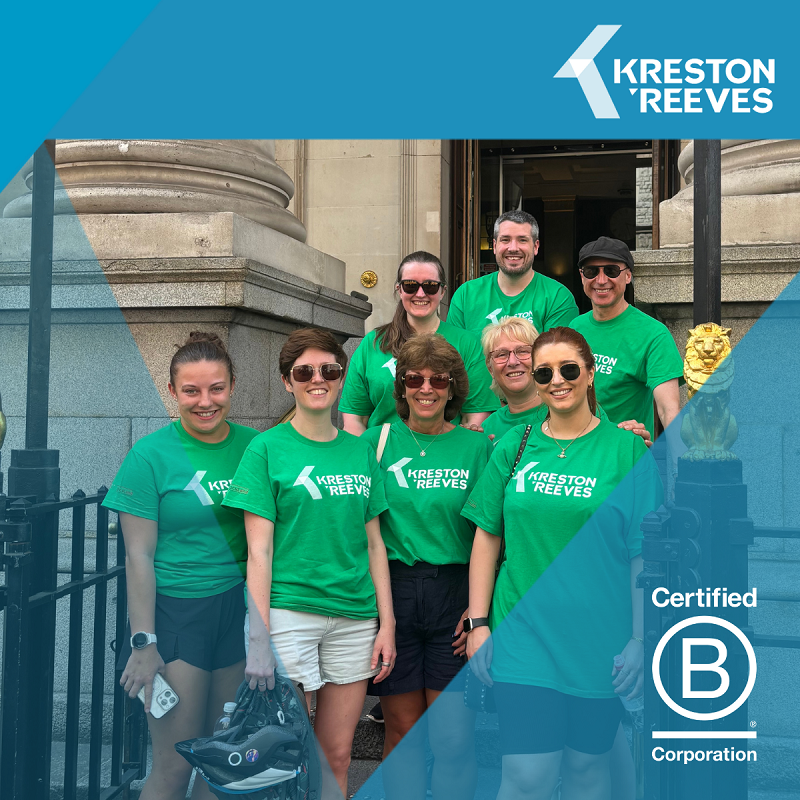
Kreston Reeves colleagues taking part in the London Legal Walk to raise funds for The Access to Justice Foundation.
Over the past few years, Kreston Reeves has taken significant steps in climate and environmental action. Could you share some of the key initiatives you’ve implemented and the impact they’ve had so far?
We believe that meaningful climate action requires both ambition and accountability. In 2022, we achieved carbon neutrality, a milestone we are proud of. While we recognise that carbon credits have faced criticism, we see them as a responsible interim measure when paired with genuine emissions reduction. Offsetting allows us to take immediate responsibility for our residual emissions while we continue to drive down our footprint year on year.
One of the ways we make climate action tangible is through our annual tree planting initiative, where we plant a tree for every client we serve. This not only contributes to global reforestation and the benefits that brings to communities but also creates a visible link between our business and positive environmental impact.
We have also taken a hard look at our property portfolio, ensuring that decisions about new or existing offices prioritise energy efficiency and environmental performance. From upgrading lighting and heating systems to considering location and transport links, these choices help reduce our operational emissions.
Equally important is raising awareness among our people and clients. We know that individual behaviours, from commuting choices to energy use, affects our carbon footprint. Through internal and external campaigns, training, and practical tips, we empower colleagues to make more sustainable decisions.
Finally, we extend this commitment to our clients by hosting webinars and speaking at seminars on climate action and ESG. These sessions help businesses understand their own impact and navigate the evolving regulatory landscape, amplifying our influence beyond our own operations.
You’ve also embedded sustainability into your client work through a dedicated ESG advisory service. How did you go about developing this offering?
Our ESG advisory service was born from a deep sense of purpose as a responsible B Corp. We believe that as a firm, we have a role to play in shifting business behaviour for the better. While our own sustainability journey is important, we recognised that the greatest impact we can have is by helping our clients do the same. This conviction, combined with increasing regulatory requirements and growing client demand, led to the creation of an ESG service line, a natural next step.
When we were initially developing the service offering, we highlighted three areas of importance:
- We need organisational buy-in and a deep understanding of the current challenges and opportunities our teams and clients are facing in this space.
- We want this to be a technology driven service for maximum efficiency and to fit with our firm approach of leading through technology.
- We are going to need dedicated resource to drive this.
To address this, we gathered key stakeholders from across our service lines and collectively identified the opportunities, what conversations are currently happening, and what they thought we could do to develop a service offering relevant to our clients. Members of this key stakeholder group remain in our ESG leadership team to ensure we get maximum support across service lines.
Having identified carbon reporting as a key opportunity for us, we began the process of identifying and interviewing several available carbon reporting platforms and eventually settled on one.
At the same time as this, we knew the best way to progress the development of this service offering was to dedicate resource. We launched a new role internally for a dedicated ESG advisor who drove internal engagement, tested software on pilot clients and developed an initial service offering.
Having launched in June 2025, we have continuously worked with clients to develop what works for them and drives maximum engagement, so that our skillset and offering match their needs.
What kind of cultural or organisational shift was needed to make the ESG advisory service offering part of your wider service portfolio?
The introduction of this service has sparked more purpose-driven conversations, both internally and with clients. It has become a focal point for building stronger relationships, as clients increasingly want to understand how sustainability can create value for their business.
Internally, we have had to adapt the language we use so that ESG resonates with different teams and feels relevant to their roles. For example, with our audit team we might focus on current or incoming sustainability related legislation that is most likely to impact their clients. This might be the Corporate Sustainability Reporting Directive (CSRD), Carbon Border Adjustment Mechanism (CBAM) or simply public procurement policy. While the focus might not appear purpose driven, we know that our audit teams are talking to our clients already about relevant legislation changes and so by equipping them with the tools to talk about sustainability legislation and the impact it has on their client’s business, it feels quite natural for both team and client. This then creates the opening to talk about the added value ESG can bring to our clients. This has been key to ensuring that our client engagement teams feel confident in introducing ESG topics and positioning them as part of a broader business conversation.
Making our service offering relevant to client teams is the first stage of integrating ESG as part of client conversations, we have then worked hard on our other existing client communication methods to make sure it is seen as part of our full service offering and not an add-on. Whether that be by incorporating climate reporting in tenders or client meeting agendas, there are various channels.
Ultimately, this service empowers our teams to add real value by helping clients navigate complex challenges, from carbon reporting to net zero planning. It’s not just about compliance; it’s about helping businesses future-proof themselves and thrive in a changing world.
Can you share an example of the ESG support you provide to clients and the kind of impact you’ve seen it create?
A current example of a project we are very excited to be working on with a client, is the development of a Climate Action Strategy. Starting from engaging key stakeholders relevant to the organisation and understanding what they are currently doing, but also what climate action and sustainability means to them.
We undertake full policy reviews to look for opportunities to influence organisational behaviour, carbon footprint assessment, cost and efficiency saving opportunities by implementing more sustainable alternatives, supplier engagement methods, governance review and mechanism development and more.
It's a great example of working with an organisation that really understands the value that ESG can generate. There is no regulatory pressure for them to act, but it just makes good business sense for them to embrace ESG and engage with their team in a different way. It sets the tone for the culture of care they are creating.
Ultimately, the expected impact of the Climate Action Strategy development project is to move Climate Action from an added side project to a fundamental part of how the organisation functions. There will be clear evidence of how climate conscious thinking is embedded at every layer of the organisation, encouragement of ownership across all levels, and the focus will be on more than just immediate internal stakeholders. They will be influencing and actively engaging with external stakeholders to spread the impact they can have.
What challenges have you faced either internally or with clients when embedding sustainability and ESG thinking, and how have you worked to overcome them?
One of the biggest challenges we have encountered is the gap in understanding among some business leaders. For those of us in what we call the “sustainabubble,” concepts like carbon footprints, net zero, and ESG reporting feel like the basics. For many leaders though, these terms are unfamiliar and can feel overwhelming. Even the phrase “ESG” itself creates a barrier, it sounds technical and abstract, which can discourage engagement before the conversation even begins.
The other frequent challenge is that it is easy for ESG to fall to the bottom of the priority list. It is understandable. Available resource is always stretched, often it is difficult to know where to even begin and there are always so many urgent priorities on a day-to-day basis. That is before you even begin to consider the current political and economic landscape.
We have learned that language matters. People do not have the time to learn every acronym or framework, so it is our job to translate sustainability into terms that resonate with their priorities. Whether that’s risk management, cost savings, attracting talent or differentiating themselves against their competitors. For example, instead of saying, “We need to improve your ESG performance,” we might say, “Let’s look at how reducing energy can cut your costs and make your business more resilient.” This reframing shifts the conversation from compliance and jargon to tangible business benefits, which is far more compelling for time pressed leaders. This helps them understand why it perhaps needs to be higher on the priority list and how we can help them think about priorities and next steps.
Finally, what message or piece of advice would you share with other firms looking to start or deepen their sustainability journey?
Accountants are trained to work within well-defined rules and frameworks, which provide clarity and certainty when advising clients. In contrast, the ESG space is still developing, particularly when it comes to reporting standards. It does not yet have the same level of maturity or consistency as financial reporting, and that can feel uncomfortable for professionals who value precision.
The reality is that sustainability and ESG will continue to evolve, and we need to embrace that change. Our role is to work with the best available guidance, apply professional judgement, and continuously improve as standards mature. Rather than waiting for perfect clarity, we focus on progress, helping ourselves and clients take meaningful steps now while preparing for what’s ahead.
