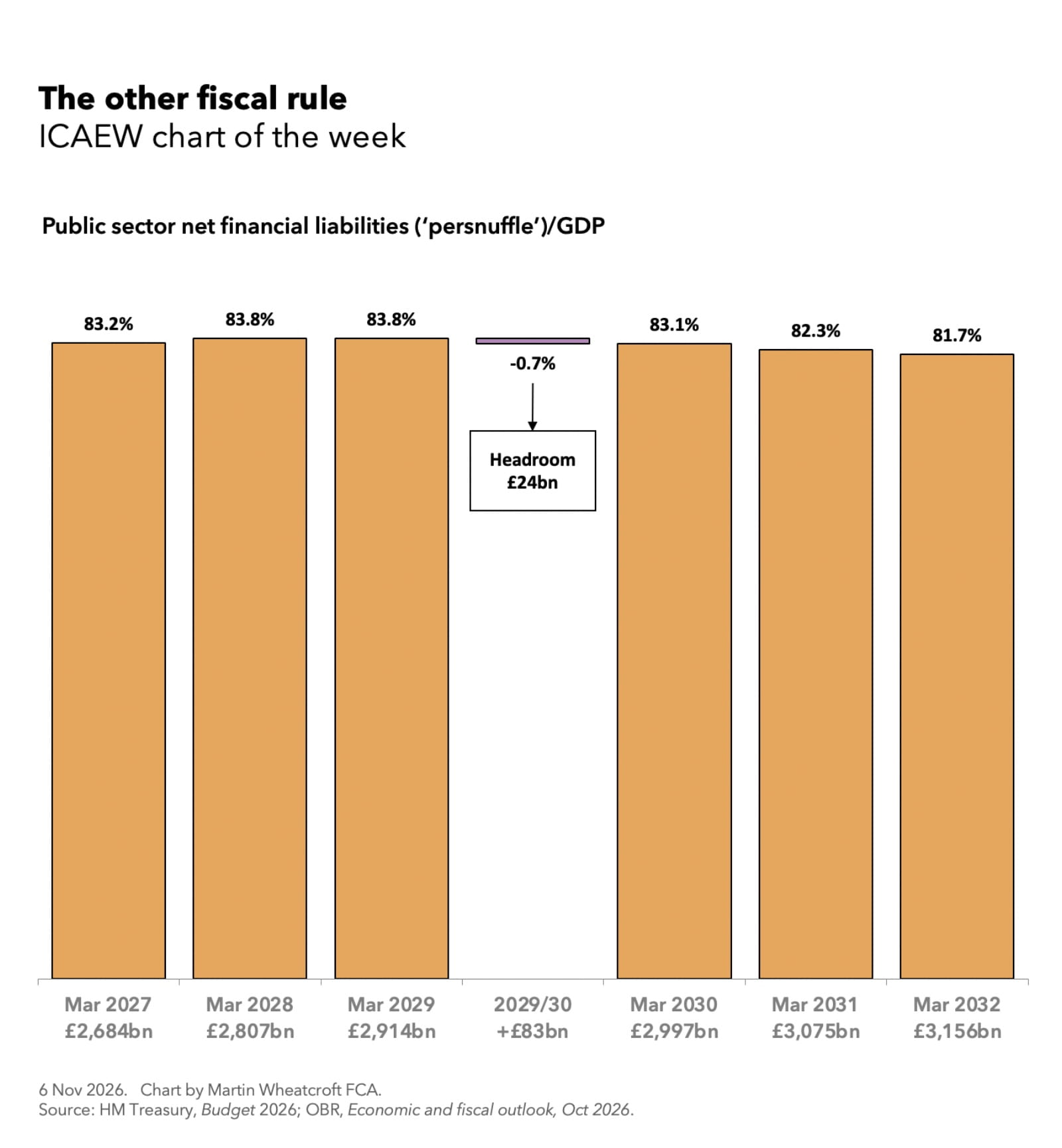
Our chart this week looks at the government’s ‘investment’ fiscal rule, showing how public sector net financial liabilities (PSNFL, or ‘persnuffle’) are expected to fall as a share of GDP in the third year of the fiscal forecast by 0.7 percentage points, equivalent to £24bn.
PSNFL is an alternative measure of the national debt, comprising public sector net debt (‘headline debt’) plus other financial liabilities less non-liquid financial assets and investments, as measured in accordance with national accounts statistical standards.
Our chart shows how PSNFL/GDP is expected to increase from 82.3% at the end of the current financial year in March 2027 to 83.8% at the end of March 2028 and March 2029 before falling to 83.1% in March 2030, 82.3% in March 2031, and 81.7% in March 2032.
Public sector net financial liabilities are forecast to increase each year, from £2,684bn in March 2027 to £2,807bn, £2,914bn, £2,997bn, £3,075bn and £3,156bn in March 2028, 2029, 2030, 2031 and 2032 respectively.
The increase of £83bn in public sector net financial liabilities in 2029/30, the third year of the forecast period, translates into a fall in the PSNFL/GDP ratio because economic growth and inflation are together forecast to increase nominal GDP at a faster rate.
The £24bn headroom on the secondary fiscal rule is higher than the £15bn headroom the Chancellor has on his primary fiscal rule, as illustrated by last week’s chart.
Flexibility to invest
One of the perceived benefits of using PSNFL as the metric for the secondary fiscal rule is that it permits the government to borrow for financial investment without affecting the achievement of this particular fiscal target. This is because borrowing used to fund new loans and equity investments is offset by the related non-liquid financial assets, in contrast with public sector net debt where only cash and liquid financial assets are deducted.
The main beneficiaries of this approach are student loans (where the recoverable element of the loans is netted off within PSNFL), investments made by public financial institutions (‘pufins’), lending to universities and research institutions, investments made by Innovate UK and foreign reserve investments in the sovereign debt of other countries.
The focus in the Chancellor’s budget speech on 28 October was on the opportunity to use pufins to help drive economic growth. Central government pufins currently include the British Business Bank, the National Wealth Fund (which despite its name is an infrastructure investment bank, not a sovereign wealth fund), Great British Energy, and the National Housing Bank, while British International Investment (the development bank arm of the Foreign, Commonwealth and Development Office) is classified as a public corporation pufin.
In theory, pufins have significant capacity to lend to and invest in the private sector but planned lending and investment by central government pufins increased by a relatively small amount (less than £1bn a year over the fiscal forecast), bringing planned investment to just under £5bn, or around 0.1% of GDP, a year on average. Meanwhile, public corporation pufins are expected to lend or invest less than £1bn a year on average over the .
The economic effect is likely to be modest at these levels, but there is the potential that pufin investment will expand in future fiscal events, especially as such investment doesn’t score against the secondary fiscal rule.
ICAEW on the budget

Latest charts
Stay up to date
You can receive regular email updates from ICAEW insights, including weekly or monthly enewsletters. Subscribe to whichever works for you.
Sign upFurther resources
ICAEW Community

Public Sector Community
The go-to place for guidance on issues affecting finance professionals working in and with the public sector. With a range of dynamic services, ICAEW provides valuable tools, resources and support tailored to the public sector.
Resources

Economy explainers
ICAEW experts offer simple guides to help understand the technical, economic jargon that is discussed when talking about public finances and the economy.
Find out moreICAEW support

Training and events
Browse upcoming and on-demand ICAEW events and webinars offering support on technical areas, such as assurance, reporting and tax, as well as personal development.
Events and webinars A-Z of courses