The UK Government published a major report on welfare reform on 17 November 2026: From a welfare state to a working state: a new settlement for the next generation.
Better known as the Milburn report, it sets out a series of reforms to reduce the number of young people not in education, employment or training (NEETs) from 13.0% in the second quarter of 2026 to 6.8% over the next decade and thereafter to 5.0%.
Alan Milburn describes the 5.0% target as ‘NEET zero’ given that there will inevitably be a small proportion of every age group unable to participate in education, training or the workforce for a variety of reasons, including severe disabilities or ill-health.
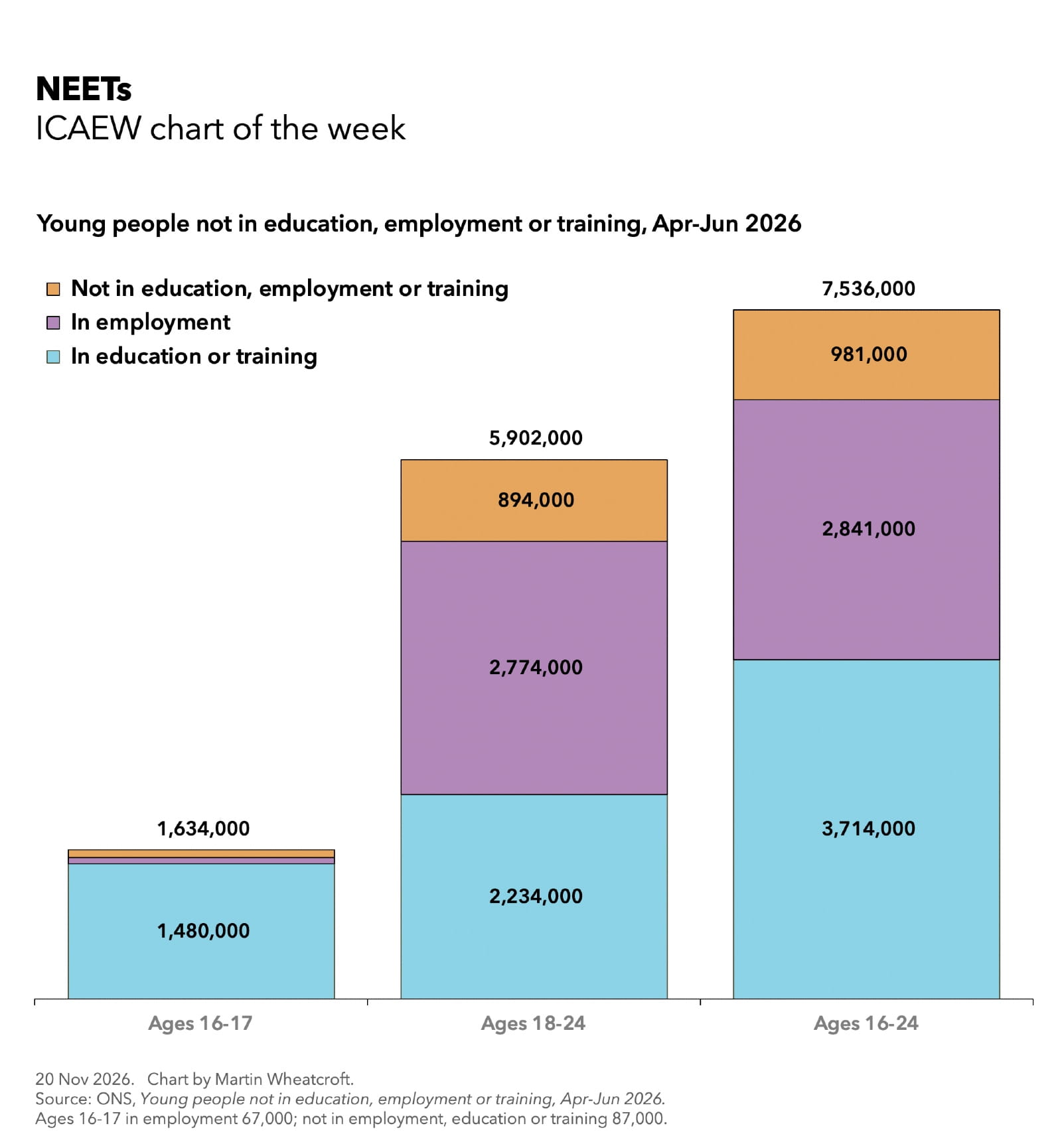
Our chart this week shows how there were 981,000 NEETs in the second quarter of 2026 (April to June 2026) according to the Office for National Statistics (ONS) out of a total population of 7,536,000 young people aged between 16 and 24. The chart also shows how 3,714,000 were in education or training, while 2,841,000 were in employment.
This can be analysed as 49.3% in education or training, 37.7% in employment and 13.0% not in education, employment or training.
Younger young people
The chart shows how the overwhelming majority of the 1,634,000 16- and 17-year-olds were still in school or college, with 1,480,000 (90.6%) in education or training, 67,000 (4.1%) in employment and 87,000 (5.3%) not in education, employment or training.
Of those in education and training, 1,374,000 were in full-time education and 106,000 were in part-time education or training, while the NEETs aged 16 and 17 can be analysed as 20,000 registered as unemployed and 67,000 economically inactive.
Achieving the 5.0% ‘NEET zero’ target for this cohort would require 5,300 NEETs (0.3% of the total) to find employment, enter training or be persuaded to return to education.
Older young people
The chart shows how there is a much larger proportion of NEETs within the 5,902,000 18- to 24-year-olds. This cohort comprised 2,234,000 (37.9%) in education or training, 2,774,000 (47.0%) in employment and 894,000 (15.1%) not in education, employment or training.
Of those in education and training, 2,009,000 were in full-time education and 225,000 were in part-time education or training, while the NEETs aged between 18 and 24 can be analysed as 373,000 registered as unemployed and 521,000 economically inactive.
Achieving the 5.0% ‘NEET zero’ target for this cohort would require 598,900 NEETs (10.1% of the total or just over two-thirds of NEETs aged 18–24) to find employment, enter training or be persuaded to return to education.
Major reforms on the way
The Milburn report proposes major changes to the welfare system and how both central and local government support young people through the education system and into work.
While the government has welcomed the report, it has yet to set out which recommendations will be adopted.
Latest charts
Stay up to date
You can receive regular email updates from ICAEW insights, including weekly or monthly enewsletters. Subscribe to whichever works for you.
Sign upFurther resources
ICAEW Community

Public Sector Community
The go-to place for guidance on issues affecting finance professionals working in and with the public sector. With a range of dynamic services, ICAEW provides valuable tools, resources and support tailored to the public sector.
Resources

Economy explainers
ICAEW experts offer simple guides to help understand the technical, economic jargon that is discussed when talking about public finances and the economy.
Find out moreRecordings

Public Sector webinars and recordings
Specialist resources and events for the public sector
See more