Early life
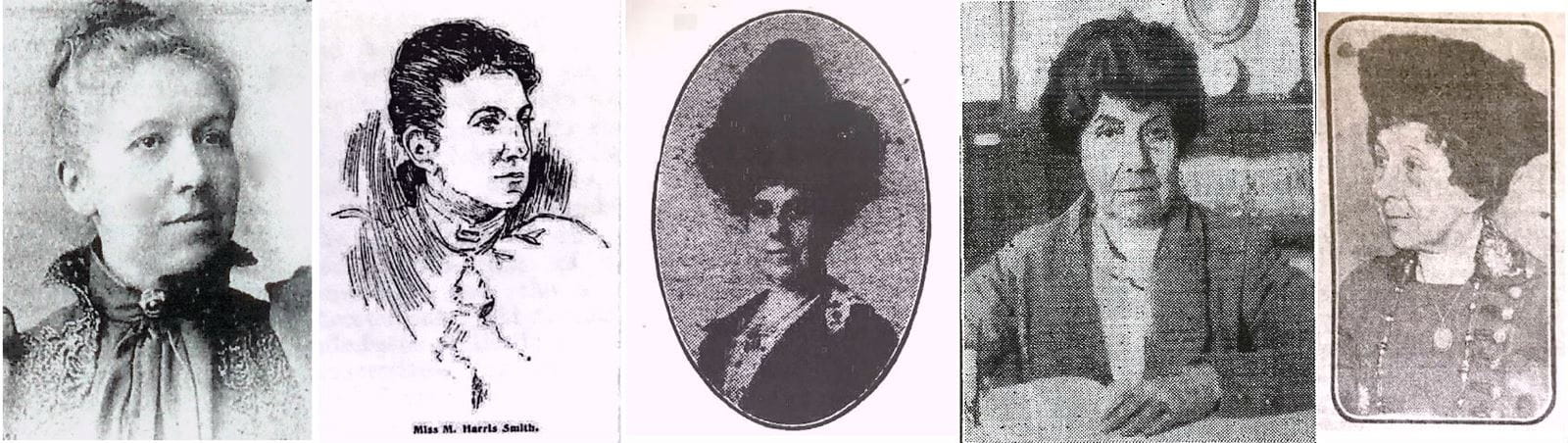
Smith was born in 1844, in Dalston, London. Her father Harry, clerk to a navy agent and banker, recognised and encouraged her abilities and she studied mathematics with a master of Kings College School when she was sixteen. She attended bookkeeping classes set up by the Society for Promoting the Employment of Women and then worked as an accountant for a mercantile firm in London for a number of years. Following this she became accountant to the Royal School of Art Needlework. Her reputation led to requests from other organisations to audit their accounts.
In 1887 Smith set up her own accounting firm at 20 Bucklesbury, EC4. The same year she applied to join the Society of Incorporated Accountants and Auditors, but was rejected on grounds of her gender. In 1891 she applied for admission to ICAEW as a fellow, applying on the basis of her experience as a public accountant over many years, which should have entitled to her to seek membership without taking the examination and articles, as allowed by the ICAEW’s Royal Charter. The Application Committee agreed but, as recorded in their minutes, decided to refer the matter to the Institute’s solicitor for clarification. The advice from the solicitor was that Smith was ineligible as the Charter referred to ‘he’, ‘his’ and ‘himself’ throughout, and ‘she’, ‘her’ and ‘herself’. The Institute showed no appetite to alter this terminology and in 1895 council minutes recorded that ‘it was unwilling to petition the Privy Council for an amendment to the charter’ which would have enabled female admission. With this in mind, Smith wrote to the ICAEW Council in 1866, requesting to sit ICAEW’s final examination as some practitioners were able to do if they met required educations standards. Again, Smith’s request was refused.
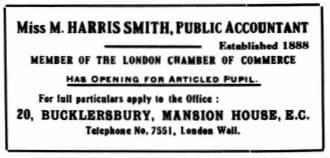
Mary Harris Smith's advert in Conservative and Unionist Women's Franchise Review, 1911.
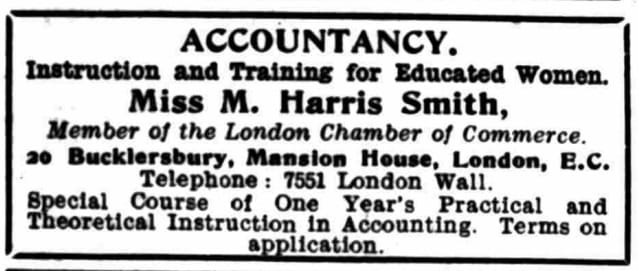
Mary Harris Smith's advert in Common Cause, 1917
Successful career
In an 1895 interview in The Women’s signal, Man’s Monopoly: An Interview with a Lady Accountant’, she described her clients as ‘very varied’, and comprised of both men and women. She also audited and provided professional services to a number of women’s organisations that supported female suffrage and equality. These included the Parliamentary Committee for Women’s Suffrage, the Society of the Return of Women as Poor Law Guardians, the Society for Promoting the Employment of Women, the National Union of Women Workers of Great Britain and Ireland, the Gentlewomen’s Employment Club, and the Soroptimist Club (a volunteer movement aiming to transform the lives of women and girls, set up in the 1920s). Other clients included the British Women’s Temperance Association and the Needlewoman’s Co-operative Association. While this work underlined her commitment to the suffragist cause, it was also part of a shrewd business plan.
When asked about her success, she replied:
“I think my speciality is investigating and reporting upon the prospects of various undertakings, planning and remodelling books of accounts so as to save labour, and to ensure a good system; unravelling neglected accounts and restoring order and good form out of chaos and confusion.”
I think my speciality is investigating and reporting upon the prospects of various undertakings, planning and remodelling books of accounts so as to save labour, and to ensure a good system; unravelling neglected accounts and restoring order and good form out of chaos and confusion.
Acceptance
During the First World War women successfully took on roles that had been the preserve of men and this led to a change in society’s attitudes. In 1918 the Society of Incorporated Accountants and Auditors changed their rules to allow the admission of women and, when she renewed her application Mary Harris Smith was made an Honorary Fellow (with an official admission date of 12 November 1919).
The passing of the Sex Disqualification (Removal) Act in 1919 made it illegal for ICAEW to continue to bar women from membership. Mary Harris Smith renewed her application to ICAEW the same year. In May 1920, at the age of 75, she was admitted as a fellow of ICAEW and became the first female chartered accountant.
I based my request on the grounds of ‘ Admission equal, and status equal with men members.’ Require of me what you would require of a man, and I will fulfil it.”

Later years
This was not boasting on the part of Smith. Rather she was clearly distancing herself from bookkeeping (usually perceived as the domain of women), aligning herself with ICAEW members. Smith further acknowledged that the quantities needed to be a successful chartered accountant were many and varied, but not the exclusive preserve of men. She was adamant that women should be trained in the same way as men.
Smith continued to practise under the name M Harris Smith, Public Accountant until ill health forced her to retire. Before retiring however, she still managed to help to advance the path of women in the profession, being the first female member to take on an articled clerk, Elsie Charlesworth in 1923, although Charlesworth failed to advance to membership herself.
Mary Harris Smith died on 7 August 1934, having retired to the Sussex coast at St Leonards-On-Sea. As The Accountant observed in its obituary of her (October 1934), "her practice developed among women with their many modern activities who entrusted their accounts to Miss Smith.”
Her election as a Fellow of the Institute in 1920 was a matter of great pride to her. She was staunch in her support of its traditions
Far from diminishing the status of ICAEW, The Accountant agreed that Harris Smith had proved that women were worthy members of ICAEW.
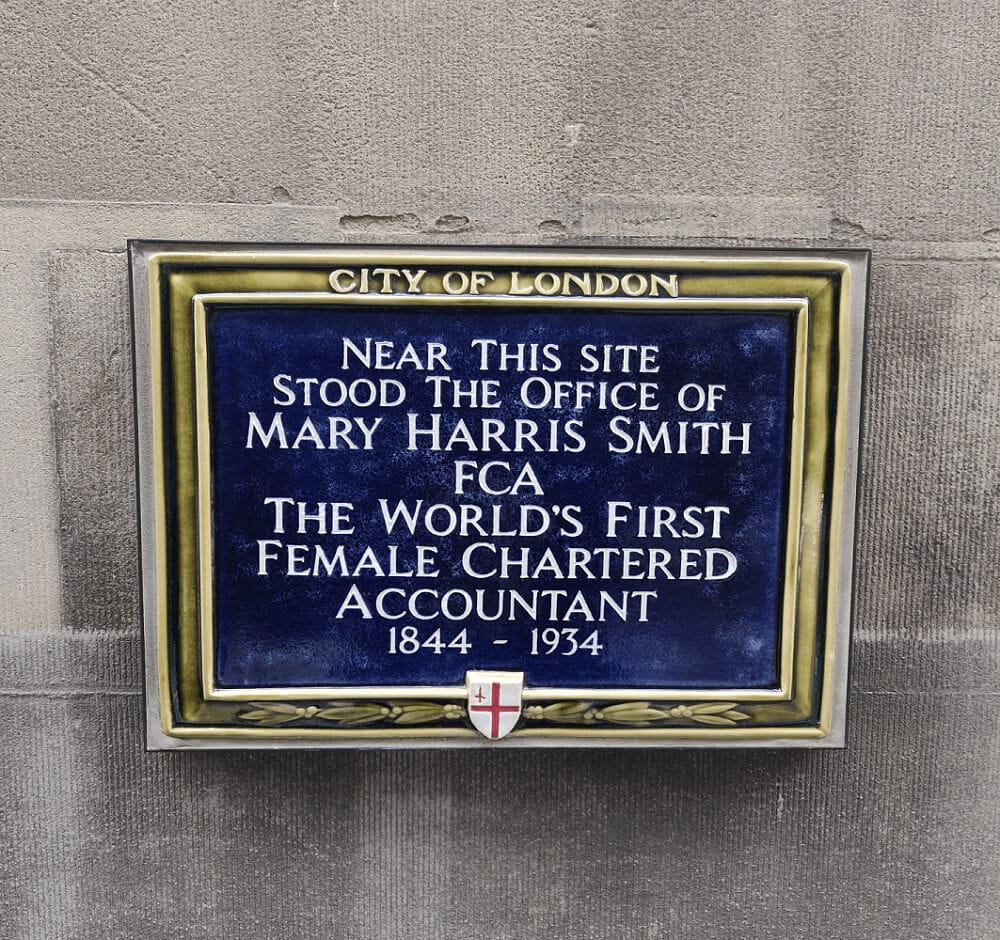
To celebrate the centenary of Mary Harris Smith becoming a member of the ICAEW in 2020, the ICAEW commissioned a blue plaque, which is sited on the City of London Magistrates' Court on the corner of Queen Victoria Street and Bucklesbury, where Smith's office once stood. A portrait by Toby Wiggins RP was also commissioned, which now hangs outside the reception room in Chartered Accountants' Hall. Smith was also recognised by the ICAEW's Outstanding Achievement Award for her ground-breaking achievements.
Of the 182 blue plaques in the City of London, this is only the third to commemorate an individual woman (there are 35 commemorating individual men). It is the second blue plaque for accountancy: the first commemorates Edwin Waterhouse, of PwC, on Frederick Place. The other two women with blue plaques are reformer Elizabeth Fry and influential Methodist Susanna Annesley.
Commenting on the news of the commissioning of the plaque, ICAEW President Fiona Wilkinson said: “I am delighted that Mary’s achievements will be honoured with this blue plaque. It is a lasting tribute to her tenacity and resilience and comes at a time when stories of overcoming adversity are more important than ever."
Further reading
- Man's Monopoly. An interview with a Lady Accountant (The Woman's Signal 1 August 1895)
- Mary Harris Smith: The first female Chartered Accountant - article on the East End Women's Museum website, September 2020
- Obituary. The Accountant, 10 March 1934, p. 496.
- Silverstone, R. 'How Mary Harris Smith led the way,' Accountancy, May 1980, Vol. 91 Issue 1041, pp.74-75, 2pp.
- Walker, S.P. 'Professions and patriarchy revisited. Accountancy in England and Wales, 1887–1914,' Accounting History Review, July 2011, Vol.21 No.2, pp.185-225, 39pp.
- Check our Library catalogue for books and articles on Mary Harris Smith
To find out how you can borrow books from the Library please see our guide to borrowing books.
You can obtain copies of articles or extracts of books and reports through our document supply service.
Acknowledgment
The text of this page is adapted from the ICAEW booklet 100 Years: Celebrating women in Chartered Accountancy (2020) written and researched by Dr Jane Berney with further research and additions by the ICAEW Library & Information Service.
Can't find what you're looking for?
The ICAEW Library can give you the right information from trustworthy, professional sources that aren't freely available online. Contact us for expert help with your enquiries and research.
Timeline
Follow our timeline to explore the development of the accountancy profession in the United Kingdom and the course of events that led to the creation of ICAEW, a story that takes us from ancient times to the present day.
See more