Overview
The architect leading these works, Sir William Whitfield CBE, had a noted eye for the fine arts and built up an impressive collection during a four decade long restoration of his home, St Helen Hall in County Durham, which he had saved from demolition. It seems likely that the chandelier was something he picked out to add to the main reception room as part of the completion of the restoration in 1970.
Some of the furnishings purchased for Chartered Accountants’ Hall in 1970 came from Dropmore, Burnham, Buckinghamshire, through a sale of the estate of Viscount Kemsley, a former proprietor of The Sunday Times, following his death in 1968. It is not known whether this was among the auction items here – or if this came from a different source.
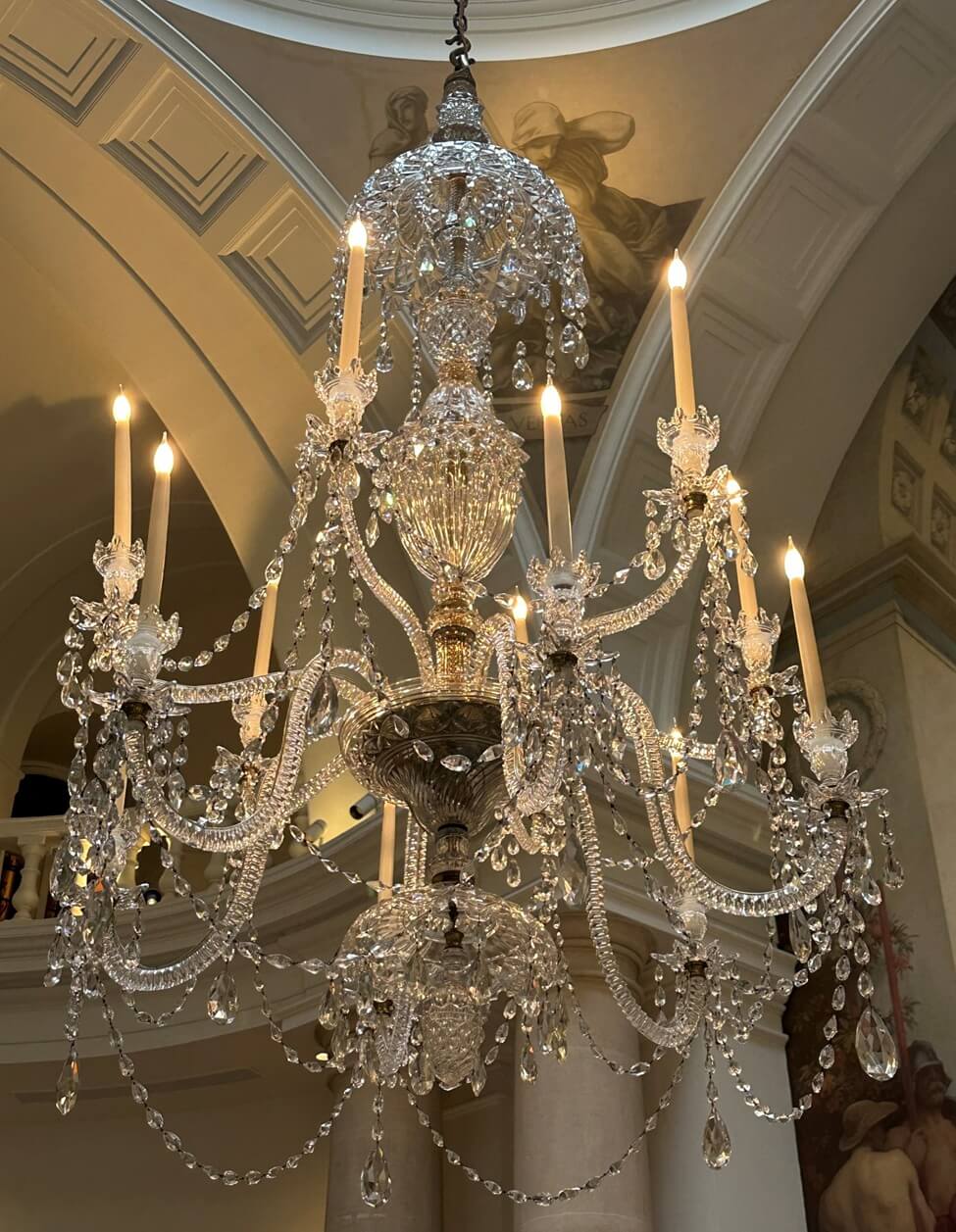
Our chandelier was originally candle lit and later electrified. It is not untypical for chandeliers to be moved and installed in multiple locations throughout their history – but ours has weathered two centuries of change remarkably well.
Provenance
The maker of the chandelier has not been conclusively identified but experts tell us that the “scale, high-quality faceted baluster stem, domed corona, scrolled branch profile and dense swagged dressing are characteristic of fashionable English chandelier manufacture around 1790-1810. Closely related structural and decorative vocabulary is found in chandeliers associated with William Parker, Samuel Parker, William Perry and their contemporaries.”
Further research in the ICAEW archives and an assessment of makers marks during the next controlled dismantling may lead to a clearer determination of the manufacturer.
Parker and Perry
The Parkers and Perry, individually and in partnership, were the leading chandelier makers of the time. Their chandeliers could be found in the homes of the rich and wealthy, in civic buildings and in royal palaces around the world. Today, you can find examples of their work at Buckingham Palace; Brighton Royal Pavilion; and the Assembly Rooms in Bath.
The White House in Washington has at least nine Parker and Perry chandeliers according to an inventory taken in 2020. The chandelier in the main reception room is remarkably similar to a pair of ten candle chandeliers by William Parker that were added to the Cross Hall in the 1940s.