The allegorical figure of Economy on the coat of arms granted by the College of Heralds in 1881 to the Institute of Chartered Accountants in England and Wales is familiar to thousands, but it is unlikely that many know whence it is derived or the significance of its various attributes.
Economia is one of several hundred allegorical woodcuts to be found in Cesare Ripa's book 'Iconologia', the first illustrated edition of which was printed in Rome in 1603. It must be from this book that the Heralds took the 'Institute lady', but they were careful to follow Ripa's printed description of her rather than the woodcut, which omits the wreath of olive about her brows.
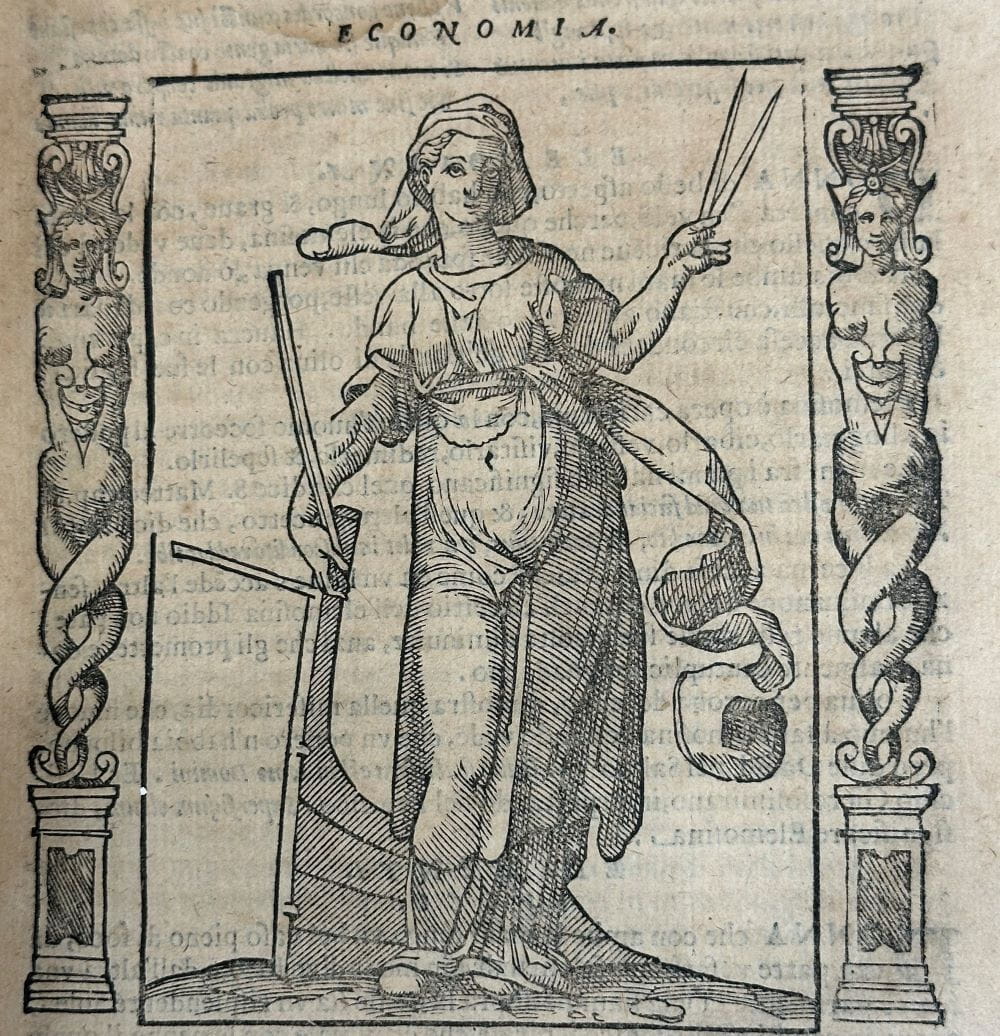
A matron of serious aspect crowned with olive and holding a compass in her left hand, a rod in her right. Behind her is a rudder. Every family has need of its own particular laws, so she is shown holding a rod signifying command. The rudder is the symbol of guidance. The garland of olive shows that the good economist must necessarily maintain peace in her house. The compass teaches how each economist should measure her powers and so estimate by means of reckoning what she has to spend.
It should be noted that the compass should more correctly be described as dividers for use in accurate measurement and this may be held to refer to Economy's impartial patronage of both auditing and standard costing.
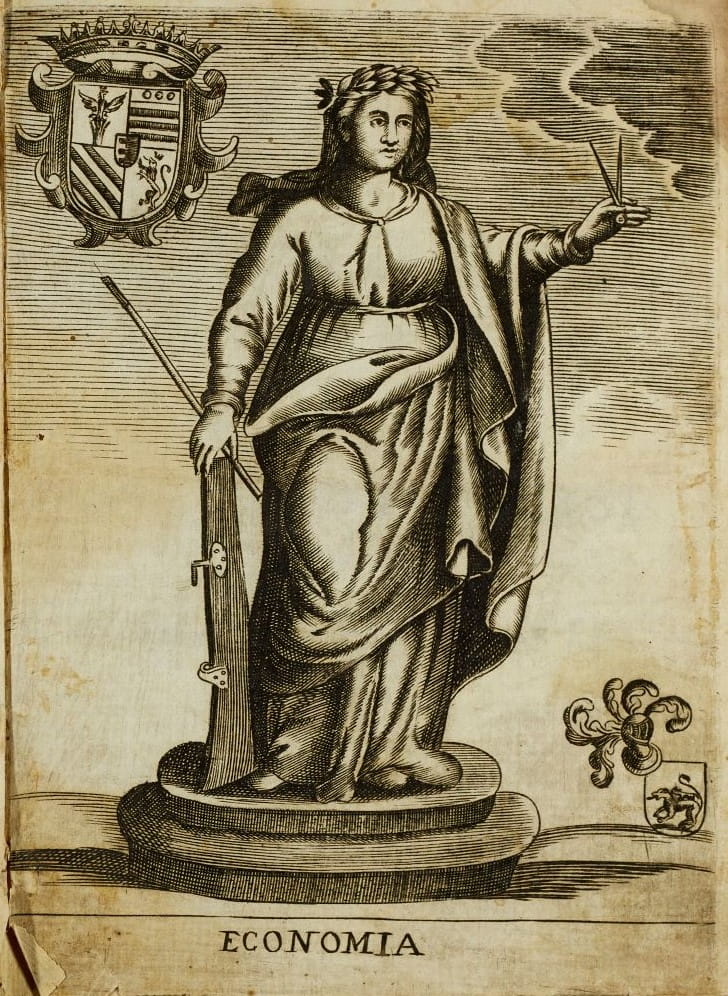
Appropriately enough, the first correct representation of Economia, with her wreath of olive, is to be found in a work on book-keeping, Onofrio Pugliesi's 'Prattica Economica Numerale', printed in Palermo in 1671. The frontispiece of this book is an engraving of Economia with her wreath of olive and all other correct attributes, and in the preface is an acknowledgment that the figure is taken from Ripa's work. A copy of Pugliesi's book was acquired by the Institute so long ago as 1913, when the collection of Karel Petr Kheil was bought, but the figure of Economia and its derivation from Ripa have only lately been noticed.
Inquiry into the original editions of Ripa discloses that the woodcut of Economia is in all probability the work of an artist named Guiseppe d'Arpino, though, as we have seen, he was less than accurate in following the author's description.
On the question whether Ripa was the original inventor of the allegorical figure of Economia with her attributes, more detailed inquiry would have to be made before a definite answer could be given, but in its present form we can safely say that it is to Ripa through the good offices of the Herald's College that the Institute owes its lady.
It may not be amiss to end by quoting Emile Mâle's words on allegorical figures in general:
the name of Ripa is forgotten, but allegory is immortal and art cannot do without these grave personages who give bodily presence to the great ideas men die for, Science, Faith, Justice
Further reading
Can't find what you're looking for?
The ICAEW Library can give you the right information from trustworthy, professional sources that aren't freely available online. Contact us for expert help with your enquiries and research.