Many of you will remember my former colleague Ian Pay looking back at the community’s highlights each year. If we haven’t met yet, I’m Bani, ICAEW’s Data Analytics & Tech Manager and I’m grateful to pick up the pen this time. Over the past four years, I’ve managed the Excel Community, supported the Data Analytics Community behind the scenes and worked on some of ICAEW’s wider technology initiatives. I’m looking forward to building on Ian’s work and making sure the community continues to offer resources and support that’s useful and relevant to you.
This year, much of the focus has been on AI and how it’s changing the way we work in the profession. As we move from experimenting with AI to considering how to build it into workflows, we’re also thinking differently about the data we collect, use and analyse in our organisations and day-to-day work. Alongside exploring the latest features of AI-based tools, we’re looking more closely at how these tools work in practice, the risks and controls we need to consider, and how the value they create compares with the costs. Things already look quite different from the end of last year, both in what the technology can do and how we’re considering using it. This makes it difficult to judge progress, as we’re not always comparing like with like. As the pace of change increases, we’re all still learning as we go.
With that in mind, let’s take a look back at five lessons from the topics we’ve explored as a community this year, before turning to what’s ahead.
Lesson 1: The starting point of AI is data.
As with analytics, AI outputs are only as good as the data behind them. Organisations setting out to adopt AI, as with many other tools and technologies, often find they first need to address issues in data quality and improve their underlying data infrastructure. In her article on AI in analytics, Franki Hackett, Chair of the ICAEW Data Analytics Community Advisory Group and Director at Grant Thornton UK, sets out some of the key questions we need to ask about our data when thinking about managing quality, including: Can the data we have actually answer our questions? And is the AI set up to protect the confidentiality and integrity of the data we’re using?
Rishi Sapra, ICAEW Member and Microsoft MVP, made a similar point in his webinar on using agents to automate financial processes. The framework he uses starts with an understanding of how to clean and restructure data, emphasising that you must get your data in order before introducing AI-based automation. He breaks this down into a) knowing what clean data looks like for the datasets you use and b) understanding the ideal data structures for the task at hand.
This issue goes beyond AI. When we spoke to audit firms about their use of analytics in external audit, firms of all sizes highlighted difficulties in obtaining and extracting data. Access to reliable data was repeatedly highlighted as a key barrier, with poor quality data limiting what analytics could achieve and the time spent obtaining the right data adding to the overall ‘cost’ of performing analytics.
Lesson 2: AI Governance doesn’t need to be completely re-imagined.
Technology governance has moved up the agenda for many executives and boards. While AI brings new aspects to consider, many of the foundations are familiar. In our community webinar on AI governance, Tony Zona, Chief Data Officer at Grant Thornton UK, highlighted that data quality, lineage and access controls still need consideration. These aspects have been part of data governance for years, so organisations will already have relevant policies and experience to draw on. What’s often different, however, is the speed and ‘blast radius’ of AI. The challenge, therefore, is to adapt existing governance to this greater pace and impact, rather than replace its foundations.
Anne Allibone, Founder of Finzu, made a similar point about assessing AI tools, noting that much of this is similar to reviewing suppliers. We still need to consider compliance, the risk of things going wrong, reliance on a single supplier and the safeguards against that dependence. We also need to understand how costs might change as usage grows, alongside the tool’s capabilities and limitations. AI may feel unfamiliar, but many of the questions we need to ask are already part of procurement, third-party risk management and technology oversight.
Lesson 3: Think about tomorrow’s problems while we’re still deciding how to use AI.
Craig Stirk, Founder of Sarcul Consulting and Chief Innovation Officer at Sprift Technologies, wrote an article earlier this year exploring some familiar lessons from history that can be applied to AI and any new technology. By looking back at earlier transformations, including coal, oil and social media, he explains that though these changes created benefits, there were also consequences for society that took much longer to address. For those of us working with data and AI, the lesson may then be to look beyond what a tool can do today. We can do this by asking the right questions now:
- Can we explain the decisions the output supports?
- Who takes responsibility when things go wrong?
- What might we be overlooking?
These questions are easier to address while we’re still deciding how to use AI, rather than once it’s embedded in the way we work.
Lesson 4: Analytics skills are still important.
AI is making advanced analytics easier to access, leading to discussions about whether accountants still need data skills. One example of this is the use of Model Context Protocol (MCP), an open standard that lets AI assistants and agents connect to databases, data warehouses and analytics tools in a consistent way. For example, if connected to Power BI, MCP servers can let AI agents connect to the semantic models allowing users to create, update or query data using natural language prompts. These developments are exciting and will undoubtedly make advanced analytics accessible to a wider range of users. But, if we don’t understand the basics of analytics, how can we effectively review and take accountability for the analysis we use in our work?
Accountants still need to judge whether the analysis is appropriate, reliable and useful for the task at hand. There’s a risk that encouraging reliance on AI-generated outputs could erode the skills of trainees and junior colleagues. We may also find ourselves accepting results without understanding how they were produced. To counter these risks, understanding data quality, thinking analytically, interpreting results and applying professional scepticism are still essential.
Our community has focused on these foundations this year through a Back-to-Basics webinar series. The series aims to build understanding of the analytics process from the beginning by exploring different data sources and how to extract data, transforming it effectively, and applying the principles of effective visualisation and analysis.
We also explored what AI means for accountants’ analytics skills at our virtual AI and Analytics conference this year. The panel of experts discussed the implications for the profession more broadly, reinforcing that AI enabling more advanced analytics doesn’t remove the need to understand and assess the analysis.
Lesson 5: AI isn’t the answer to every problem.
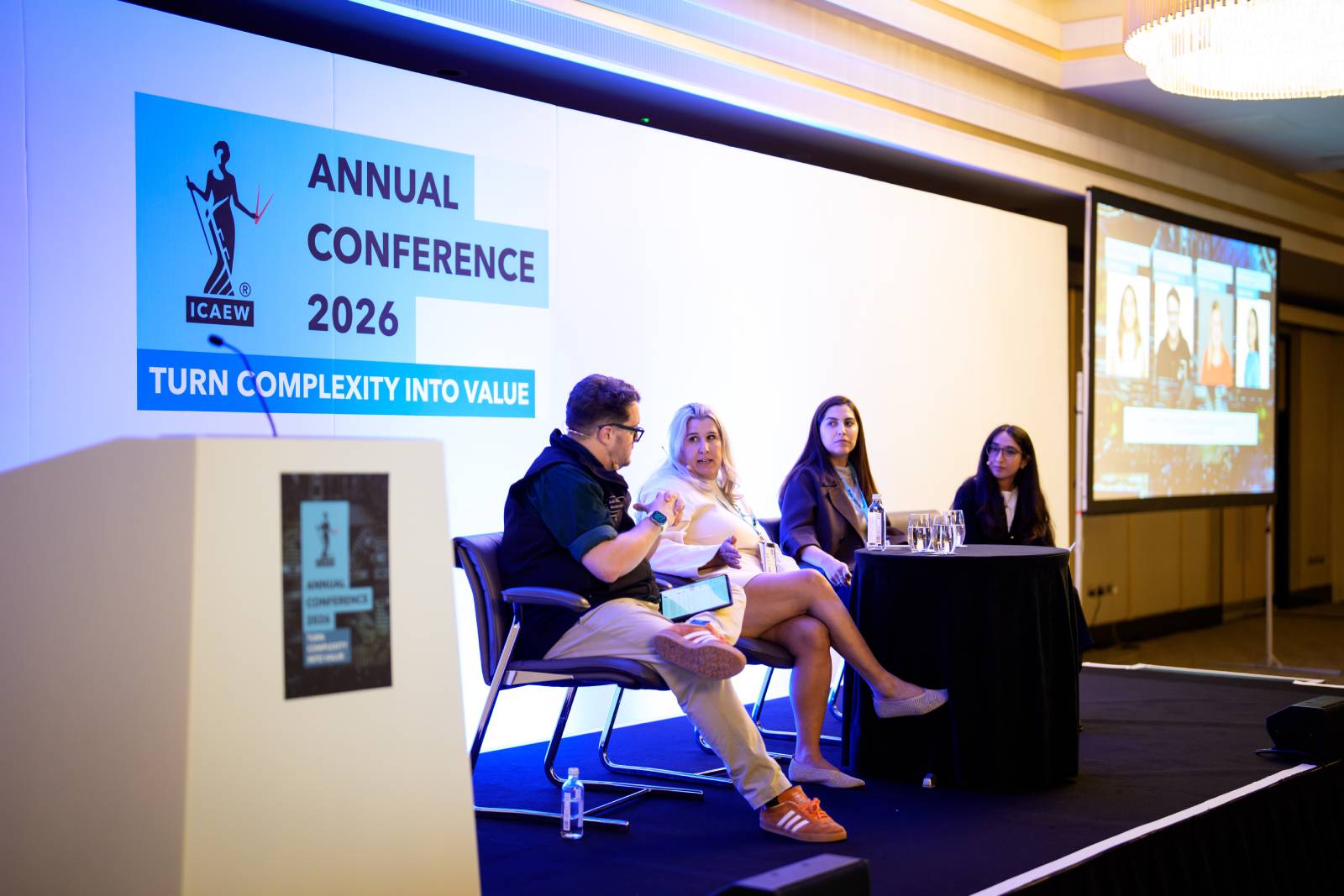
I had the opportunity to chair a panel session at ICAEW’s Annual Conference this year on how to implement, operationalise and scale AI in practice. The panel brought together experts including Fay Bordbar, Founder of Excellence AI, Aaron Patrick, Head of Accounting at Boffix, and Becky Shields, Partner at Moore Kingston Smith.
Drawing on their experiences, all three panellists suggested that good AI implementation often focused on specific use cases centred on a business problem. Aaron and Becky both shared examples from their organisations where they needed to distinguish between problems that needed AI from those that would benefit more from process or people changes. Becky also described AI as a catalyst for redesign, rather than seeing AI adoption as the final goal.
Fay outlined a four-stage framework to guide this process:
- Education
- Readiness assessment
- Use-case selection
- Building.
She cautioned that while pilots may start earlier, skipping readiness work, including selecting and refining use cases, often makes scaling harder later.
Looking ahead
This year, the community’s flagship conference returned in a virtual format, making it accessible to members outside the UK for the first time. It’s still available on demand too! While the conference will take a break again next year, we’re continuing to plan events for the community, including an in-person, hands-on event where you can learn while building something tangible for yourself or your organisation. We’ll share more details in due course, so watch this space!
We’ll also continue to deliver webinars and articles for the community. Power BI remains one of our most requested topics, so there will be more content throughout the year. Alongside this, we’ll focus on the fundamentals, including starting with Power Query to build a foundation for Power BI. We’ll still be covering more on AI, by exploring what AI governance looks like in practice and how data governance fits into it. We’ll also look at how agentic AI is transforming workflows and processes, and the data fundamentals you’ll need to consider.
As the lessons above highlight, a good understanding of data and analytics remain important. In 2027, we’ll be exploring a set of principles to help you feel more confident in commissioning, undertaking, challenging and using data analysis effectively and responsibly.
These topics will also be increasingly reflected in the learning and training available to you. Our self-paced Power BI certificate remains available for those looking to build a foundation in analytics. Other learning opportunities from the Academy, alongside CPD courses, will help you join the dots, develop your understanding of data and analytics, and build confidence in using AI.
2026 has been another successful year for the community. With over 47,000 members, we’re excited to keep working towards the 50,000-member milestone. Don’t forget, the community remains completely free for everyone, including non-ICAEW members. Please encourage friends and colleagues to join and share your favourite content and webinars on social media.
