What is the DIP?
The Defence Investment Plan (DIP) presented by the Ministry of Defence (MoD) to Parliament on 30 June 2026 sets out how the government plans to spend a defence budget of £297.6bn – an average of £74.4bn a year – over the four financial years from 2026/27 through to 2029/30.
According to the government, the DIP includes an additional £15.0bn for defence investment, which sounds like a lot of money (and is). However, it is deliberately exaggerated through the use of a four-year total rather than a per annum amount, and by including hoped-for efficiency savings and asset sales that do not represent increases in the MoD’s budget.
Extra investment
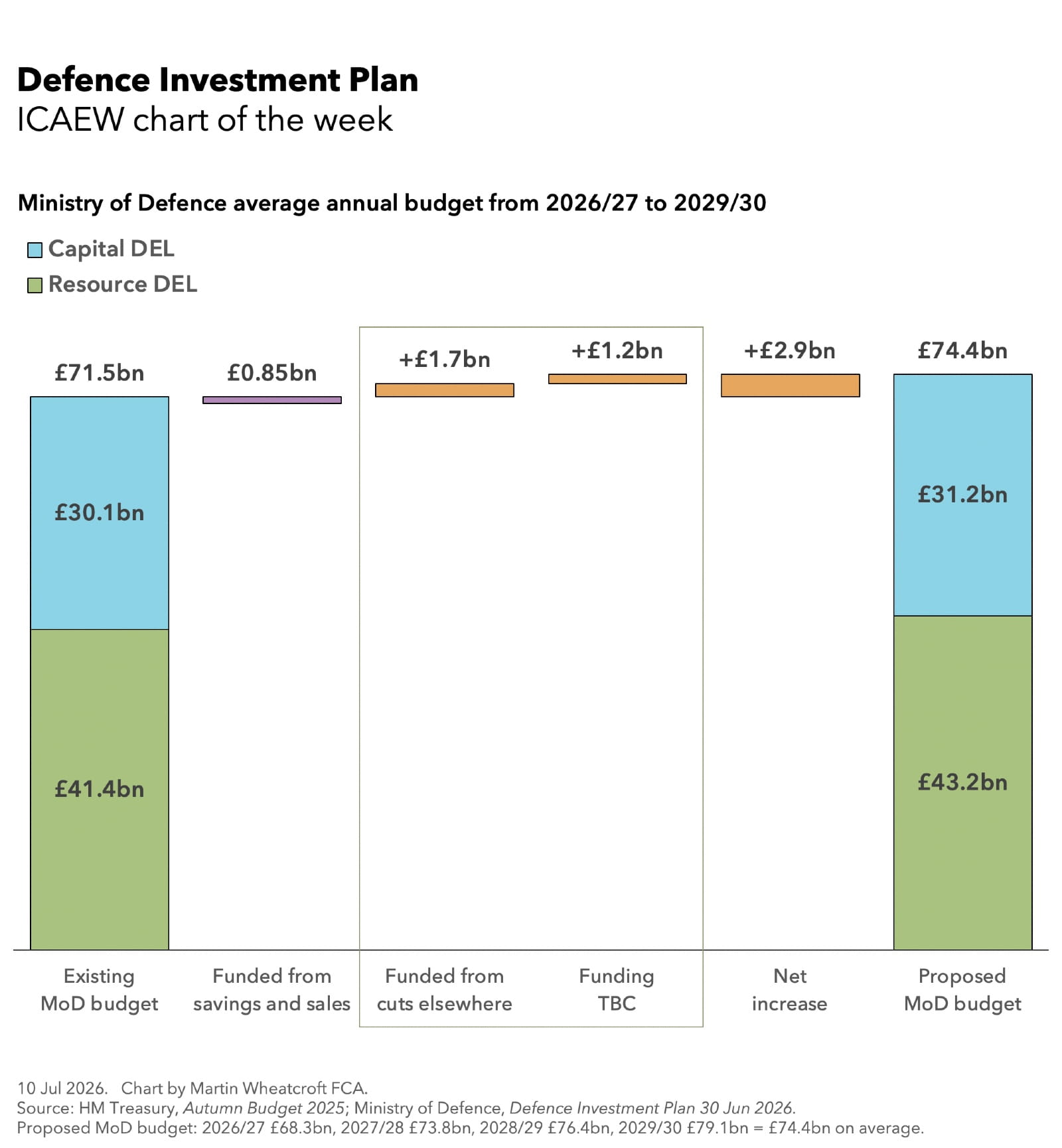
Our chart starts with the existing MoD budget over the period of £71.5bn, being the average of £65.3bn, £70.9bn, £73.5bn and £76.3bn respectively in 2026/27, 2027/28, 2028/29 and 2029/30. This comprises a resource department expenditure limit (resource DEL or the budget for ‘day-to-day’ spending) of £41.4bn on average and a capital departmental expenditure limit (capital DEL) of £30.1bn on average.
The first step in our step chart is £0.85bn a year on average that is funded from savings and sales within the MoD. This does not change the budget allocated to the MoD as it comprises £0.6bn a year on average from the reinvestment of hoped-for efficiency savings in defence procurement and £0.15bn a year on average from the proceeds of additional asset sales by the MoD that are netted off against capital DEL under government accounting rules. The efficiency savings in the DIP are in addition to already planned cost savings within the existing MoD budget.
The second step in our chart is an increase of £1.7bn on average in the MoD budget that is funded by cuts elsewhere, comprising an average of £1.0bn a year from cutting the capital budgets of other government departments by 1%, and £0.5bn and £0.2bn respectively taken from the budgets of the Department for Energy Security and Net Zero and the Department for Transport.
This is followed by a third step showing an increase of £1.2bn a year on average in the defence budget for which funding has yet to be identified, or £4.8bn in total over four years.
Together the second and third steps result in an increase of £2.9bn in the defence budget over four years to £74.4bn, being the average of £68.3bn, £73.8bn, £76.4bn and £79.1bn between 2026/27 and 2029/30. This can be broken down into an average of £43.2bn a year in day-to-day spending and an average of £31.2bn a year in capital expenditure.
A long way to go to reach the NATO 3.5% target
Defence spending, based on the GDP forecasts prepared by the OBR in March 2026, is projected to be 2.16%, 2.25%, 2.25% and 2.26% of GDP respectively in 2026/27, 2027/28, 2028/29 and 2029/30.
This is less than the percentage reported by the government for NATO-qualifying defence and security spending, which is expected to be around 2.6% in the current year, rising to 2.7% over the subsequent three years. It is also less than the commitment that the government has made to increase defence and security spending to 3% of GDP by 2030. And it is far below the NATO target to spend 3.5% of GDP on defence by 2035.
In other words, average defence spending of £74bn over the next four years is combined with £5bn on the security services and £10bn of other qualifying spending to give an average of approximately £89bn per year of defence and security spending for NATO purposes.
A further £11bn a year on average would be required to get to the government commitment of 3.0% of GDP and another £17bn a year on top of that (ie, £28bn per year overall) to get to £117bn per year to reach 3.5% of GDP.
More money please?
The irony is that by using four-year totals to exaggerate the amount of money being added to the defence budget, the government has been subject to significant criticism about how it will find the £4.8bn (£4.7bn in many reports) that it will need to fully fund the DIP over four years.
In reality, £1.2bn a year is a rounding error when compared with the forecast for total managed expenditure of £1,490bn a year on average over the next four years and so it should not be difficult to find such a relatively small amount down the back of the Treasury’s sofa come the Autumn Budget.
The real problem for the current Prime Minister and Chancellor is the tight economic and fiscal situation that means even a billion a year cannot be found with the existing spending envelope.
That no doubt explains why the government has been so hesitant to set out how it is going to find the £11bn or so a year that will be needed to meet its own commitment to get to 3.0% of GDP by 2030, let alone the tens of billions a year that will be required to reach the NATO target of 3.5% by 2035. This is also before considering how much defence is needed as a nation, which could end up being a lot more in some scenarios.
So, while the £1.2bn a year unfunded element of the DIP should not be an issue for the next Prime Minister and Chancellor, defence spending definitely will be high on their agenda.
Latest charts
Stay up to date
You can receive regular email updates from ICAEW insights, including weekly or monthly enewsletters. Subscribe to whichever works for you.
Sign upFurther resources
ICAEW Community

Public Sector Community
The go-to place for guidance on issues affecting finance professionals working in and with the public sector. With a range of dynamic services, ICAEW provides valuable tools, resources and support tailored to the public sector.
Resources

Economy explainers
ICAEW experts offer simple guides to help understand the technical, economic jargon that is discussed when talking about public finances and the economy.
Find out moreICAEW support

Training and events
Browse upcoming and on-demand ICAEW events and webinars offering support on technical areas, such as assurance, reporting and tax, as well as personal development.
Events and webinars A-Z of courses