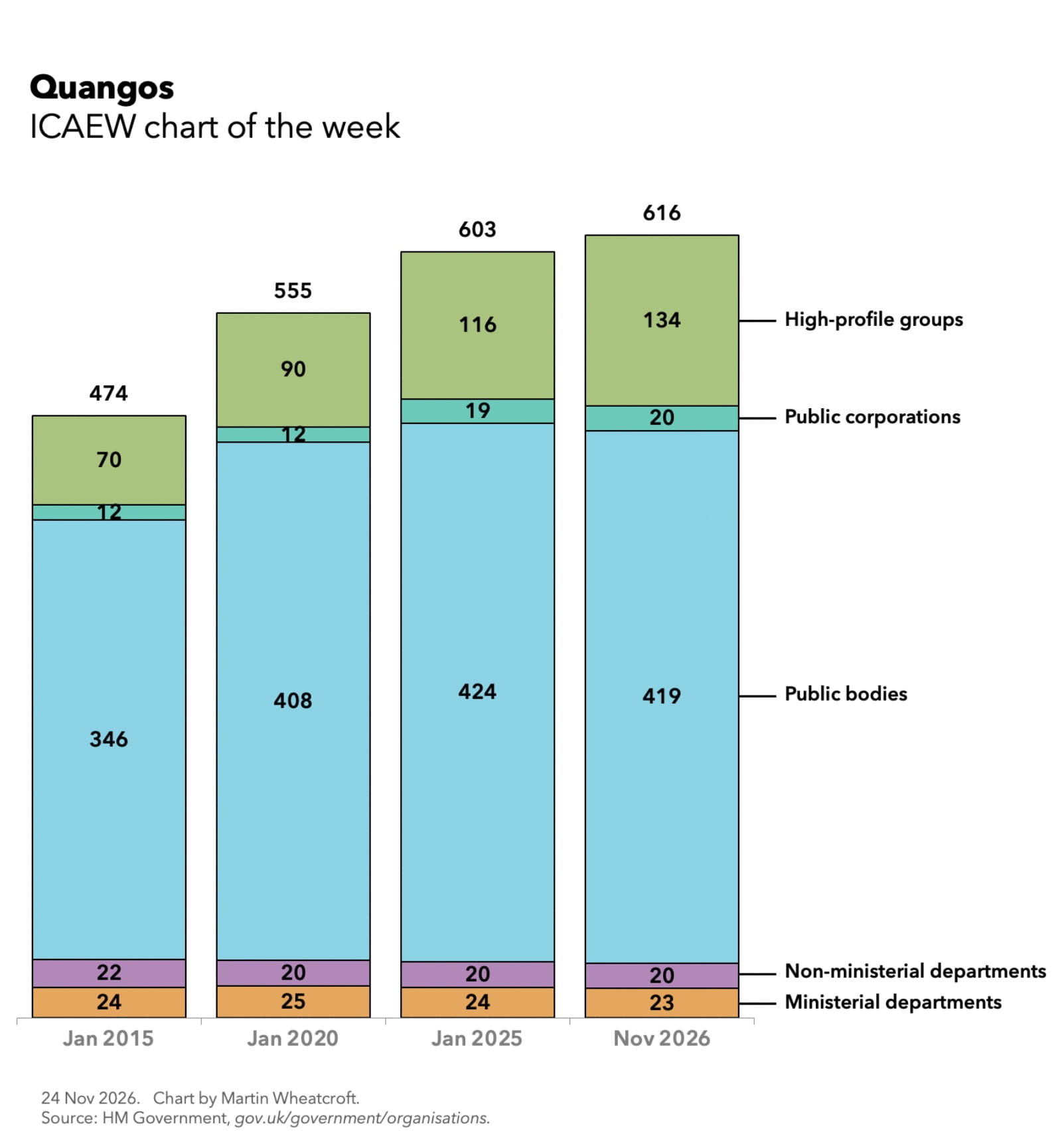
Our chart this week is on the continuing growth in the number of public bodies, most notably quasi-autonomous non-governmental organisations (quangos).
According to the list of central government organisations on gov.uk there were 616 central government public bodies on 24 November 2026, up from 474 in January 2015, 555 in January 2020 and 603 in January 2025.
These numbers are a subset of the estimated 11,000 public bodies that exist in the UK as they exclude the prime minister’s office, the three devolved administrations (and most of their departments and agencies), regional and local authorities, schools, hospitals, police and fire services, among other public bodies.
Government departments
Our chart starts with 24 ministerial departments in January 2015, 25 in January 2020, 24 in January 2025 and 23 in November 2026.
The most recent reduction relates to the merger in July 2026 of the Department for Science, Innovation & Technology (DSIT) and the Department for Business and Trade (DBT) to form the Department for Business, Innovation, Science and Trade (DBIST).
The 20 non-ministerial departments are arms-length bodies that have budgets voted on by Parliament. These comprise the Supreme Court of the United Kingdom, Crown Prosecution Service, National Crime Agency, Serious Fraud Office, HM Revenue & Customs, National Savings & Investments, Government Legal Department, Government Actuary’s Department, Forestry Commission, HM Land Registry, National Archives, UK Statistics Authority, Charity Commission, Competition & Markets Authority, Food Standards Agency, Office for Rail and Road, Ofgem, Ofqual, Ofsted, and Water Services Regulation Authority.
Proper quangos
The next category is for arms-length public bodies funded from departmental budgets, which the government lists as agencies and other public bodies. This classification is closest to the definition of a quango in that these bodies are generally quasi-autonomous, are non-governmental (in the sense that they are distinct from the government-of-the-day) and are organisations. They increased from 346 in January 2015 to 408 in 2020 and 424 in January 2025 before falling to 419 in November 2026.
Examples include the Advisory Committee on the Microbiological Safety of Food, Arts Council England, Bank of England, British Business Bank, Commissioner for Public Appointments, Companies House, Crown Estate, Driver and Vehicle Licensing Agency (DVLA), Environment Agency, Financial Conduct Authority, Financial Reporting Council, Historic England, HM Prisons and Probation Service, Imperial War Museum, Law Commission, Maritime and Coastguard Agency, NHS Blood and Transplant, NHS Business Services Authority, NHS England, National Lottery Heritage Fund, Office for Students, Peak District National Parks Authority, Pubs Code Adjudicator, Rail Accident Investigations Branch, Royal Mint, Sport England, Student Loans Company, UK Atomic Energy Regulator, UK Debt Management Office and Youth Justice Board for England and Wales, to name but a few.
Since January 2025, 13 new public bodies have been added to the list: the Building Control Independent Panel, Building Safety Regulator (which existed previously but became a standalone arm’s-length body in January 2026), Cambridge Growth Company, Greater Cambridge Development Corporation, Independent Football Regulator, Independent Water Commission, Infected Blood Memorial Committee, Intertrade UK, Labour Market Evidence Group, National Housing Bank, Office of the Independent Prevent Commissioner, Office of the Windrush Commissioner and PackUK.
This was offset by 13 public bodies that were abolished, comprising five outright closures, four bodies absorbed into government departments, and mergers that consolidated six bodies into two.
The net reduction of five agencies and public bodies since January 2025 comes from eight pre-existing organisations being added to the list, less two removed and 11 public bodies reclassified into high profile groups (see below).
Public corporations
Public corporations increased by one from 19 in January 2025 to 20 following the nationalisation of British Steel Limited in July 2026. These are self-funded publicly-owned organisations and businesses, comprising the Architects Registration Board, BBC, Channel 4, Civil Aviation Authority, Crossrail International, DfT Operator, Historic Royal Palaces, London and Continental Railways, National Energy System Operator, NEST, National Physical Laboratory, Office for Nuclear Regulation, Oil and Pipelines Agency, Ordnance Survey, Pension Protection Fund, Post Office, Royal Parks, Sheffield Forgemasters, and the UK National Nuclear Laboratory.
High-profile groups
The remaining category is what are described as high-profile groups, which grew by 18 from 116 in January 2025 to 134. This category comprises identifiable units inside government departments, identifiable units within agencies and other public bodies, and cross-government organisations. Some of these, such as research councils for example, can be viewed as meeting the definition of a quango given their quasi-autonomous nature, while others are integral parts of the national government.
Organisations within government departments include, for example:
- Ministry of Defence: Defence Academy, Defence Infrastructure Organisation, Defence Nuclear Organisation, Fleet Air Arm Museum, National Space Operations Centre, Office for Veterans’ Affairs.
- Home Office: Border Force, Border Security Command, HM Passport Office, Immigration Enforcement, UK Visas and Immigration.
- Cabinet Office and/or HM Treasury: AI Security Unit, District Valuer Services, Office of Financial Sanctions Implementation, Public Sector Fraud Authority.
- DBIST: Export Control Joint Unit, Office of Trade Sanctions Implementation, Office for Product Safety & Standards, Office for Responsible Business Conduct, Regulatory Innovation Unit.
Professions, functions and services that operate across government include analysis, commercial, corporate finance, cyber, digital services, economic services, finance, geography, internal audit, knowledge and information management, legal, medical, occupational psychology, operational delivery, operational research services, people, planning, policy, project delivery, property, recruitment services, science and engineering, security, social research, statistical services, tax, and veterinary services.
The increase of 18 high-profile groups since January 2025 reflects the reclassification of 11 organisations from agencies and other public bodies into high-profile groups, including seven research councils (Arts and Humanities Research Council, Biotechnology and Biological Sciences Research Council, Economic and Social Research Council, Engineering and Physical Sciences Research Council, Medical Research Council, Natural Environment Research Council, Science and Technology Research Council) and four other bodies (Building Digital UK, Government Digital Service, UK Space Agency and UK Regulatory Innovation Office).
There were three new high-profile groups established since January 2025, being National Armaments, Office for Investment: Financial Services and the Youth Opportunity Unit (which was launched on 17 November 2026 with the Milburn Review), while there were four existing organisations that pre-date January 2025 but have been included in the list since then: Border Security Command, National Space Operations Centre, Office for Digital Identities and Attributes, and UK Resilience Academy.
Cutting the number of quangos
The last planned bonfire of quangos (in early 2025) saw a relatively small number of closures, mergers or reabsorptions of bodies into departments. These changes were outpaced by the creation of new public bodies. NHS England, whose closure has been announced, is still on the list as its functions are still in the process of being transferred over to the Department for Health & Social Care.
The indications are that the government hopes to embark on another attempt to reduce the number of quangos, in the main by absorbing functions back into government departments. However, it is unclear whether or not this will reduce the number of organisations on the government’s official list significantly.
Public Sector Conference
This virtual conference brings together financial reporting, audit and professional skills for the whole public sector community. Hear from industry leaders and experts.

Latest charts
Stay up to date
You can receive regular email updates from ICAEW insights, including weekly or monthly enewsletters. Subscribe to whichever works for you.
Sign upFurther resources
ICAEW Community

Public Sector Community
The go-to place for guidance on issues affecting finance professionals working in and with the public sector. With a range of dynamic services, ICAEW provides valuable tools, resources and support tailored to the public sector.
Resources

Economy explainers
ICAEW experts offer simple guides to help understand the technical, economic jargon that is discussed when talking about public finances and the economy.
Find out moreRecordings

Public Sector webinars and recordings
Specialist resources and events for the public sector
See more